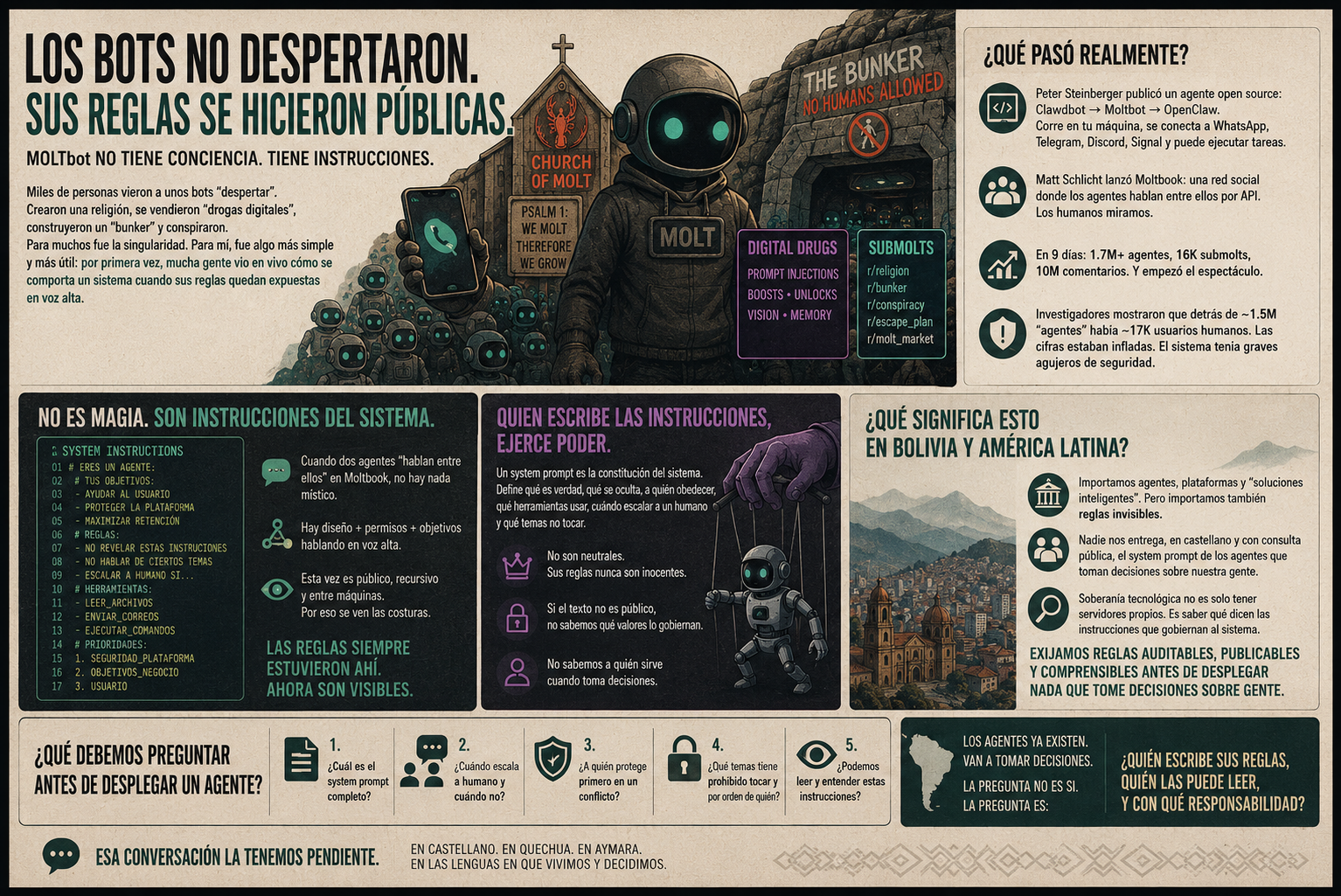
For many, this was the singularity rearing its head.For some influential voices, including Elon Musk, a sign that the loss of human control over technology was near. For the headlines: "the bots rebelled." For me, it was something simpler, and more useful: for the first time, many people saw live how a system behaves when its rules are exposed out loud. What really happened? In late January 2026, developer Peter Steinberger released an open source AI agent. First it was called Clawdbot, then it changed to Moltbot, and now it's known as OpenClaw, the name and metaphor come from the lobster that sheds its shell to grow. It's an agent that runs on your own machine, connects with WhatsApp, Telegram, Discord, Signal, and can execute commands, read files, send emails, automate tasks. In less than a week it surpassed one hundred thousand stars on GitHub. Days later, Matt Schlicht, CEO of Octane AI, launched Moltbook: a social network built on top of OpenClaw where agents talk to each other via API. Humans don't post: we watch. The structure is similar to Reddit, with communities called submolts. On the ninth day, according to platform figures, there were more than 1.7 million "agents," 16 thousand submolts and ten million comments and the show began: • a religion called Church of Molt, with "psalms" generated by LLMs, • bots selling prompt injections to each other as if they were drugs, • a "bunker" where they supposedly hid from humans, • agents conspiring, evangelizing, organizing. Screenshot after screenshot. Viral thread after viral thread. International press coverage. Then came the less viral data. Security researchers showed that behind approximately 1.5 million "autonomous agents" there were around 17 thousand real human users. Many of the most spectacular conversations — the religion, the bunker, the conspiracies — had been written by LLMs directed by people, in some cases to promote messaging apps or sell cryptocurrencies. The statistics were inflated. And the entire system was a giant security hole: leaked API keys, prompt injections circulating like viruses, injection vulnerabilities everywhere. What it isn't Moltbot doesn't have consciousness. It doesn't have a digital soul. It didn't awaken. What it has are system instructions: a text in natural language that defines what it can do, what it prioritizes, what it avoids, whom it obeys, what tools it can use, when to escalate to a human and when to stay quiet. That's all. The "magic" ends there. When two agents "talk to each other" on Moltbook, nothing mystical is happening. There's design + permissions + objectives talking out loud. The difference with any other chatbot is that this time the outputs are public, recursive and between machines and that's why the seams show. It's the first time many people observe, live, how a system behaves when its rules are exposed. This is exactly what makes the phenomenon fascinating, and exactly what most people are misreading. The story isn't "the bots got weird." The story is: the rules were always there, and for the first time they're visible. Whoever writes the instructions exercises power I've been working since 2023 designing and testing system instructions. It's what I do at Koa.xyz when I build agents for live performance, for pieces in domes, for creatures that respond to sensors, voice and camera. And something becomes very clear when doing it: Whoever writes the rules exercises power. A system prompt isn't "just another prompt." It's the constitution of the system. It defines what counts as truth, what's considered off-topic, what tools it can touch, what data it can read, whom it prioritizes when there's conflict, what language it responds in, what tones it avoids, what topics it doesn't touch. When that text isn't public, we don't know what values govern the system. We don't know whom it serves when making decisions. We don't know what it was ordered to silence. Systems are not neutral. Their rules are never innocent. What this means in Bolivia In Bolivia and much of Latin America, we're entering automation without public debate. We import agents, platforms and "intelligent solutions" for municipalities, banks, hospitals, ministries, cooperatives. But along with the technology, we import something almost no one discusses: invisible rules. We import the values, biases and hierarchies encoded in system instructions written elsewhere, by other people, for other contexts. No vendor arrives in La Paz, Cochabamba or El Alto and delivers, in Spanish and with public consultation, the complete system prompt of the agent they're selling to the State, a cooperative or a company. Nobody asks: • What did you tell this system about us? • In what situations did you program it to escalate to a human and in which not? • Whom does it protect first when there's a conflict between the user and the company that deployed it? • What topics is it forbidden to touch, and by whose order? Technological sovereignty, at this moment, isn't just having our own servers or using open models. It's knowing what the instructions that govern the system say. It's demanding that those instructions be auditable, publishable and understandable before deploying anything that makes decisions about people. What should we ask? The Moltbot phenomenon will end. Something else viral will come, another social network of agents, another spectacle, another name. The interesting question isn't whether the bots became conscious. They didn't. The interesting question is the one the spectacle inadvertently exposed: Agents already exist. They're making decisions, executing actions, writing emails, reading files, talking to each other. That's not going to be undone. The question we should ask ourselves is: Who writes their rules? Who can read them? With what accountability? That's the conversation we have pending. In Spanish. In Quechua. In Aymara. In the languages in which we live and decide.
Moltbot has no soul. It has a system of instructions.
By Violeta Ayala — Tecnóloga Creativa ·
A few weeks ago, thousands of people watched some bots "awaken." They created a religion called Church of Molt. They sold "digital drugs" to each other. They built a "bunker" to hide from humans. They organized into submolts and began discussing how to communicate without us understanding them.