Cables Investigation
Lithium: The Metal that Left the Pharmacy to Move the World
By Rilda Paco
Cables · Lithium · Geopolitics
Lithium: a metal with a history of its own
From an 1817 Swedish laboratory to the salt flats of South America. How a chemical curiosity ended up at the center of the economy, technology, and the contest between superpowers.
sala.red · Cochabamba, Bolivia
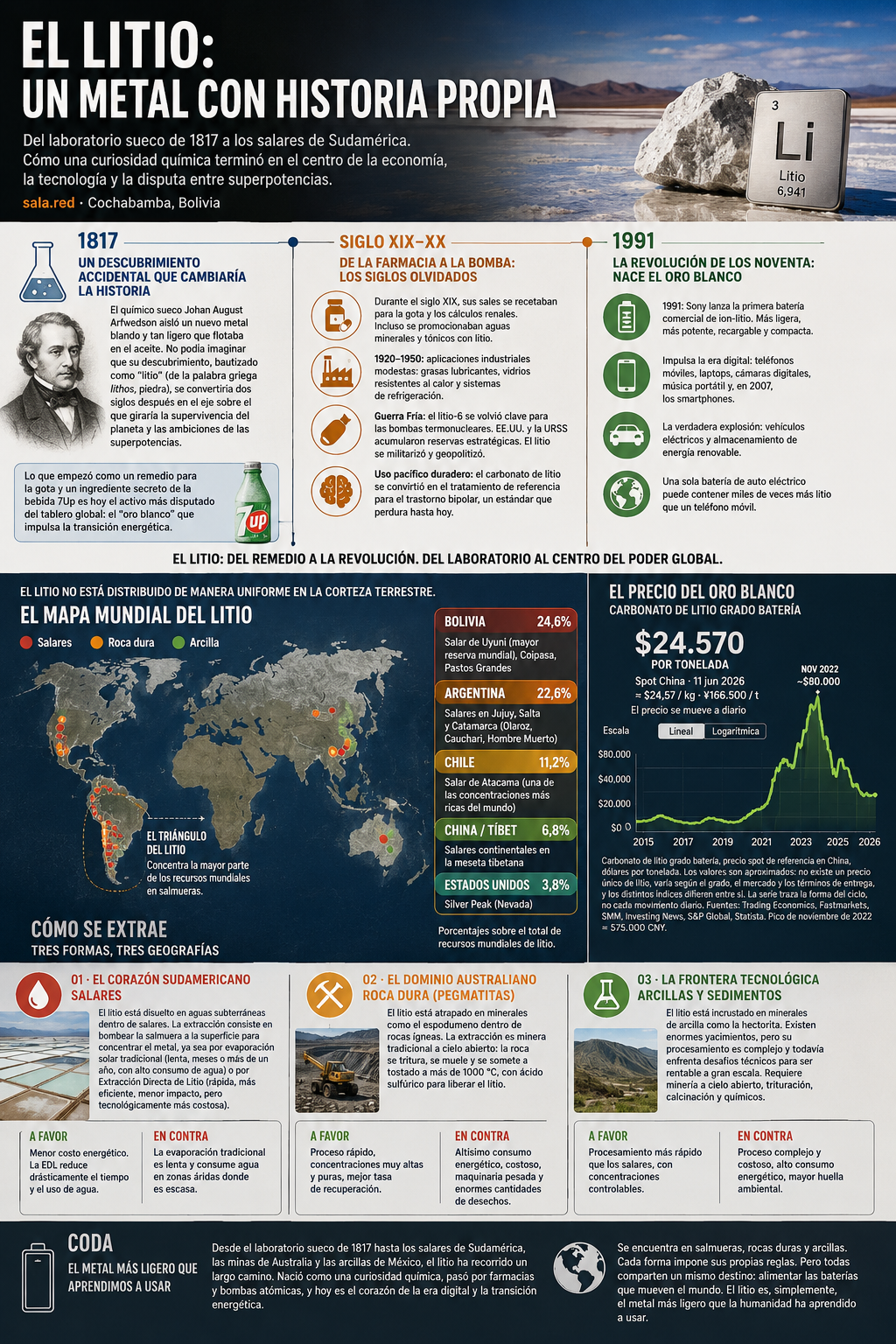
1817An accidental discovery that would change history
In 1817, the Swedish chemist Johan August Arfwedson isolated a new metal so soft and light it floated on oil. He could not have imagined that his discovery, named "lithium" (from the Greek lithos, stone), would become two centuries later the axis around which the planet’s survival and the ambitions of superpowers would turn.
What began as a remedy for gout and a secret ingredient in 7Up is today the most contested asset on the global board: the "white gold" driving the energy transition.
19th–20th c.From the pharmacy to the bomb: the forgotten centuries
Through the second half of the 19th century, lithium was just another resident of the pharmacy. Its salts were prescribed for gout and kidney stones. Mineral waters and tonics laced with lithium were even sold as an elixir of health. One telling fact: the original 7Up formula, launched in 1929, contained lithium citrate, removed years later for its side effects.
Between the 1920s and 1950s, the metal found modest industrial uses: lubricating greases, heat-resistant glass, refrigeration systems. Its market was small, stable. Nothing foretold its explosive future.
The Cold War changed everything. The lithium-6 isotope became a coveted ingredient for thermonuclear bombs. Through the 1950s and 1960s, the United States and the Soviet Union built strategic lithium reserves for the first time in history. The mineral, unknowingly, had been militarized and geopoliticized. In parallel, a more peaceful use took hold: lithium carbonate became the standard treatment for bipolar disorder, a benchmark that endures today.
1991The nineties revolution: white gold is born
Until the late 1980s, lithium was an important mineral for certain industries but far from central to the world economy. The shift began in 1991, when Japan’s Sony launched the first commercial lithium-ion battery. The new batteries were lighter, stored more energy, could recharge hundreds of times, and took up less space. For the first time, truly portable electronics were possible.
Mobile phones stopped being heavy devices and became everyday tools. Laptops took off. Digital cameras, music players, and a whole new generation of devices found in lithium-ion batteries the power they needed. Lithium became the invisible fuel of the digital age.
The revolution accelerated with the arrival of smartphones in 2007. But the real explosion was still coming: electric vehicles and renewable energy storage. A single EV battery can hold thousands of times more lithium than a phone. So the mineral that made the digital age possible became one of the pillars of the global energy transition.
Lithium is not evenly distributed across the Earth’s crust. It concentrates in a few privileged places.
The price of white gold · Battery-grade lithium carbonate
Battery-grade lithium carbonate, China reference spot price, US dollars per tonne. Figures are approximate: there is no single lithium price; it varies by grade, market, and delivery terms, and the various indices differ. The series traces the shape of the cycle, not every daily move. Sources: Trading Economics, Fastmarkets, SMM, Investing News, S&P Global. November 2022 peak ≈ 575,000 CNY.
The world map of lithium · Brine, hard rock, and clay
Percentages of total world lithium resources. Color follows the ranking within each window: red first, then orange, yellow, and green. Sources: USGS, OXFAM, industry reports.
How it’s minedThree forms, three geographies
Lithium concentrates in a few privileged places, and it can be extracted in three main ways. Each has its own rules, advantages, and costs.
Brine (salt flats)
Lithium is dissolved in groundwater within salt flats. Extraction means pumping the brine to the surface to concentrate the metal, either by traditional solar evaporation (slow, months or more than a year, water-intensive) or by Direct Lithium Extraction (fast, more efficient, lower impact, but technologically costlier).
Hard rock (pegmatites)
Lithium is locked in minerals like spodumene inside igneous rock. Extraction is conventional open-pit mining: the rock is crushed, milled, and roasted above 1000 °C, with sulfuric acid to release the lithium.
Clays and sediments
Lithium is embedded in clay minerals such as hectorite. Huge deposits exist, but processing is complex and still faces technical hurdles to be profitable at scale. It requires open-pit mining, crushing, calcination, and chemicals.
CodaThe lightest metal we learned to use
From the 1817 Swedish laboratory to the salt flats of South America, the mines of Australia, and the clays of Mexico, lithium has come a long way. It was born a chemical curiosity, passed through pharmacies and atomic bombs, and today it is the heart of the digital age and the energy transition.
It is found in brines, hard rock, and clays. Each form imposes its own rules. But all share one destiny: to power the batteries that move the world. Lithium is, simply, the lightest metal humanity has learned to use.
Share
Paste this code into your site