Culture Mozilla Fellowship Artificial Intelligence
The Quipu That Dances
By Violeta Ayala — Tecnóloga Creativa
Where the Movement Is Born
In a motion capture room in Cochabamba, artists and creative technologists are building the first Kullawada and breaking movement dataset governed by our own community. The cameras are ours. The data is ours. So is the model.
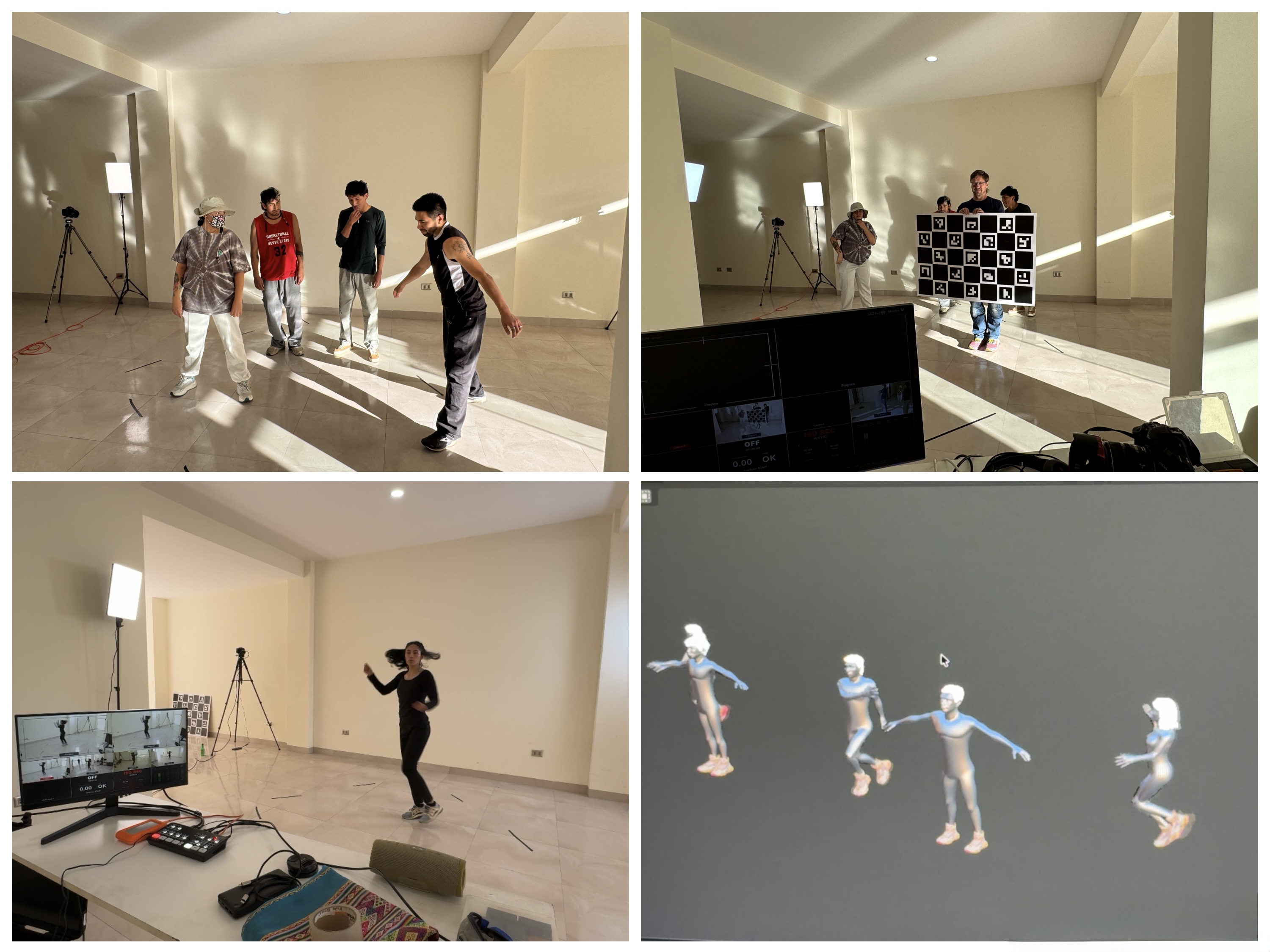
Four cameras surround a floor of pale tiles. Keny opens with footwork. Camili answers with the steps of the Kullawada. On our screen, their bodies appear as constellations of fluorescent points joined by cords. Every joint is a knot. Every trajectory, a cord knotting itself through time. Our system is called Paqarina, and it turns dance into a quipu.
Quipus held the memory of the Tawantinsuyu in knotted cords. They recorded censuses, harvests, tributes and stories for centuries. We take up that language to record movement: the Kullawada, the Suri Sicuri, the Tinku and the breaking of Cochabamba, captured in three dimensions, at real metric scale, by the same community that dances them and programs them.
Each dance brings its own force to the archive. The force of breaking lives in individuality: every artist earns a name in the cypher with a style of their own, a vocabulary of freezes and power moves that nobody executes the same way. The force of the Kullawada lives in the collective: the tropa advancing together, the shared step that makes community, the fiesta danced by everyone. And the Tinku carries both forces at once: the body to body encounter, individual skill inside a deeply collective ritual. The Suri Sicuri brings its crown of feathers and its altiplano circles to the next captures.
Silvia Rivera Cusicanqui calls ch'ixi that which is and is not at the same time: the gray that up close reveals black and white points living together without merging, the Indigenous and the modern coexisting without dissolving into each other. Paqarina is a ch'ixi project. The quipu and the code. The tropa and the cypher. The grandmother and the algorithm. We captured a duet where Tinku and breaking answer each other in the same space, two logics of confrontation and virtuosity side by side, each one whole, neither absorbed by the other.
The great dance datasets of the world record soloists. We just captured the dialogue.
The whole system runs on our own computers, with no cloud and no outside platforms. Four synchronized cameras feed a 3D triangulation engine calibrated with a precision board. A second generation engine repairs the detector's errors when we spin or cross, and follows the identity of every body through contact. Data cleaning obeys a strict rule: the system interpolates brief gaps and leaves blank what no camera saw. Honest data is worth more than complete data.
We also built our own workstation: a browser where every take plays in 3D next to its original video, synchronized frame by frame. Quality diagnostics live there, along with calibration, one click triangulation and the training runs of the artificial intelligence. The tool's aesthetic is the quipu: fluorescent knots on ink.
Many people believe creating local artificial intelligence is impossible. We are creating it in Cochabamba. On our archive we train a movement model that follows Yann LeCun's joint embedding predictive architecture, implemented from scratch for our data, with no borrowed weights and no external licenses. Sovereignty covers every layer: the cameras, the pipeline, the dataset and the model weights. Every layer can be audited. Every layer is governed by us.
This work lives in our computational creativity lab, where experimenting is the goal. We the artists name our takes, review our captures and decide what enters the archive. Ten working meetings have woven the protocols and the vocabulary of every session. The horizon is an intelligence that learns to dance with those of us who created it: one that receives the movement of a live body and answers with movement of its own, trained on our dialogue.
Movement is data. Data is territory. This territory is ours, and it dances.