Culture Chronicle
Tepito already built the future
The future will not be made by billionaires. They don't know how to invent cumbia sonidera. A chronicle from a neighborhood that governs itself — contradictions and all.
By Violeta Ayala — Tecnóloga Creativa
I'm writing this at Benito Juárez airport, where I always understand life by context and by feeling. I was in Mexico with a group of scientists, developers, all of them geniuses — I'll tell you soon what we were up to. Everything intense, and we spent the gathering in la Condesa, but on the last day I went to Tepito to visit an Australian friend. From the gentrified Condesa to Tepito is only forty minutes — or however long the metro takes.
Two worlds, one metro ride apart.
I work in technology, film, and robotics. I spend my time in rooms where people debate who is going to build the future — with which models, with what capital, with whose permission — and then I land in a barrio that already built it without asking anyone.
The name comes from Náhuatl. Cecilio Robelo traced its origin to Teocaltepiton — «small temple» — after a little temple that stood on the site, still called San Francisco Teocaltepiton, or Tecuahltepiton, in the colonial period, until phonetic contraction left only Tepito. Fray Alonso de Molina and Rémi Simeón agree: tepiton, something small. The barrio is named for a small temple. The temple never left.
- Where la Santa Muerte has an altar on Alfarería and people bring her cigarettes, apples, tequila — the temple only changed saints.
- Where two teenagers kiss in the street without discretion.
- Where kids play fútbol against a wall with a goal painted on it.
- Here the music is invented.
- Where señoras in their seventies are dressed better than any fashion show.
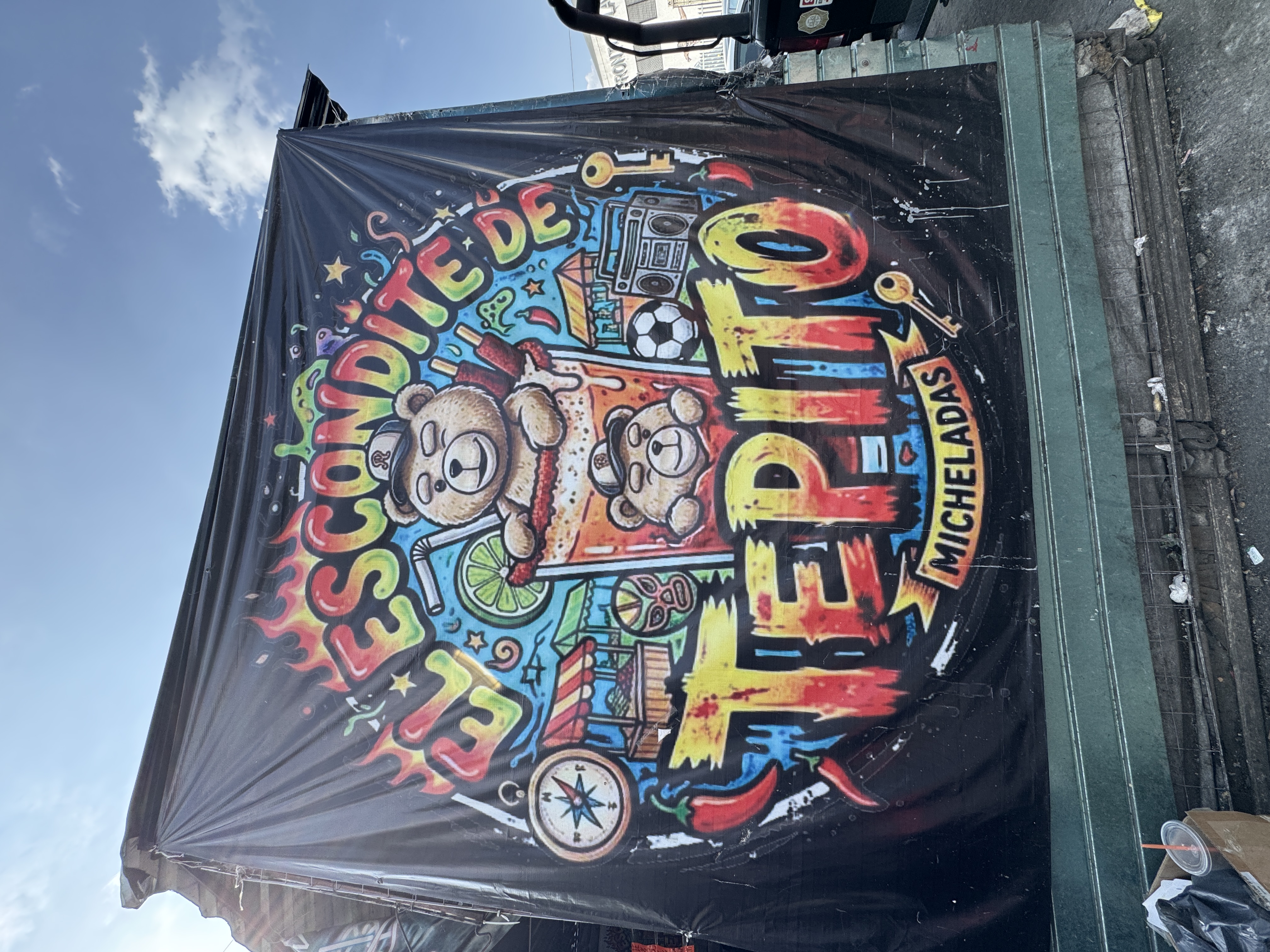
- Three micheladas for a hundred pesos (5 USD). Everything loud, everything specific, nothing waiting for permission.
Live with this much intensity and a hundred and fifty years is too much. In la Condesa there are people optimizing their sleep to reach a hundred and fifty. Further north, in Silicon Valley, there is an obsession with preservation — which I'm not saying is wrong, but context is everything. On Alfarería nobody is asking for the extra century. Death is respected here.
Where the live DJ plays cumbia and reads the saludos out loud between songs. Dedications written on slips of paper and handed over by hand. A greeting to a cousin in Chicago. To a brother inside the Reclusorio Norte. To someone's mother in Puebla who will hear about it tomorrow from a neighbor. A message-passing network running on a rented sound system. No logs. No owner. It can't be acquired. It has moved more meaning across borders than most of the platforms we spend our lives building and auditing.
The network · no owner
Send a saludo to the air
Write your dedication and it goes out between songs. No logs: refresh the page and they're gone, like the real sonidero.
La rebajada already proved it: a cassette motor dragging, Gabriel Dueñez letting it drag, cumbia slowed until it opens into something heavier. A malfunction turned into a genre. In Houston, DJ Screw arrived at the same thing on his own, in the same years — two communities discovering that slowing recorded time down opens a sensory space that didn't exist before. The invention came from the ear and from material scarcity.
Copying works the same way. Shenzhen's shanzhai workshops were called pirates until the reverse-engineering base beneath them produced DJI and Huawei. La fayuca (contraband) is how technology reaches the places capital declines to serve, and the place of arrival is where the uses get invented. El fayuquero and el sonidero do continuous work.
Cash works like this. No behavioral profile, no credit score, no dataset sold to a broker. Fayuca and tianguis: an economy that works and leaves no trace. Data minimization, implemented for a century by people who never came to the working group.
Cash also makes el cobro de piso possible. The same autonomy carries the extortion. The economy that refuses surveillance also has no pensions, no recourse, no ambulance that comes fast. In Andean thought we have a word, ch'ixi: something that is two things at once and stays that way, without resolving, without turning gray. Tepito is ch'ixi. It's not a model to deploy. A version that keeps the michelada and drops the violence would be one more extraction, easier to consume than the barrio itself.
The barrio has carried that contradiction for centuries. Mecamalinco, one of its old names, was among the last places where the Mexica and the Tlatelolca resisted Cortés. When they fell, the site was named Tequipeuhcan: «place of slavery». Five hundred years of governments wanting to make the barrio disappear —reorder it, demolish it, ship its people to the east of the city— and it's still there, taping up posters about dignity on the walls. It has survived every prediction of its own end.
Elon Musk tells himself he is a Cassandra: he sees the future better than anyone and is doomed not to be believed. «What I say will come to pass», he insists. He predicts that within five years artificial intelligence will surpass the sum of all human intelligence. The sum. As if intelligence were a quantity you could total and then exceed. Musk can't understand Tepito, because the intelligence of the uncounted —those of us who were never a unit, those of us who have survived— is not a sum. It's carrying the contradiction without resolving it. It's staying alive in the place they named slavery. It's inventing a genre with a broken motor. No superintelligence surpasses that, because it was never a number.
The future of technology won't be built by billionaires. They can't invent la cumbia sonidera. They don't know how to live with intensity. They're too busy not getting older. No community, no responsibility, only a bubble they've convinced themselves is the world. They don't have a chance.
The art of resistance isn't asking us to design it. Loud, contradictory, already governing itself, and it will outlast several of our cycles.