Data Analysis
The shield
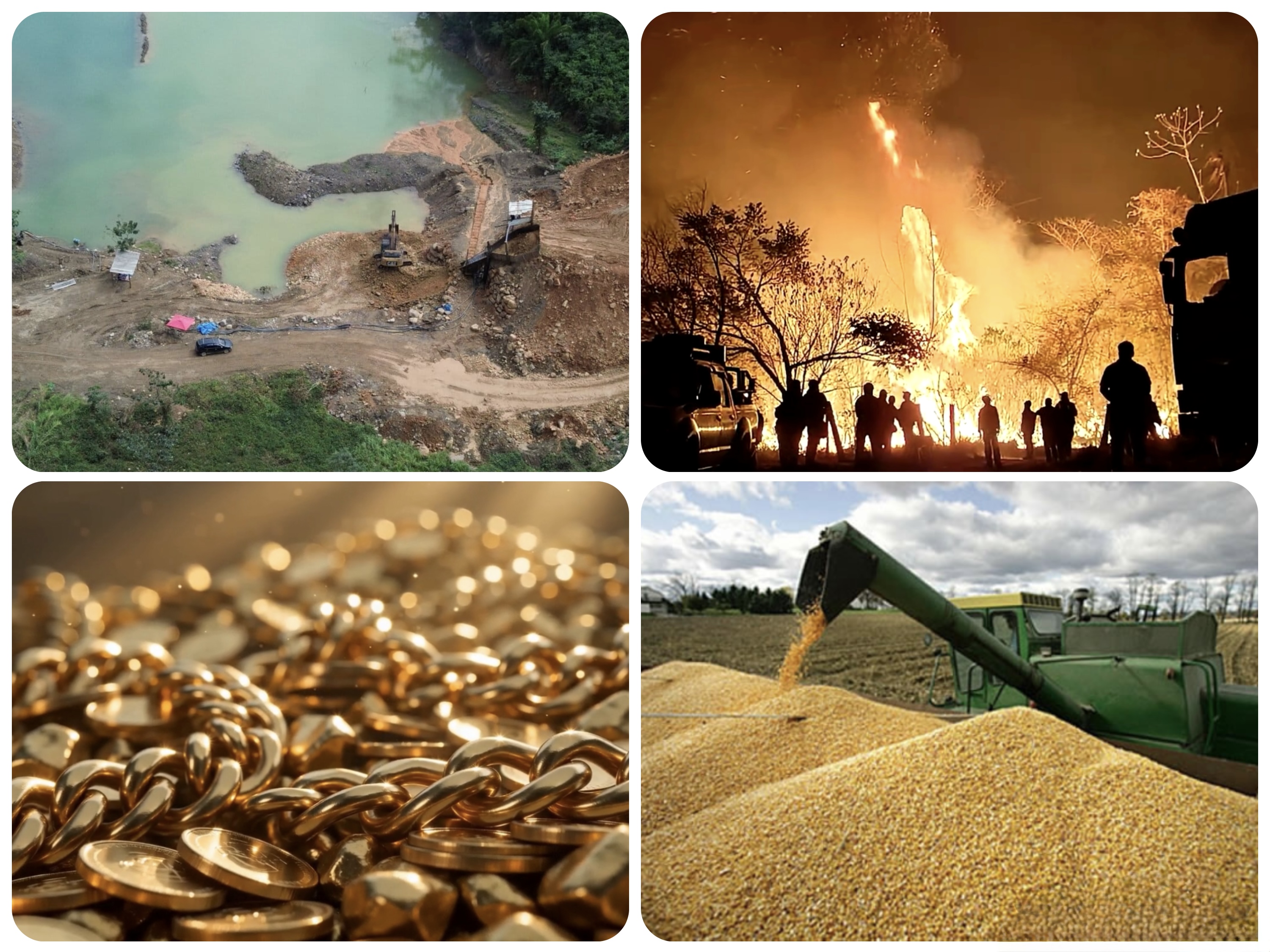
Gold pays a 2.5 percent royalty at record prices. Agribusiness pays up to 19 dollars per hectare a year. Two regimes designed for the small, captured by the big, defended in the name of the small.
By Violeta Ayala — Tecnóloga Creativa
The crisis and the money
The conversation about Bolivia's crisis is always the same: who will lend, on what terms, with what adjustment. This piece looks at the opposite: the money that is already ours and goes uncollected.
Two sectors export billions under tax regimes designed for subsistence-scale production. Gold and agribusiness.
Gold
The 2014 Mining Law pegged the gold royalty to a reference price of 700 dollars an ounce. The ounce is worth six times that today.
The royalty has not moved a decimal in ten years.
all-time record
1.5% if declared marginal
of 316.7 million
Sources: Law 535, the Mining Ministry's Statistical Dossier of the Mining and Metallurgy Sector 1980 to 2023, Fundación Solón's analysis of that dossier, and analyst estimates published in the Bolivian press. An independent professional pays 13 percent VAT, 25 percent on profits and 3 percent on transactions.
The marginal production category was created for the pan miner: up to 2 kilos a month for an individual operator, up to 20 for a cooperative. At July's National Mining Summit, experts said it at the table: the exception became the rule, and even those exporting tons declare marginal gold.
The sector's own leaders admitted the gap that allows it: neither Senarecom nor the tax service reaches the places where gold is mined.
Big capital operates behind the category. In the first quarter of 2022, 99 percent of the gold produced in Bolivia was registered as cooperative production. An ANF investigation documented Chinese companies running dredges in northern La Paz behind cooperative fronts, in exchange for rent.
Fundación Jubileo calculates the gold compensation should be 7 percent. The provision written for small miners cuts it to a third.
The current government deepened the scheme. Decree 5503 grants the sector tax stability for up to fifteen years, a power that belongs to the Legislative Assembly. And in May it signed an eight-point agreement with Fencomin committing to release new mining areas and flexibilize environmental rules tied to protected areas.
At July's Summit, the press was barred from the negotiating tables.
Agribusiness
The farm sector's instrument is called the Unified Agricultural Regime, the RAU: one annual payment per hectare that replaces four taxes.
It was created in 1996 for the small producer. The numbers are in the table.
per hectare, per year
against roughly 9.80 unsubsidized
+ 3% transactions
Anyone owning mills, silos, cold storage or processing plants is excluded from the RAU on paper.
Run the numbers at the top fee. Ten thousand hectares in the best zone pay, at most, 190,000 dollars a year for four taxes combined. At the bottom fee, 4,000 dollars.
And RAU taxpayers issue no invoices, so they sit outside the entire VAT chain. The estate's tractor fills up on diesel at the same subsidized price as a minibus.
The Eastern Agricultural Chamber is pressing to lift export quotas and approve transgenics. And it opposes any change to the diesel subsidy.
Sell at international prices, produce at subsidized ones. The subsidy is not neutral: the larger the estate, the more liters it burns and the more subsidy it captures. Nobody proposes scrapping it overnight, because that hits small producers and transport. What is missing is a ceiling of liters per declared hectare. The data exists: everyone declares their hectares under the RAU and everyone buys diesel on the record.
The sector's political weight is in plain sight. Paz's cabinet includes two former representatives of Santa Cruz's business and agribusiness lobby. The Eastern Agricultural Chamber is pressing for laws on transgenics and the lifting of export quotas, and the economy minister suggested approval was imminent.
June's protesters accused the government of governing for elites and agribusiness lobbies. Three ministers resigned that week.
The pattern
Both regimes make the same design error: they read identity where they should read scale.
Cooperativist and campesino are identities, and no identity tells you how much someone earns. Production does: kilos, hectares, invoicing. A wealthy campesino should be taxed as wealthy. A cooperative exporting tons should be taxed as an exporter of tons.
At the Mining Summit, leaders defended their benefits arguing that cooperativists are also comunarios. In farming, the small producer's regime shelters properties of thousands of hectares.
The pan miner and the subsistence farmer are the shield of the dredge and the soy giant. The regime protects those who do not need it, in the name of those who do.
And the trap rests on a measurement vacuum, admitted by the beneficiaries themselves: the state cannot weigh the kilos or verify the hectares.
The scale rules exist on paper. Without a scale, the category decides.
The same votes
On August 30, 2026, President Rodrigo Paz put it this way: politics does not do the people any good; what does is public works, projects, hospitals, schools, roads. And he announced 500 million dollars awaiting approval in the Senate and close to 200 million from the World Bank in the Chamber of Deputies, 700 million in total, for social protection and cash transfers.
These are loans. The Assembly approves them and the country repays them with interest.
That same Assembly set the gold royalty in 2014, pegged to a 700 dollar ounce. Today it is worth 4,400 and no one has filed a bill to update it. The RAU is a 1996 decree that a law can replace.
Putting the country into debt requires the votes of deputies and senators. So does taxing gold. Same votes, same chamber. One decision brings borrowed money with interest; the other, the country's own money in hard currency.
The math
On a billion dollars exported, every percentage point of royalty is ten million dollars. In hard currency, which is exactly what is missing.
Gas always paid around 50 percent between taxes and royalties. Nobody proposes that for gold overnight. But the distance between 2.5 and any serious number is measured in hundreds of millions a year.
A loan gets repaid with interest. A royalty never has to be.
What must be asked
The national tax service should publish how many taxpayers are registered under the RAU, how much land they declare, and what the regime collected over the last five fiscal years.
From Senarecom, the mining authority and Customs: declared production per cooperative, how many claim the marginal category, and gold exports by exporter for the last three years.
None of this is secret. It all exists in public records that no institution publishes cross-referenced, and any citizen, legislator or newsroom can demand it through access to information mechanisms.
This piece leaves the list ready. Whoever files it, publish the answers. And if they never come, publish that.
Sources
- Law 535 on Mining and Metallurgy, 2014. Royalty scale for small-scale mining, topping out at 2.5 percent above 700 dollars an ounce.
- Ministerial Resolution 165 of 2017, Ministry of Mining. Marginal production limits: 2 kilos a month for individual operators, 10 for small mining, 20 for cooperatives.
- Statistical Dossier of the Mining and Metallurgy Sector 1980 to 2023, Ministry of Mining and Metallurgy, cited by Visión 360 and CTV Bolivia in January 2025: mining tax revenue of 316.7 million dollars in 2023, of which 297.9 million from private mining, 4.7 from the state sector and 750,475 dollars from cooperatives.
- Fundación Solón, December 2025. Pablo Solón's analysis of Decree 5503, the record gold price, and the 712,990 dollars in taxes paid by the entire cooperative mining sector in 2022, per the official Mining and Metallurgy Statistical Dossier 1980 to 2023.
- Analyses published in the Bolivian press, May 2026. Raw gold exports of 1.183 billion dollars in 2025, royalties of about 53 million, estimated sector sales of 3 billion, and the comparison with the general regime's burden.
- Agencia de Noticias Fides, November 2022. Investigation into Chinese companies operating behind cooperatives in northern La Paz, and the registration of 99 percent of gold as cooperative production per the Ministry of Mining.
- Fundación Jubileo. Report on gold royalty avoidance: 7 percent provided by law against 2.5 paid.
- La Región and Erbol, July 2026. Coverage of the National Mining Summit: the sector's demands, the warning that the exception became the rule, the admission that Senarecom and the tax service do not reach gold mining zones, and the barring of the press.
- El Diario, May 2026. Eight-point agreement between the government and Fencomin.
- Supreme Decree 24463 of 1996 and Board Regulatory Resolution 102500000038 of the national tax service, September 2025. Design and current fees of the Unified Agricultural Regime.
- Infobae, November 2025. RAU fees of 0.40 to 19 dollars per hectare, the diesel subsidy, the machinery tariff exemption, the cabinet's composition and the Eastern Agricultural Chamber's pressure.
- Public remarks by President Rodrigo Paz, August 30, 2026, on the 500 million dollars awaiting Senate approval and the roughly 200 million from the World Bank in the Chamber of Deputies.
- Press coverage of the June 2026 protests and ministerial resignations.
Figures come from published legal norms, the mining sector's official statistical dossier and the cited reports. The 3 billion dollar sales figure is an analyst estimate and is presented as such. This piece describes legal avoidance mechanisms and tax design, and attributes no crime to any person or organization. The data detailed in the final section sits in public records and can be requested from the entities named by anyone through access to information mechanisms.