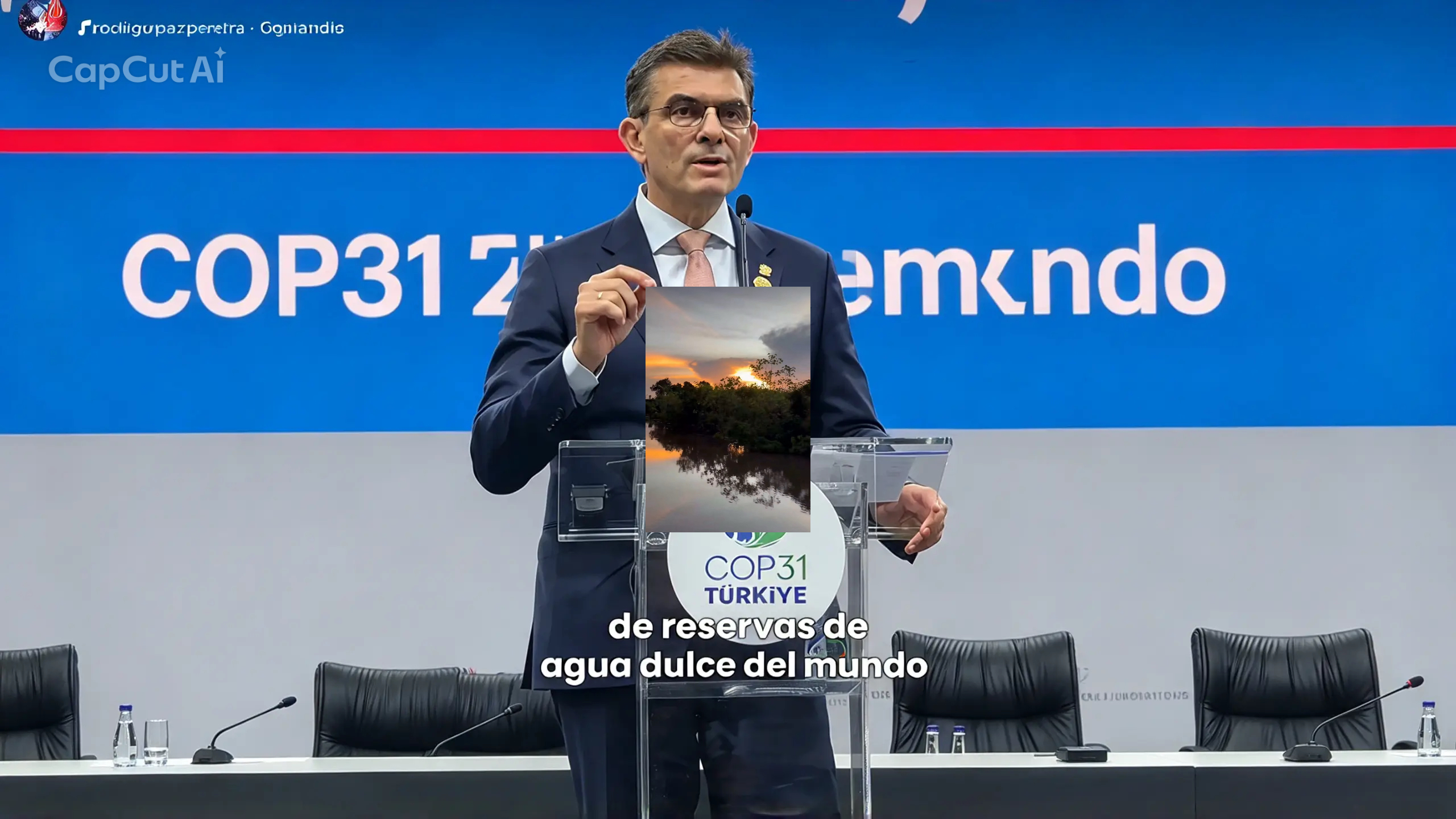
Data Verification · COP31
Paz publishes false data about Bolivia's water.
Paz presents Bolivia as the planet's largest generator of water to ask for green finance. Brazil generates almost 19 times more. The 60% he cites shrinks to 10% in measured river flows.
By Violeta Ayala — Tecnóloga Creativa
Fact check · COP31
Rodrigo Paz tells COP31 that Bolivia supplies 60% of the water in the Amazon and La Plata basins. Measured river flows put the ceiling near 10%.
Of every 100 litres carried by the Amazon and La Plata
60come from Bolivia, according to Paz
10at most pass stations that receive Bolivian water
The claim
Bolivia's president is in Antalya, Turkey, at the UN climate summit. Between 11 and 12 November he repeats one figure in speeches and on his own Instagram account. The quotes below are translated from Spanish.
- Paz publishes the figure in writing on his verified Instagram account. The post states that 60% of the water in the two basins comes from Bolivian territory and presents the country as "the largest generator of water on the planet". Instagram, @rodrigopazpereira, 12 Nov 2026
- At a UN-Habitat event he says that "60% of the water of the Amazon basin and the La Plata basin" comes from Bolivia. At the same event he describes Bolivia as the country that generates the most water in the world. El Deber, 12 Nov 2026
- In his main speech he refers to a "contribution of 60% of that fresh water worldwide". El Mundo, 11 Nov 2026
- The EFE news agency records a third version: Bolivia as the heart that pumps water into the Amazon and La Plata and supplies 60% for South America. EFE via Infobae, 11 Nov 2026
Neither the post nor the statements cite a source for the figure.
The verdict
Bolivia supplies 60% of the water in the Amazon and La Plata basins.
Bolivia generates more water than any other country. Brazil generates almost 19 times more.
Bolivia has a lot of water per person. It ranks above Brazil on that measure.
Bolivia struggles to get water to its people. Paz says so in the same speech.
The Amazon math
The Amazon discharges 206,000 cubic metres per second into the Atlantic. That equals 17% of all fresh water reaching the world's oceans. The figure comes from the 1972-2003 water balance published by Callède and colleagues in 2010.
Almost all of Bolivia's Amazon water leaves through one river: the Madeira. The Beni and the Mamoré form it. The Porto Velho station, in Brazil, measures the flow past the border. The 1974-2004 average is 18,300 cubic metres per second.
That flow carries water from three countries. Bolivia, Peru and Brazil share the Madeira basin.
18,300 ÷ 206,000 = 8.9%
Ceiling: the entire Madeira at Porto Velho counted as Bolivian.
Surface area confirms the scale. The Bolivian Amazon makes up 11.2% of the continental Amazon basin, according to Amazon Cooperation Treaty data.
The La Plata math
Bolivia holds 221,994 square kilometres of the La Plata basin. That is 7.0% of the total. Brazil holds 44.4% and Argentina 30.9%. The data comes from the basin's intergovernmental coordinating committee (CIC).
Bolivia's share sits on the dry side. The CIC states that the western tributaries, in the Gran Chaco, contribute minimal flows to the system.
The whole Paraguay River, with water from Brazil, Bolivia and Paraguay, carries 3,550 cubic metres per second at Puerto Pilcomayo. The Paraná carries 17,200 at Corrientes. The Uruguay carries 4,200 at Paso de los Libres.
The sum
The size of the rivers
Mean flow in cubic metres per second. Bars to scale.
The Amazon already includes the Madeira flow. The Paraná at Corrientes already includes the Paraguay.
| Measure | Flow (m³/s) |
|---|---|
| Madeira at Porto Velho (Bolivia + Peru + Brazil) | 18,300 |
| Paraguay River at Puerto Pilcomayo (Brazil + Bolivia + Paraguay) | 3,550 |
| Ceiling attributable to Bolivia | 21,850 |
| Amazon at the mouth | 206,000 |
| Paraná at Corrientes | 17,200 |
| Uruguay at Paso de los Libres | 4,200 |
| Both basins combined | 227,400 |
21,850 ÷ 227,400 = 9.6%
The ceiling sits near 10% and hands Bolivia water from Peru, Brazil and Paraguay. The real contribution is lower.
FAO data offers a second check. Bolivia generates 303.5 cubic kilometres of renewable water per year inside its territory, across all its basins. The Amazon discharges about 6,500 cubic kilometres per year. All the water generated in Bolivia equals 4.7% of that flow.
The world's largest generator
Brazil generates 5,661 cubic kilometres of renewable water per year inside its territory. Bolivia generates 303.5. The gap is 18.7 times. The data is FAO AQUASTAT for 2020.
Bolivia stands out on another measure. It has 49,173 cubic metres of renewable water per person per year. Brazil has 40,680.
Where the 60 may come from
One Bolivian statistic sits close to that number. The Amazon basin covers 724,000 square kilometres of the country, 66% of its territory. Another source, based on the Amazon Cooperation Treaty, gives 75%.
That statistic measures how much of Bolivia is Amazonian. Paz's claim states how much of the Amazon is Bolivian. These are two different measures.
Why it matters
The figure travels with a funding pitch. Paz presents Bolivia as the heart of the world's fresh water to attract green finance at COP31. He announces 250 million euros from the German development bank KfW for forests, water, energy and private investment. He declares Bolivia's interest in joining the Tropical Forests Forever Facility promoted by Brazil.
The same government dissolves the Ministry of Environment and Water in November 2025. On 3 August 2026 it eliminates the Ministry of Development Planning and Environment, which had inherited the environmental portfolio. In 2024 Bolivia loses 1.8 million hectares of forest and agribusiness accounts for 90%, La Silla Vacía reports, citing Mongabay.
Bolivia sits at the headwaters of two of the continent's great basins and has more water per person than Brazil. That argument is verifiable. One gauging station disproves the 60%.
Sources
- Callède et al. (2010). Amazon discharge to the Atlantic, 1972-2003. Revue des sciences de l'eau.
- Espinoza Villar et al. Regional runoff changes in the Amazon basin, 1974-2004. Table 1, Porto Velho station. IWRA.
- CIC Plata and OAS (2017). Transboundary Diagnostic Analysis and Strategic Action Program, executive summary. Table 1.1.1. cicplata.org.
- FAO AQUASTAT and World Bank, renewable water resources by country, 2020 data. World Bank and compiled table.
- Bolivia's Amazon area: Madeira River study (724,000 km², 66%) and Pan-Amazon Social Forum (75% of the country, 11.2% of the basin).
- Madeira basin across three countries: Muniz (2013), UFAM.
- Finance and agenda at COP31: Unitel, Radio Kollasuyo.
- Ministries and deforestation: La Silla Vacía.