Data Analysis
First The Law
SEGIP will travel to all 335 municipalities over the course of one year collecting fingerprints and facial images, using facial recognition technology. Bolivia has no data protection law. Kenya did the same thing and its High Court ruled it illegal.
By Violeta Ayala — Tecnóloga Creativa
The announcement
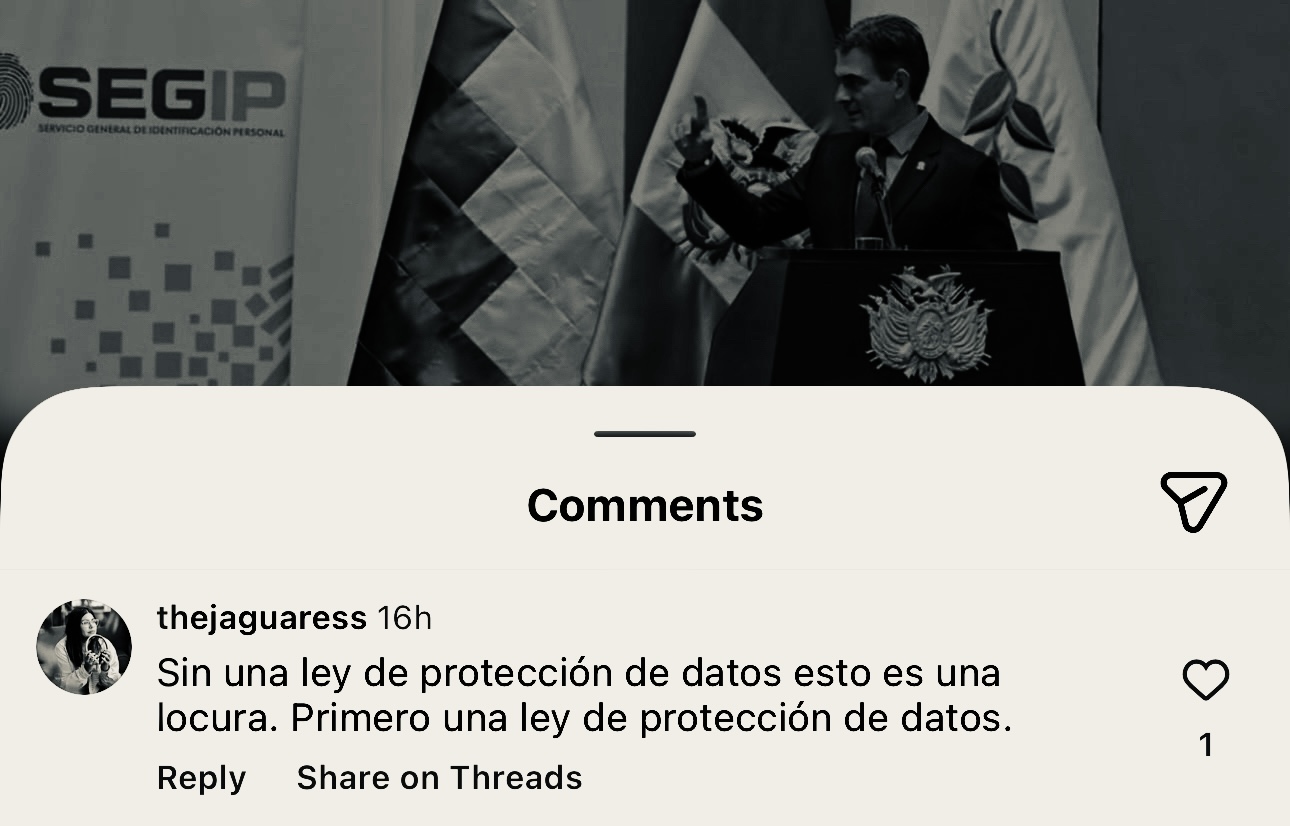
On September 16, President Rodrigo Paz presented the new version of SEGIP Digital and a programme called Marcando Huella por Bolivia, and framed it as the end of the obstructive state, those ninety-minute queues to get a duplicate ID card.
I left a comment on his post: without a data protection law this is madness, a data protection law first. This piece explains why.
I will start with what is good, because it is good. Eighty-one out of every hundred people queuing at SEGIP are replacing a lost, stolen or damaged ID card, and that request can now be made from a phone, paid by QR and collected in four minutes.
For someone living five hours from the departmental capital, that is not a convenience. It is a day's work not lost and a bus fare not paid. Nobody sensible opposes that.
What it actually is
It is worth understanding what is being built, because this is not an app for looking at your ID card on a screen.
The digital ID rests on the Single Identification Registry, the database where SEGIP already holds fingerprints, a photograph and validated civil records for every Bolivian. To activate it you have to go to an office, have your phone linked to that database, and access is then enabled.
Figures from SEGIP, the September 16, 2026 presentation and coverage by El Día, Opinión, La Patria and Red Uno.
Facial recognition. That is the part worth reading twice, because you can refuse to give a fingerprint and you wear your face everywhere.
What makes a face different from a password
Tap each column.
Explanatory diagram. The facial recognition SEGIP refers to is used to validate the identity of the person collecting a document. This piece does not claim that camera surveillance exists or that the system is used for anything else; it describes what kind of record a face is and why handling it requires different rules.
The brigades
Marcando Huella por Bolivia is a set of mobile brigades that between August 2026 and July 2027 will travel through the nine departments, the 335 municipalities and the eight Indigenous Originary Campesino Autonomies.
They carry satellite internet to work in remote areas, and prioritise rural communities, border zones, hospitals and prisons. They do physical and digital ID issuance, licence activation, and something mentioned in passing: cleaning and updating records.
Translated: for a year, the state will travel the whole country taking and updating biometric data, prioritising the populations with the least access to legal advice, the least press coverage and the least ability to complain if something goes wrong.
This will be the largest collection of sensitive data in the country's history, and it will be done with no rule limiting it.
It is worth dismantling here the argument that usually accompanies these programmes, the one about bringing identity to those who lack it, because in Bolivia that work has already been done.
SEGIP was created by Law 145 of June 27, 2011, which took identification out of the hands of the national police, placed it in a decentralised public institution and made it the only body empowered to issue the identity card and to run the Single Identification Registry. Mass campaigns followed: school enrolment across 15,000 educational establishments for more than 1.7 million students, free processing for children in shelters and street situations, consular issuance from 2016 in Argentina, Brazil, Chile, Spain and the United States, and the 2017 Plan Guardián, which linked the live birth certificate to the identity number to curb trafficking of undocumented children.
Bolivia settled the question of identity documents more than a decade ago. Some people remain undocumented, some always do, and that is a problem at the edges, not across the whole country.
If the undocumented were the objective, the brigades would go where they are. They are going to all 335 municipalities, which is to say everywhere. What is being done is not documenting those who are not documented. It is re-registering, in digital biometric form, a population that was already registered.
SEGIP itself lists confidentiality among its institutional principles, in these words: citizens' information will be used solely for identification purposes.
That is a principle written on a web page, not an enforceable legal obligation. Without a data protection law nobody can compel compliance, no authority can penalise a breach, and no citizen can complain if that information is one day used for something else.
What does not exist
Bolivia has no personal data protection law. This is not a technical detail, it is the entire framework that is absent.
It means nobody is required to tell you what information about you they hold, or to delete it when you ask, or to warn you of a breach, or to limit the reuse of data collected for something else, or to run a risk assessment before building a new system. There is no supervisory authority. There is no penalty. There is nobody to complain to.
Without that law, the most elementary questions carry no obligatory answer. Who built the system, where the biometric templates are stored, whether the servers sit in Bolivia, how long the data is kept, which other institutions can query that database, what happens if it leaks.
None of it is forbidden and none of it is permitted, because none of it is written down anywhere.
The point is not that this government will do something wrong with that data. The point is that nothing stops it, and that the next government will have nothing stopping it either.
A national biometric database lasts decades. Governments last five years.
Kenya did exactly this
One country walked this road all the way and serves as a map. In 2019 Kenya launched a national biometric identity system known as Huduma Namba, with the same argument: modernise, speed things up, end the paperwork.
Between April and May of that year it collected fingerprints, facial images and biographic data from some 36 million people. Only in November, with the data already taken, did parliament hurriedly pass the country's first data protection law.
Judgments of the High Court of Kenya in Nubian Rights Forum and others v the Attorney General, and coverage by Privacy International, the Oxford Human Rights Hub, CIGI and Biometric Update.
The court did not say digital identity was illegal. It said the system could not proceed without a comprehensive legal framework addressing privacy, the risk of discrimination, the risk of exclusion and the risk of mass surveillance.
A year and a half later it ruled again, this time because the government never carried out the impact assessment the law itself required before processing the data. The project was abandoned, with ninety million dollars spent and the supplier barred by parliament.
Kenya did not lose the system through opposition. It lost it by doing things in the wrong order.
It collected first and legislated afterwards, and by the time the law arrived it was too late to ask 36 million people for permission.
The order matters
Two countries, the same four decisions, in a different order. Tap each path.
What to ask for
None of this requires halting the programme, and it would be foolish to ask for that. The announced route runs to July 2027, so there is ample time to do it properly.
One point is also worth clarifying because it is not clear. Press coverage puts the start in August 2026, and yet the president's own post of September 16 refers to the brigades in the future tense, saying they will reach the 335 municipalities. If they have not yet set out, the moment to write the law is now rather than later.
Any citizen can request this information in writing from SEGIP and the Ministry of Government.
The last row of that table is the one that matters most to me, and it concerns the eight Indigenous Originary Campesino Autonomies on the brigades' route.
Informed consent is not a signature at the bottom of a form. It is someone explaining to you, in your own language, what they are taking, what for, for how long and what you can do if you change your mind. Without a law that explanation is not required, and without a requirement it does not happen.
The order
Paz said something at the event worth taking seriously: a card does not give you your identity, your identity is yours, but the card certifies it to the world.
He is right, and precisely for that reason, when the card becomes your fingerprint and your face inside a state database, what is at stake stops being paperwork.
I am in favour of a woman in Charagua not having to travel six hours to replace her ID card. I am against her fingerprint and her face entering a system nobody is obliged to explain to her, or protect for her, or delete for her.
Both are solved by the same thing, and it is not stopping anything. The law first.
Sources
- Presentation of the new SEGIP Digital functions and the Marcando Huella por Bolivia programme, September 16, 2026, with statements by President Rodrigo Paz and Minister of Government Marco Antonio Oviedo, reported by El Día, Opinión and La Patria: QR payments, biometric validation by fingerprint or facial recognition, the reduction in collection time, the brigades' satellite internet, the route through 335 municipalities and eight Indigenous Originary Campesino Autonomies between August 2026 and July 2027, priority for rural communities, border zones, hospitals and prisons, and the figure of more than 150,000 digital procedures in the first half of the year.
- Servicio General de Identificación Personal, requirements for the digital identity card: being over 18, holding a consolidated and biometrically registered record, a digital signature on the last issuance, a cost of 20 bolivianos, two years of validity and in-person activation at an office.
- Red Uno, with statements by SEGIP's departmental director in Cochabamba, and coverage of the app's link to the Single Identification Registry, the database holding fingerprints, photographs and validated civil records.
- Law 145 of June 27, 2011, creating the Servicio General de Identificación Personal as a decentralised public institution under the Ministry of Government, the sole body empowered to issue the identity card and to create, administer and maintain the Single Identification Registry.
- On the identity card campaigns: coverage of school enrolment across 15,000 educational establishments for more than 1.7 million students; the start of consular issuance in 2016 in Argentina, Brazil, Chile, Spain and the United States; and the 2017 Plan Guardián linking the live birth certificate to the identity number.
- Institutional principles published by SEGIP, among them universality and confidentiality, with the formula that citizens' information will be used solely for identification purposes.
- Judgments of the High Court of Kenya of January 30, 2020 in Nubian Rights Forum and others v the Attorney General, and of October 2021 on the absence of an impact assessment, reported by Privacy International, the Oxford Human Rights Hub, CIGI and Biometric Update: the collection of data from some 36 million people between April and May 2019, the passage of the data protection law in November of that year, the cost of more than 90 million dollars and the later blocking of the successor system Maisha Namba in December 2023.
This piece describes a publicly announced government programme and does not claim that SEGIP, the Ministry of Government or any authority has misused personal data. The argument concerns the absence of a legal framework regulating such uses, not the conduct of any person or institution. The author left a public comment on this subject on the president's post cited at the start, and declares it. The questions listed are public information requests any person may file. There is a discrepancy between press coverage, which places the start of the brigades in August 2026, and the president's post of September 16, which refers to them in the future tense; this piece does not establish whether the route has begun. SEGIP and the Ministry of Government have been asked for information on the programme's progress, the supplier of the biometric platform, where the data is stored and whether an impact assessment exists.