Ideas Mozilla Fellowship Education
Multiskills, or people from another galaxy.
When someone brings together four things that nobody brings together, from the outside it looks like they come from another galaxy. They come from the same neighborhood as you, with multiple skills and several years of persistence behind them.
By Violeta Ayala — Tecnóloga Creativa/ Cineasta
Last week I was in Mexico City at a gathering. I met incredible people doing work that can change the technological future of humanity, the way Firefox did when it refused to leave the internet as a Microsoft monopoly.
Since I started working in technology and embodied cinema, every single week I get messages asking me the same thing. What should I study, or which are the professions of the future in the middle of this technological revolution.
I give everyone the same answer. The degree matters little. Two things matter.
Get good at things nobody puts together. And build your own space, because the space you are looking for does not exist yet.
Be able to be good at many things. Multidimensional and multidisciplinary. Good enough in more than one world to hold your ground in each of them. Philosophy and mathematics. Exact sciences and art. Theory and your hands. Thinking globally and concretely at the same time. And one thing almost nobody trains: speculating futures, imagining worlds that do not exist yet and then going out to build them.
It is not two things. It is as many as you can hold at once. Multidisciplinarity is exactly this and nothing more: walking into a room where each person knows one thing, and being the only one who follows what all of them are saying.
When somebody combines four things nobody combines, from the outside it looks like they arrived from another galaxy. They come from the same neighbourhood as you, carrying multiple skills and several years of stubbornness.
The second part is the one people say less. Nobody is going to post a job ad for what you know how to do. That position is not written down anywhere. It appears when someone makes the thing, shows it, and holds it up for a couple of years.
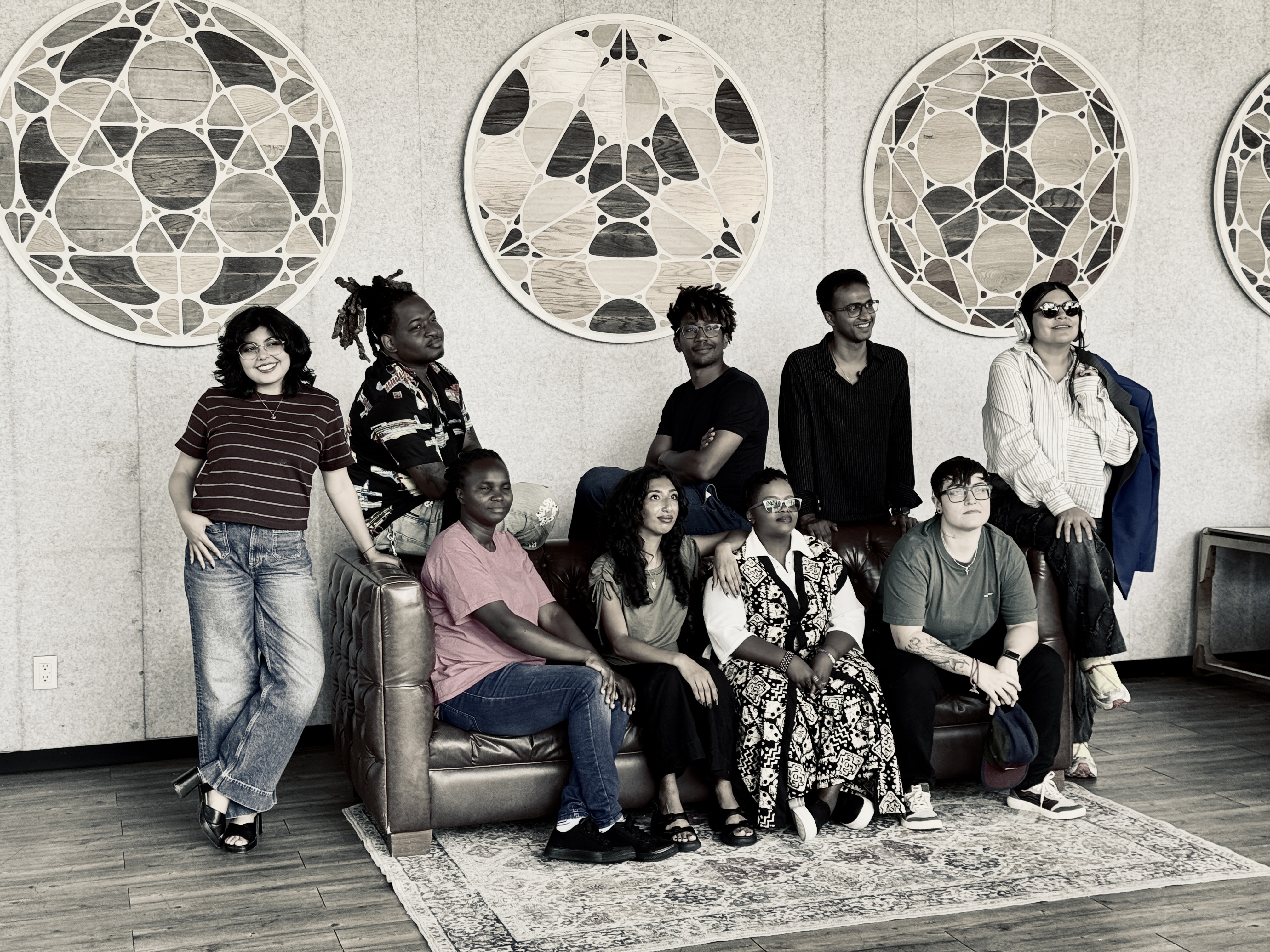
I interviewed four of my nine colleagues about what they are building. In Barcelona, in October, I interview the rest. Their answers are in the video. This first part is the introduction.
Four people, and everything they combine
None of them does one thing. Each combines skills that rarely travel together, and each built the place where that crossing makes sense. Tap a name.
She audits systems that assign a score to a person, and that score carries weight when a judge decides. You need to open the model and you also need to know who invented the category the model measures. With only one of those skills the work falls apart.
She publishes her analysis tools in the open so anyone can repeat what she does. A published method turns into a field, and she is already inside it.
How she got there: sociology, a master's on algorithms and criminal justice, then she enrolled again from year one in statistics. R and Python she taught herself.
She is building a digital protection system for journalists. First she documented how surveillance operates in Venezuela. Then she turned that into something a reporter uses on her phone, under pressure and with no training beforehand. The second skill decides whether the tool is any good.
Her app opens more than thirty censored outlets inside Venezuela. Nobody commissioned that product. The censorship existed, she existed, and she built the tool from exile.
How she got there: systems engineering. Digital rights, censorship measurement and teaching she learned on the job and in workshops.
He trains models in languages no large company considers profitable, and puts them to work transcribing hearings in overloaded courts. A district court runs in the language of the district. Commercial models run in English. That distance is paid in years of waiting, and it is paid by whoever cannot afford a lawyer.
He left a tech company and founded his own, with public courtrooms as the territory. Nobody was competing for that market. That was exactly the opportunity.
How he got there: computer science and computational linguistics. How a courtroom actually works he learned inside the courts.
She measures how governments cut and degrade internet access, and classifies the tools that get around them. A shutdown feels like broken wifi until someone turns it into a data point with a timestamp, a carrier and a method. At that moment it stops being bad luck and becomes somebody's decision.
She put together research that lives between two faculties that do not talk to each other, electrical engineering and social theory. She held that crossing until the institutions came looking for her.
How she got there: computer science, then a master's in science and technology studies, then a PhD sitting between the two.
Nobody handed them the space
This is the pattern that interests me most about the four of them. None of them sent a resume to a job that described what they do. That job did not exist. They made the thing first. The institution arrived later, with prizes and fellowships, to certify something that was already working.
I make stories and reports. I film, I investigate, I write, I code, I build machines that move. None of that fits in one degree and I stopped trying to make it fit a long time ago.
And I did the same as them. Nobody was going to buy a Bolivian film about an uncomfortable case, so I built the platform and distributed it myself. Nobody was going to open a computational creativity lab in Cochabamba, so I opened one. Permission never arrives. Finished work does.
This is not startup motivational talk. It is simpler and harder than that. You will hold up your own thing for a long stretch, with no clear salary, while people ask what you do for a living and you cannot answer in one sentence. That awkward moment is a sign you are in the right place.
And you, what can you do?
Pick what you already handle. I will tell you what I would cross it with, what gap it fills, and what you could build.
Your thing, plus the missing ones
Pick a skill from the list.
The second skill is almost always learned without tuition. Coding, measuring, mapping, interviewing. All of it has open material, people who answer questions, and public data to practice on. The hard part is the question. And the question comes from where you are.
Bolivia holds data nobody else has. Court rulings nobody has analysed. Water and land registries. Thirty six official Indigenous languages under the Constitution, plus Spanish and Bolivian Sign Language. Three of the thirty six are already extinct and thirty are endangered, according to UNESCO. Almost none of them has digital material. Connection cuts nobody measures. Every one of those gaps is a space waiting for someone to occupy it. Your own country has its own list.
Start with what you already do well. Add two or three things nobody pairs with it. And then stop waiting for an invitation. Build your place, hold it, and let the world come ask you how you did it.
Share
Link copied.