Laboratory Mozilla Fellowship Research
The body knows the music
A machine trained in Cochabamba recognises Kullawada, Tinku and breaking without labels, and found the music’s beat by measuring only the dancers’ ankles.
By Violeta Ayala — Tecnóloga Creativa
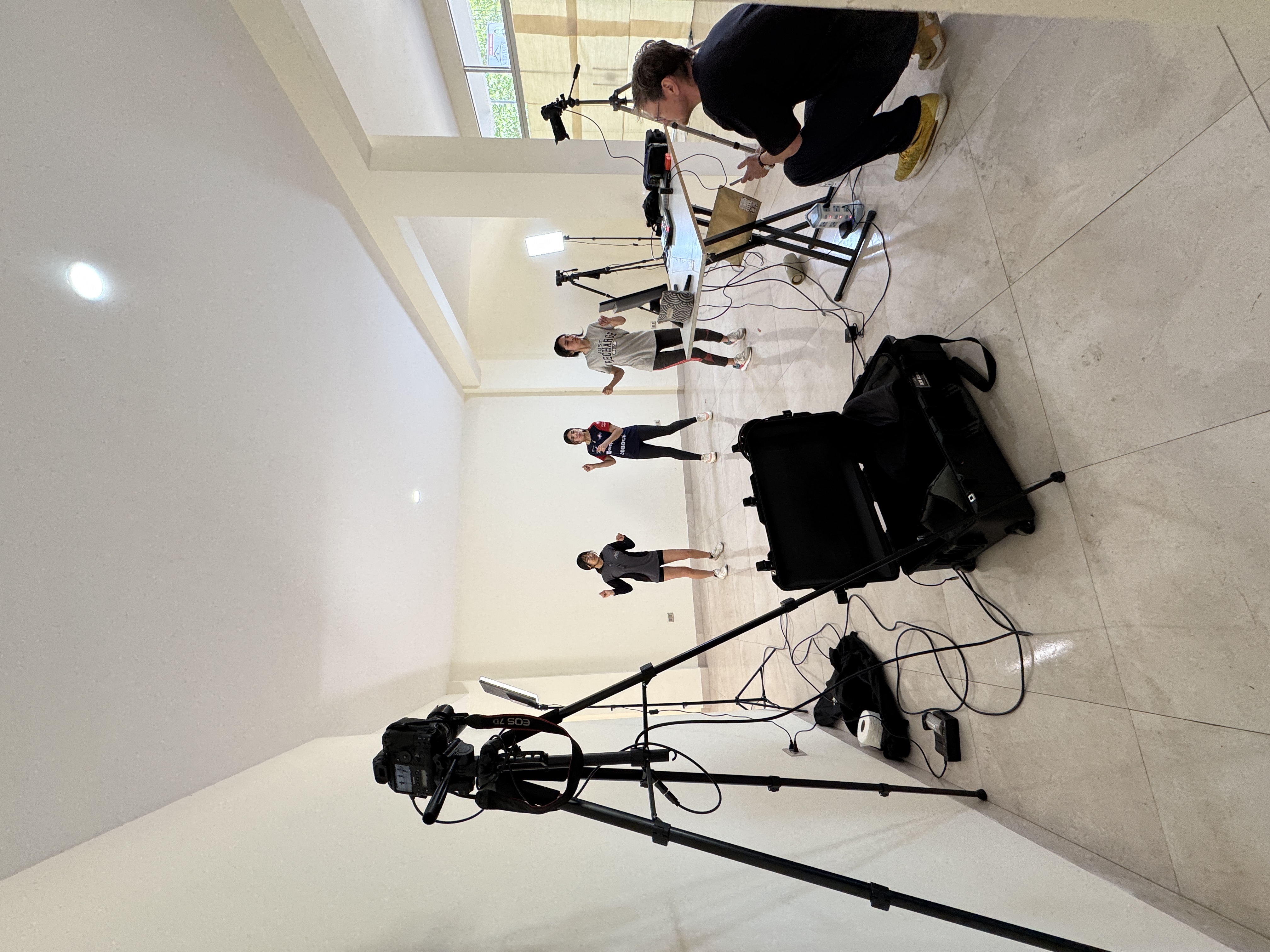
In a capture space in Cochabamba, four calibrated cameras record seven dancers: Camili, Keny, Sean, Galgo, Lu, Ivana and Valentina. They dance Kullawada, Tinku and breaking. The cameras do not record video to show. They record to measure: each body becomes 26 points in space, in metric three dimensions, thirty times per second.
That archive is called Paqarina. It holds 46 takes and about 66 minutes of dance. It is small next to any commercial motion dataset, and it has already produced findings no commercial dataset can produce, because no commercial dataset contains what this one contains.
The music the machine found without listening
The system does not know sound exists. It has never received an audio file. It works only with joint positions in space.
We measured ankle height over time, because feet strike the ground on the beat. In three independent Kullawada takes, the detected pulse was 82.4, 82.3 and 80.4 beats per minute. Three takes, three capture days, under two beats of difference. In the Tinku: 154.0, 154.9 and 155.1.
Pulse detected from ankle height across three independent takes per dance. Breaking does not mark the beat with its feet: its time lives in the music and the torso.
The dancer carries the orchestra in her ankles.
There is more. The movement cycle of the Kullawada, measured from whole-body energy, lasts 66 to 70 frames, with five takes agreeing within two. At 82 beats per minute, one musical beat lasts 17.5 frames. Four beats are 69. The movement cycle is the bar of music, measured by two routes that know nothing of each other.
Recognising without labels
We trained a model from the JEPA family to predict masked movement. We never told it which dance each take was. Then we asked: given any fragment, find the most similar fragment in another take. It names the dance correctly 83.6 per cent of the time. Chance would give 33.
| Dance | Accuracy | |
|---|---|---|
| Kullawada | 90% | |
| Breaking | 77% | |
| Tinku | 68% | |
| Chance | 33% |
The interesting part is what it looks at. Fifty-seven per cent of the variation the model treats as important correlates almost perfectly with one thing: shoulder height. Before any subtlety, a dance is a relationship with the ground.
The model's dominant axis correlates 0.96 with shoulder height. Kullawada standing, Tinku crouched, breaking against the floor.
And a dance's identity lives in the phrase, not the step. With two-second windows the model recognises little. At six seconds it peaks. At eight it starts to drop. A single step does not say which dance it is; the phrase does.
The vocabulary experiment
The cleanest measurement in the project came from an accident. In one Tinku take, one of the two dancers gets bored halfway through and switches to breaking. The other stays in Tinku.
Movement energy of the two bodies. The distance between them barely changes: what breaks is the language.
Synchrony is neither closeness nor moving at the same time. It is speaking the same language with the body. That is now measured.
The Kullawada trio shows the honest version of the same phenomenon: a single shared pattern explains 39.1 per cent of what the three dancers do, barely above the 35.7 of chance. Of 22 eight-second windows, only 2 show a clear shared pulse. They lock in for moments and the rest of the time each dances her own version. The perfect synchrony of a fraternity block is an achievement, never a starting point.
The errors that teach
Here the errors get published, because each one measured something no success would have shown.
For months the Tinku seemed to be recognised at 53 per cent. It was false. Two breaking takes were mislabelled as Tinku and kept finding each other in the evaluation, inflating the number. When the catalogue was corrected, Tinku dropped to 47. Mislabelled material does not lower a result. It raises it, and that is why it is so hard to see. A number that falls when the data gets cleaned is a sign the previous number was wrong.
Then cleaning the tracking raised it to 68 without capturing a single new frame. The two cleanups moved the number in opposite directions and both were right.
We also know exactly where the system breaks. One of Sean's thighs measured 3.05 metres in a floorwork take; its real length is 37 centimetres. The detector loses the body when the body inverts, occludes itself, spins against the floor. The floorwork takes from one August afternoon are between 35 and 64 per cent destroyed, and nearly a minute of healthy stretches was rescued from inside them with surgical cuts. The overhead camera the rig lacks is a finding of the system.
And free generation of new dance does not work yet, and we know why: the ceiling is data. Seventy homogeneous minutes are not enough for a model to invent new Kullawada, and the model said so in four different ways before we believed it. What does work is recombination: the model picks real fragments that splice well, and the result already moves an avatar in Blender, with captured feet and rigid bones.
Why industry does not do this
Commercial motion datasets capture individuals in tight clothing performing generic gestures. Their unit of analysis is a single person.
The dances in this archive have another unit. Kullawada is synchrony: bodies in phase. Tinku is opposition: two bodies coupled by antagonism, each movement answering the other without copying it. Breaking is turns: the cypher alternates and the others respond. Capturing these dances one body at a time captures the trivial half and loses the part that defines them.
Paqarina is governed by the community that dances it. The methods are published in full, this text included. The data belongs to those who produced it with their bodies, carried on Local Contexts labels that record that belonging. The models open up; the archive is cared for.
What comes next: a capture session with more dancers, Tinku first because it is the dance with the least material, capture suits designed with one colour per body segment, and the overhead camera for floorwork. The characters that emerge from this archive will be born with the proportions of the real bodies that danced them.
The dancer carries the orchestra in her ankles. Now there is an archive that can prove it.
Paqarina is a project by United Notions Film and the Koa.xyz lab, within the Mozilla Fellowship 2026–2027. Systems: Dan Fallshaw. 3D: Brian Condori. Dancers: Camili, Keny, Sean, Galgo, Lu, Ivana and Valentina. Measurements reflect the state of the project on 20 August 2026.