Power Analysis
How is a vote found?
Bolivia voted for Lara, they say. That is true, and it explains the matter. A segmentation machine does not manufacture voters. It finds them.
By Violeta Ayala — Tecnóloga
The objection
Every time we publish something about Cerimedo's machine, the same comment lands: Bolivia did not vote for Paz, it voted for Lara.
Yes, and they are right. The thing is that this disproves nothing. If anything, it is the best explanation of how the business works.
Me
Let me use the example I know best, which is mine. And I will start with the important part: I did not vote in that election. I only registered this year, and my first vote was in the regional elections.
This is what reached me, and what I would have decided with it.
What reached me was that Paz would not go to the International Monetary Fund. I liked Lara's swagger against the system. I do not like it when they talk about God, or the machismo, but in the end they all talk about God and I let it go. I could not vote for Tuto: my grandfather was a political prisoner under Banzer's government. Almost nothing about Andrónico came up for me. Samuel bored me.
Of all the bad options, I would have voted for Paz, because I believed him about the Fund and he seemed the most social.
My neighbour voted for Paz too, but for something else: so Evo would not come back. I do not know why she decided against Tuto. My friend voted for Tuto.
Three women, three screens, not one promise in common. That is how a country is left after a segmented campaign: each of us decided on her own, and none of us knows why the other decided as she did.
My neighbour's fear was of someone who was not on the ballot. Evo Morales was barred by the Constitutional Court, and the Supreme Electoral Tribunal left him off the list of eligible candidates.
You could not vote for him or against him. Even so, for an entire segment of the electorate the enemy was called Evo. A real fear does not need to be possible.
The same name served both purposes. Some people voted for Paz so Evo would not come back. And some people voted for Paz because word went round that this was what Evo wanted.
During the runoff, Evo Morales asked for none of that: he said that for his sector there was no second round and that there would be no deal with either candidate. The day after Paz won, he wrote that Paz and Lara won with the evista vote. One name, sold as a threat and as an endorsement at the same time, in the same election.
The majority voted for an unknown with a political pedigree. Son of an exile and former president, Jaime Paz Zamora. Great-nephew of Víctor Paz Estenssoro, the man who gave indigenous Bolivians the right to vote and the agrarian reform. He started his campaign at 1.8 percent.
An unknown with a familiar face is the best material for segmentation: every group, every person, can be shown a different Rodrigo Paz. Those of us looking for someone more social got the photo on the motorbike, with a Che Guevara air, the surname of a father who comes from the left, and his link to Edman Lara, the people's policeman. Those who wanted order but did not trust Tuto because of his past got a Rodrigo Paz in a tie. Every version was true in some way. None was complete.
Edman Lara was a police captain in Santa Cruz. In 2022 he began denouncing police corruption on TikTok. In 2024 he was permanently discharged, with no right to reinstatement. He ended up selling second-hand clothes.
In May 2025 the PDC made him its vice-presidential candidate, after the original one resigned. He arrived with more than 130,000 followers and a story no agency, and no Cerimedo, can invent for you.
His most shared line: we are going to blow up social media with our proposals, we have no money for a campaign, but we do have conviction.
And it worked. La Nación reported that Lara won over even campesinos who used to go with the MAS. A rural leader in La Paz put it this way: the base has gone over to Paz and Lara.
In a campaign debate, Paz was categorical: I am not going to the International Monetary Fund to ask for 12 billion dollars.
On July 29, 2026, an agreement with the International Monetary Fund was announced, for 1.9 billion dollars. Bolivia's first multi-year programme with the institution since 2006. The negotiations were confirmed by José Luis Lupo, the same man Paz, campaigning in opposition, used to criticize as an expert in taking on debt.
I would have voted on a belief. That belief was reversed in eight months.
I cannot prove my screen was designed. That is exactly the problem. Nobody can. I know what I saw, I know what I decided, and I have no way of knowing why I saw that and not something else. In Bolivia there is no law that lets me ask.
What a segmentation machine does
A segmentation machine does not manufacture voters. It finds them.
It measures a country's mood in real time, splits it into groups by what is hurting them that week, and tells the campaign where to press and with which message. Convincing someone to switch sides is expensive and almost never works. Finding the person who is already unsure comes far cheaper.
How a vote is found
Each dot is a person. The system measures everyone's mood and splits them into groups by what hurts them this week. Tap a group and you will see what that group sees.
It costs a lot and almost never works. Convictions do not move because of an ad.
Someone undecided, angry or tired. There is nothing to convince them of. Just reach them first, and with their own thing.
Explanatory diagram of how a segmentation platform works in general. The groups and messages are examples, not data from any specific campaign.
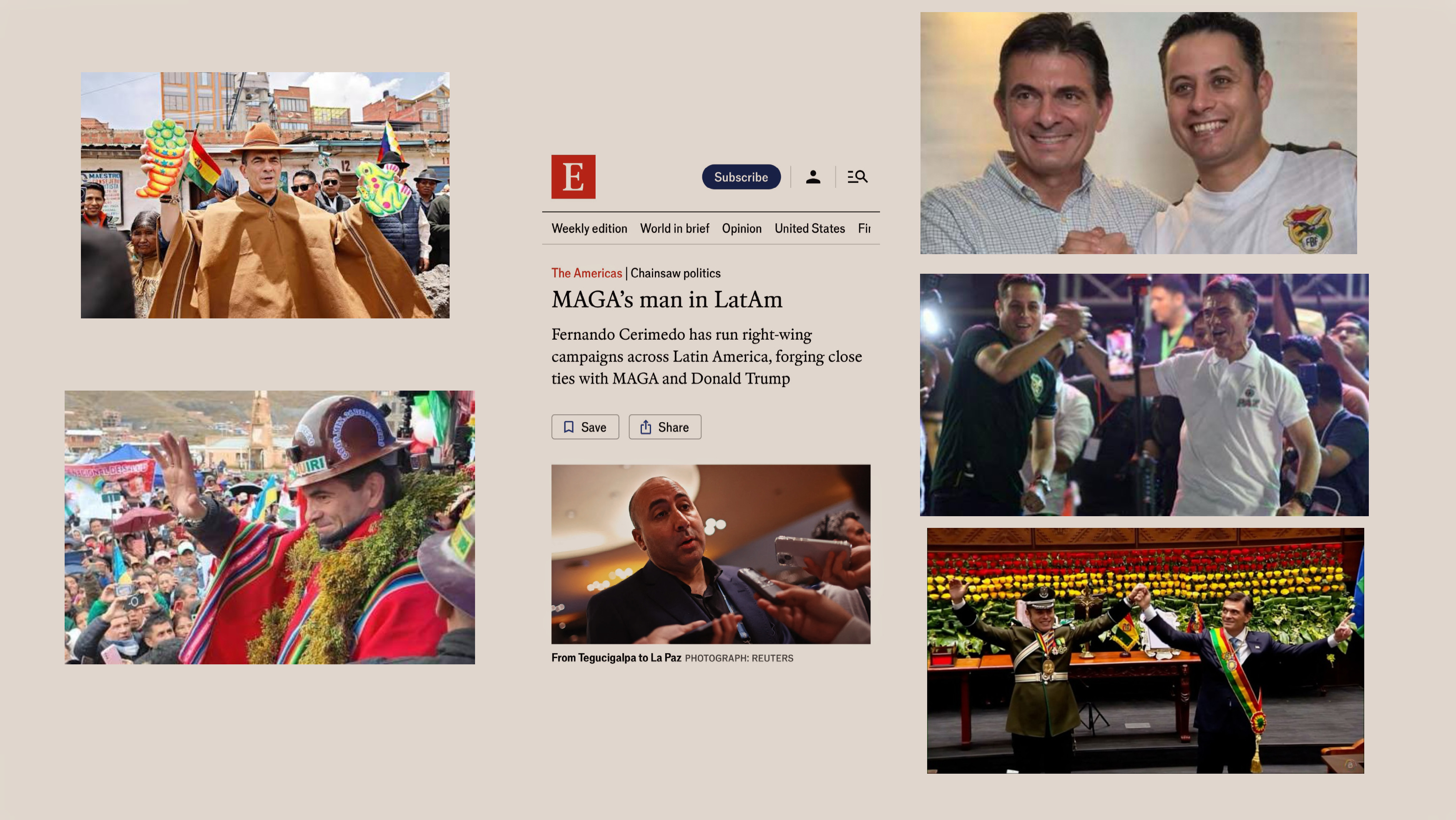
Cerimedo described his own method to The Economist: monitoring conversations and using that information to influence with tailored messages.
In March 2025 he was announced as the exclusive Latin America licensee of Campaign Nucleus and Eyes Over, Brad Parscale's platforms. Eyes Over measures public sentiment with artificial intelligence.
The polls said third
Before August 17, 2025, the final polls placed Rodrigo Paz third, behind Samuel Doria Medina and Jorge Quiroga.
That night he came first with 32.14 percent. Quiroga took 26.81. Doria Medina sank.
Polls today are obsolete. They misread the country. Did the campaign know something the polls did not?
A poll asks a thousand people every two weeks. A sentiment system running on artificial intelligence processes millions of signals every day.
In a talk in December 2025, the campaign's communication strategist, Catalina Paz, the president's daughter, described what they received: daily data on Bolivians. It is the closest thing we have to an official description of the system.
It does not say who produced it, or from what data.
How the two fit together
Lara supplies the emotion. The machine measures it and says where to aim.
A viral phenomenon is raw material, nothing more. Someone has to read which of his videos catches fire in which department, which group is moved by the corruption message and which one needs to be told something else, and when the calm candidate works better than the furious captain.
The campaign put Paz's conciliatory tone together with Lara's fighting drive. Two faces of the same ticket, for two different audiences.
That is already segmentation, with software or without it.
Who was inside
The campaign's social media was run by two people: Catalina Paz and Mike Zalles, a young man who travelled with the candidate. Noticias Fides and El Deber reported it.
Cerimedo was inside with no post and no contract.
In July 2026, the then minister of the presidency, José Luis Lupo, described him this way: he is an adviser to the President, he works directly with him, he is not a public official, he has no office and no parking space, and the Bolivian state does not pay him. He called him an external adviser and accepted the word satellite.
And he said what the man did: he spoke directly with Paz, issued political judgments, and carried out specialized measurements of social media. That is the function, described by the government itself. Lupo could not specify who financed his services.
After the election he coordinated the president's agenda at the CAF International Economic Forum in Panama, and accompanied him to the Shield of the Americas summit.
Who paid him is still unanswered, and there are four versions. The campaign said he worked for free. His lawyer Ernesto Giraldes said he was paid for a consultancy through an agreement with the CAF. The CAF replied that no contractual relationship exists. And Nadia Beller maintained that he draws no salary, that he is paid through contracts the inner circle signs with large companies.
An adviser without a contract leaves no accounting trail. Nor any record of what data he used or where it came from. Before the Bolivian courts, Cerimedo declared income of one million dollars a month.
What is still unknown
This piece does not say the machine won the election. It says the Lara phenomenon and the machine are not competing explanations. Lara explains where the emotion came from. The machine, if it operated as its own owner describes it, explains how that emotion became votes sorted by segment, department and week.
The questions remain three, and they are verifiable: what data was used, where it came from, and who paid for it. The answers sit in the campaign's filings with the Supreme Electoral Tribunal, in the contracts the prosecutor's office has seized, and in the testimony nobody has yet demanded under oath.
If Bolivia voted for Lara, all the better: it means the machine did not manufacture the vote, it found it.
That was always the business. Cambridge Analytica did not invent voters. It found them. Ten years later, the people who hired it appear to be selling the same thing here.
Sources
- The Economist, "MAGA's man in LatAm", December 9, 2025. The method Cerimedo describes of himself, his partnership with Brad Parscale in Numen, and his work in the region.
- Ámbito, March 2025. Announcement of Cerimedo as Latin America representative of the digital platforms used in the Trump campaign.
- Plurinational Electoral Body of Bolivia. First-round results of August 17, 2025: 32.14 percent for the Paz-Lara ticket and 26.81 for Quiroga, and the October 19 runoff.
- On the pre-election polls placing Paz third and on Edman Lara's trajectory: CNN en Español, August 21, 2025; Infobae, August 18, 2025, with his campaign lines; La Nación, October 20, 2025, on the reach of the phenomenon among rural voters previously aligned with the MAS; and CR Hoy, August 20, 2025.
- Catalina Paz, "El arte de conectar", Global Youth Leadership Forum, December 11, 2025, published by Trendsetter Bolivia and reproduced by eju.tv: the campaign account, the unpaid team, and the daily data on Bolivians.
- The campaign's social media run by Catalina Paz and Mike Zalles: Agencia de Noticias Fides y El Deber, September 2025.
- La Razón, July 22, 2026, and El Deber. Statements by the then minister of the presidency José Luis Lupo: external or satellite adviser, with no post, office or state payment, in direct contact with Paz, issuing political judgments and specialized measurements of social media, without specifying who financed his services; and the coordination of the presidential agenda at the CAF forum in Panama.
- The versions on payment: Agencia de Noticias Fides, on the account given by his lawyer Ernesto Giraldes; Red Uno, August 19, 2026, with the CAF rejecting any contractual link; and La Jornada, August 20, 2026, carrying Nadia Beller's statements to El País about contracts with large companies.
- Evan Ellis, "Bolivia's Governance Crisis Under Rodrigo Paz", Center for Strategic and International Studies, June 30, 2026. Report based on interviews in Bolivia between May 20 and 30, 2026: it describes the social media campaign as driven by Catalina Paz and her former Argentine professor Fernando Cerimedo, notes that Paz publicly credited his victory to his daughter's digital campaign, and records that Lara considered his own role in the win decisive.
- Bolivia Verifica. Profile of Cerimedo as Paz's key adviser, his closeness to Milei and the Brazilian case.
- NW Noticias, August 19, 2025. Reconstruction of the campaign plan without jingles or rallies.
- On Evo Morales's position during the runoff: El Comercio and EFE, October 17, 2025, on his statements that for his sector there was no second round and that there would be no deal with either candidate; and La Nación, October 20, 2025, with his later message attributing the Paz-Lara victory to the evista vote. The Supreme Electoral Tribunal recorded 19.87 percent null votes in the first round.
- On the political genealogy: Jaime Paz Zamora, Rodrigo Paz's father, was president between 1989 and 1993 and lived in exile during the dictatorships; he is a nephew of Víctor Paz Estenssoro, who led the 1952 Revolution and under whose government universal suffrage was decreed in July 1952 and the agrarian reform in August 1953.
- CNN en Español, August 13, 2025. Evo Morales barred by the Plurinational Constitutional Court and absent from the list of eligible candidates presented by the Supreme Electoral Tribunal.
- On the reversal regarding the International Monetary Fund: Visión 360 and EFE, August 3, 2026, on the 1.9 billion dollar agreement announced on July 29 and the campaign position; and Contacto Sur, May 2026, with the verbatim quote from the campaign debate and the confirmation of negotiations by José Luis Lupo.
This piece describes what a segmentation platform does, what the campaign itself said about the data it received, and what is documented about Fernando Cerimedo's presence. It does not claim that this platform was used in the Bolivian election, nor that the election was won because of it: that is not proven and this piece does not prove it. Cerimedo is charged in Bolivia over matters unrelated to this subject and the presumption of innocence applies. The first-person section is the author's testimony about what reached her screen during the 2025 campaign, offered as illustration. The author was not on the electoral roll for that election and did not vote in it; her preference is stated in the conditional and declared as such in the text. That testimony is not evidence that her feed was segmented by any campaign. The questions of what data was used, where it came from and who paid for it remain open, and the answers sit in records that can be requested. The income figure mentioned comes from Cerimedo's own declaration before the Bolivian courts, per Argentine press coverage, and has not been independently verified.