Power Analysis
From tin to lithium, the same decree.
By Violeta Ayala — Tecnóloga
Memory of the exception
Every time the State declared a siege, who was it against?
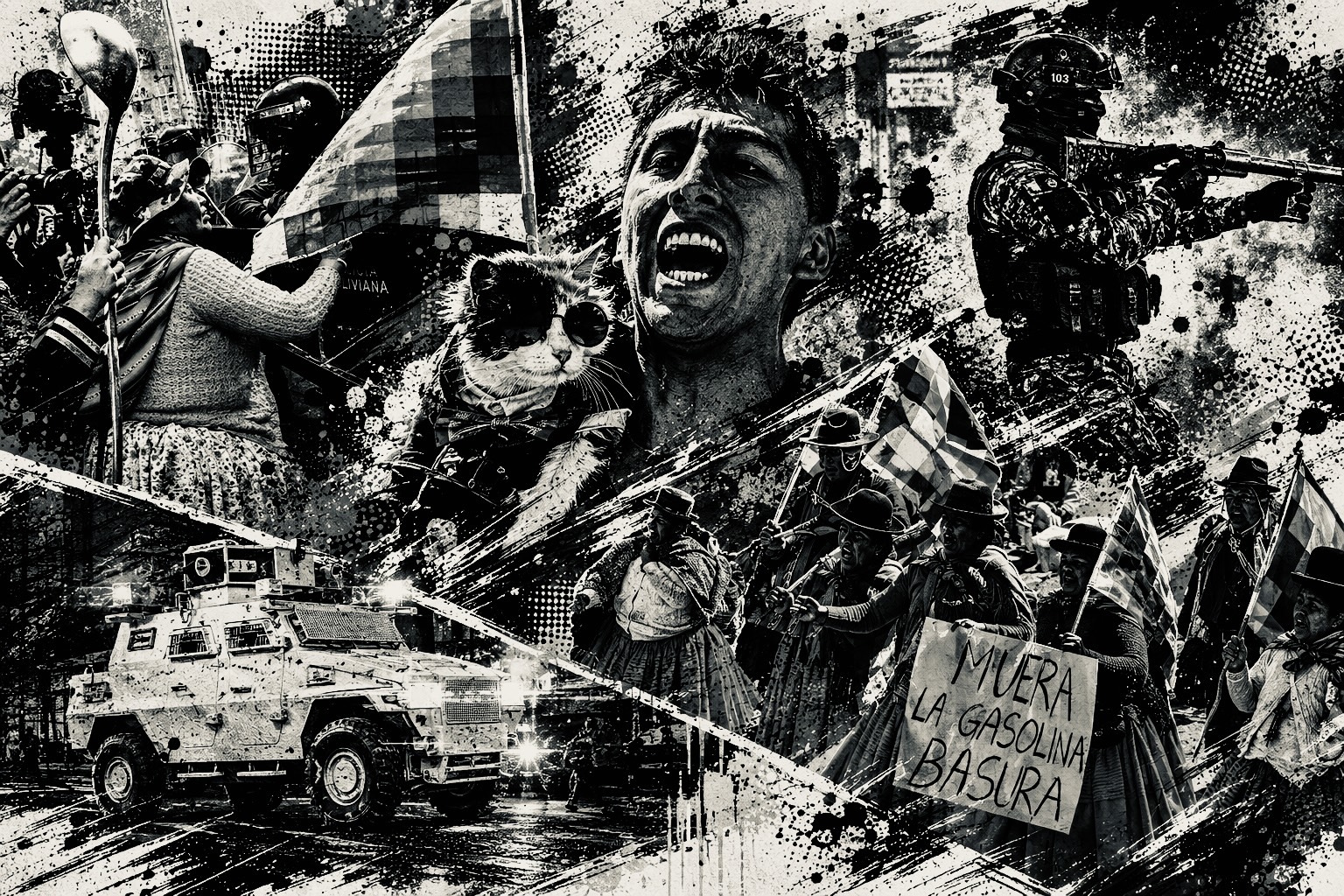
From the mining massacres to the Water War, the state of siege in Bolivia was almost never raised against an external enemy. It was raised against miners, teachers, farmers, and those defending their water. This is the timeline. And how each one ended.
What it is
The State's most extreme tool.
A state of siege is the suspension of constitutional guarantees. While it lasts, power concentrates, soldiers take the streets, and detentions without a warrant, confinements, and curfews become permitted. It is the closest a State at peace can come to a state of war against its own population.
In Bolivia it was a habit. The 19th century lived in chronic instability: coups, caudillos, and revolts almost without pause. The exception was not the exception, it was the method. The 20th century gave it a name and a decree. The question that matters is not how many times it was declared. It is against whom, and how it ended.
Interactive timeline
How each one began and ended.
Tap a card to see why it was declared and how it ended.
Analysis
The pattern is not chance. It is structure.
Seen together, the eleven cases stop being isolated facts and become a system. Five patterns repeat from Barrientos to Paz.
How each one ended · 11 cases
Tap a bar to filter the timeline by that outcome. Among those already closed, as many ended by crushing the protest as by dragging down the government that declared it.
What is different today
The method is the same. What is at stake is not.
Every state of siege on this list enforced an economic decision by force, but over one resource at a time: tin, water, gas. The one declared this morning is born of a real crisis. But it lands in a moment unlike any before it.
The technological revolution turned a group of minerals into the most contested resource on the planet. Artificial intelligence, batteries, defense, and the energy transition all run on lithium, rare earths, gallium, germanium, indium. Bolivia has documented presence in 48 of the 60 the United States considers critical. Never, in two hundred years, has the Bolivian subsoil been worth this much.
And right on top of that portfolio sits a Memorandum of Understanding signed on April 27 whose text is still secret. Six weeks later, the military backing and the word narcoterrorism. Today, the state of exception. You do not need to prove that one caused the other to read the pattern that runs through this history: the exception always appeared where there was a resource to impose and a population that refused. Before, the resource was one. Today there are 48, and they are worth more than ever.
That is what changed. The exception no longer protects a raw material. It protects a position in the supply chain of the AI era, at the exact moment that position became decisive. And there is only one thing that is different in the people's favor: the exception's oldest ally was always darkness. That darkness, for the first time, can be broken from below. What cannot be seen cannot be questioned. That is why this exists.
What the list teaches
The state of siege almost never defended the people. It disciplined them.
Look back at the outcomes. Most of the time, the exception aimed inward: at miners refusing their dismissal, teachers on strike, farmers marching, neighbors defending their water. Almost never at an enemy from outside.
When it worked, what it broke was a legitimate protest. In 1985 and 1986 it sealed the defeat of the mining movement. When it did not work, the people won anyway: in 2000, despite the siege, Cochabamba expelled Bechtel and recovered its water. And sometimes it backfired: the government that militarized the street ended up falling.
The figure changed its name with the 2009 Constitution. Today it is called a state of exception and needs the Assembly's approval within 72 hours. For 18 years none was declared. The streak broke in the early hours of this Saturday, June 20, 2026: Rodrigo Paz decreed a state of exception across the country. And he did it against the same target as always, farmers, Indigenous people, and coca growers, with the same word that runs through this history: narcoterrorism.
The state of exception is not declared against those who hold power. It is declared against those who get in the way of their business.
That is the lesson, and it has just repeated in real time. While agreements over minerals are signed with no public text and those who protest are called “narcoterrorists,” history remembers who was always the real target of the exception. Not the one who signs. The one who gets in the way. This time, the ending is still being written.