Power Analysis with service
They hid my community from me
Instagram has limited political content by default since March 2024, and calls political any social topic affecting a group of people. I changed one setting and the marches came back, and my friends, and the world. None of it had stopped existing.
By Violeta Ayala — Tecnóloga Creativa
What I stopped seeing
This week I cleaned out my Instagram algorithm, went in to look at the result, and the first thing that came up was people in the street demanding an end to the genocide in Gaza, in several cities, this week, right now.
I sat staring at the screen for a long while, because for months I had come to believe that this barely happened any more, that people had got tired, that the subject had dropped out of the world.
People never stopped marching. What had changed was my screen.
The setting
This is not a theory or a hunch. Instagram limits political content by default, its head Adam Mosseri announced it on February 9, 2024, and it began rolling out in March of that year.
The app stopped recommending political content from accounts you do not follow, and the setting arrived switched on. There was no in-app notice. One day your configuration was already set to limit, without anyone asking you.
The definition is what makes this enormous. Instagram calls political content anything likely to mention governments, elections, or social topics that affect a group of people or society at large.
Meta refused to say more. Under that definition, a genocide is a social topic. A march is a social topic. Water, land, a trial, a mining law, all of it is a social topic.
Instagram's February 2024 announcement and coverage by NPR, Variety, Time, TechCrunch and Ars Technica between February and April of that year.
Why my feed emptied out
The limit does not erase the accounts you follow. That is the detail that makes it so hard to notice.
I was following the same people as always. Their posts were there, somewhere, in a feed of a thousand accounts where nothing guarantees anything reaches you. What disappeared was the other channel, the recommendations, which is where you find out something is still happening even when you know nobody who is reporting it.
That is how the sense that a subject has died gets built. Nothing needs to be censored and no post needs to come down.
It is enough to stop suggesting. The march exists, the photo exists, the account that posted it exists, and you never see it.
That is the cheapest way to switch off a subject, it is legal, and it was announced in a corporate blog post nobody read.
What went dark on my phone was not the protest. It was my way of knowing the protest was still going.
The two channels of your feed
Tap each state to see what reaches you.
Explanatory diagram. Instagram's political content limit does not affect accounts you already follow; it switches off recommendations from accounts you do not follow, which is where you find out about what you did not know was happening.
The proof arrived on Tuesday
On September 15, 2026, Ed Sheeran's North and South American tour was left without support acts. All four walked on the same day.
It started with Macklemore, who, opening for Sheeran in New Jersey, gave a speech calling for all human beings to be treated with dignity, respect and equality. The Israeli-American Council called for his removal, claiming he was using his platform to advance a one-sided political agenda. Macklemore was dropped from the tour.
Sheeran posted on social media that the decision had been the tour promoters'. Hours later the Irish acts Aaron Rowe and Beoga, the Danish band Lukas Graham, and Finneas, Billie Eilish's brother and musical collaborator, all walked.
Beoga was not only a support act: the band played several songs alongside Sheeran in the middle of each show, some of which they co-wrote.
Finneas wrote it on Instagram: artists must not be silenced when they speak up for the oppressed. He had decided to withdraw from his upcoming dates with Ed Sheeran. He stands with Palestine and its people.
Beoga said it from their own history: they are Irish people who understand colonialism, and as founding members of the Irish Artists for Palestine movement, they are committed activists for justice and will continue to be.
Look at the mechanism, because it is the same one as on my phone, at another scale.
No government censored Macklemore. A promoter dropped him. Nobody deleted the Gaza posts from my account. They simply stopped being suggested. In both cases the speech exists, the artist exists, the photo exists, and what closes is the channel.
There is the answer to what I believed. Four artists walked off a stadium tour in a single day.
That is what people who have not got tired look like. I was not seeing it because my phone had decided it did not interest me.
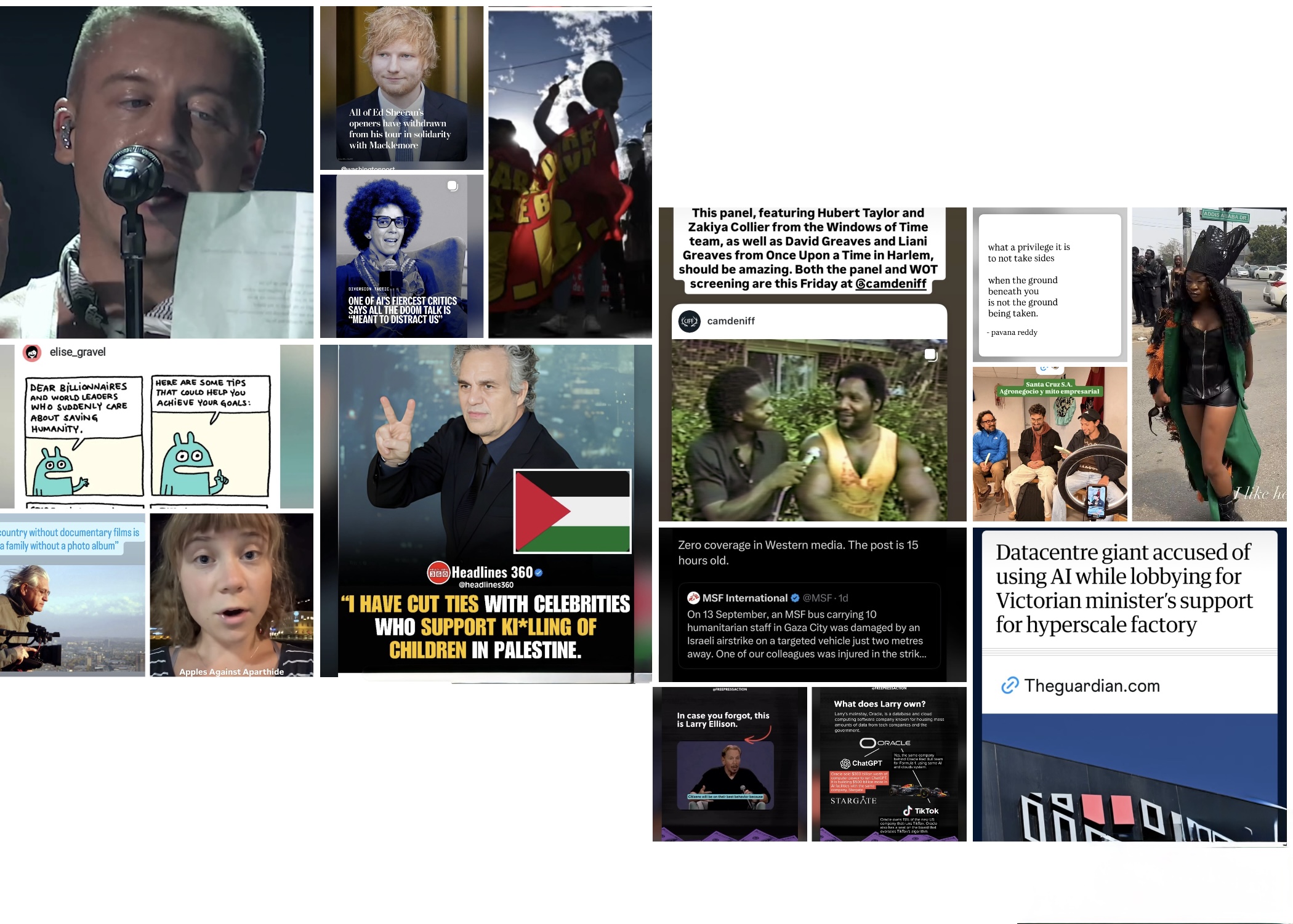
My feed today
One day after touching that setting, I opened the app and wrote down what came up. It is not a scientific sample, it is what I saw.
Screenshots taken on September 16, 2026, the day after the setting was changed. This piece describes what appeared on screen and does not verify the content of each post.
Look at the dates. The MSF bus was the 13th. Macklemore spoke on the 14th. The support acts walked on the 15th. The march in La Paz was on the Reuters wire.
None of this is new, none of it happened because I pressed a button. All of it was going on anyway, in the same world, while I was looking at a different screen.
Now look at what those posts are about. Datacentres, algorithms, who owns what, Bolivian agribusiness, workers in La Paz, documentary makers talking about archives.
That is literally my job. For months the system was hiding from a journalist the news on her own beat, and it did so without deleting anything, without blocking anyone and without breaking a single rule.
There is one post in that list that sums up everything, and it is Assal Rad's about the MSF bus: zero coverage in Western media, the post is fifteen hours old.
The same mechanism, one level up. The event happens, the organisation publishes it, and the channel that was supposed to carry it does not. Nobody banned it. It simply did not arrive.
There is something else in those screenshots that took me a while to see, because I was looking for news. They are not only news. They are my friends.
People I know, people I have worked with, documentary makers, researchers, musicians, organisers. Each of them fighting from wherever they can. All of them there, all of them still going, all of them still caring.
The algorithm did not only hide the news from me. It hid my people.
And with that it made me believe I was the only one still watching. That is the part I find hardest to forgive, because I did not invent that loneliness. It was served to me on a screen.
How to switch it back on
It takes thirty seconds to fix and it is the most important setting you will touch on your phone this year.
Stop limiting political content
Route verified in September 2026. Menus change often.
-
- Go to your profile and open the three-line menu, top right.
- Tap Settings and activity.
- Scroll down to Content preferences.
- At the bottom of the list, open Political content.
- Choose Don't limit political content from people you don't follow.
The same setting applies to Threads. Check it again in a few weeks: some users reported it reverting on its own to the default.
-
- In Content preferences, open Your Algorithm and review the topics the system thinks matter to you. Ask for more of what you want and remove what you do not.
- On the home screen, tap the word Instagram top left and choose Following or Favourites to see only the accounts you picked.
- In Your activity, switch on the daily limit if you want to measure how long you spend there.
None of these options comes switched on. All of them sit three or four submenus away.
I was not the only one
In April 2024, hundreds of creators convened by the organisations GLAAD and Accountable Tech signed an open letter asking Instagram to make that limit opt-in rather than switched on by default.
The letter's argument is the same one I found on my own screen this week: many of those people produce content that helps others understand what is happening, and the setting cuts down their ability to reach anyone who does not already follow them.
Users also reported that the setting reverted on its own after they had changed it, with no explanation.
Meta never responded to that publicly. In January 2025 the company announced it would phase political content back in, without saying how or when the process would end.
Here
Think about what that definition means in a country like ours. Governments, elections and social topics that affect a group of people.
A road blockade is a social topic. A mining cooperative is a social topic. Diesel, the dollar, a vigil of members at the door of their own cooperative, all of it fits inside, and all of it stops being suggested to anyone who does not already follow someone reporting it.
Nine million Bolivians use the internet and we spend three hours and twenty-six minutes a day on social media, an hour more than the world average. We have no data protection law and no rules at all on this.
The decision about what counts as political was made by a company in California, with a definition it refused to specify, and applied by default on everyone's phone.
Clean out your feed. On every platform.
Not because it will fix the world, but because for months I believed people had stopped taking to the streets, and it was not true. Thirty seconds in a submenu gave me back a piece of reality I did not even know I had lost.
Sources
- Adam Mosseri's announcement of February 9, 2024, and Meta's post that same month on ending political content recommendations on Instagram and Threads.
- NPR, March 26, 2024: the rollout, the absence of user notification, the definition of political content used by the app, and the route to switch the limit off.
- Variety, February 2024, and Time: the setting's reach across Explore, Reels, feed recommendations and suggested accounts, and its default-on status.
- TechCrunch, April 10, 2024: the open letter from hundreds of creators convened by GLAAD and Accountable Tech asking for the limit to be opt-in.
- TechCrunch, January 2025: Meta's announcement on phasing political content back in.
- Associated Press, September 15, 2026, reporting by Mark Kennedy: Macklemore's removal from Ed Sheeran's tour after his remarks on Palestine, the Israeli-American Council's call for his ouster, Sheeran's attribution of the decision to the promoters, and the withdrawal of Finneas, Aaron Rowe, Beoga and Lukas Graham, with their statements on Instagram.
- NME and Just Jared, September 15, 2026: coverage of the withdrawal of the support acts and the backing band from the tour.
- DataReportal, Digital 2025 report on Bolivia: nine million internet users and three hours twenty-six minutes daily on social media.
The first-person account describes what the author observed on her own account after changing her settings, and does not constitute a measurement of the system's behaviour for other users. The political content limit described is a feature publicly announced by Meta, with the characteristics and dates cited; this piece does not claim that Meta suppressed specific content about any particular conflict, nor that the setting responds to an intention other than the one the company declared. The use of the term genocide reflects sala.red's editorial position and the words of the people quoted; the International Court of Justice is hearing a case on the application of the Convention on the Prevention and Punishment of the Crime of Genocide in Gaza and has issued no merits judgment as this edition closed. The menu routes correspond to September 2026 and platforms change them frequently.