Power Analysis
Who controls AI?
Behind every answer there are people who almost never appear and never get paid.
By Jasmin Jiménez Gonzales — Psicología, Tecnología, cultura e IA
Part two. In the first we saw that an AI learns by looking at thousands of examples. Now the question that follows: where do those examples come from.
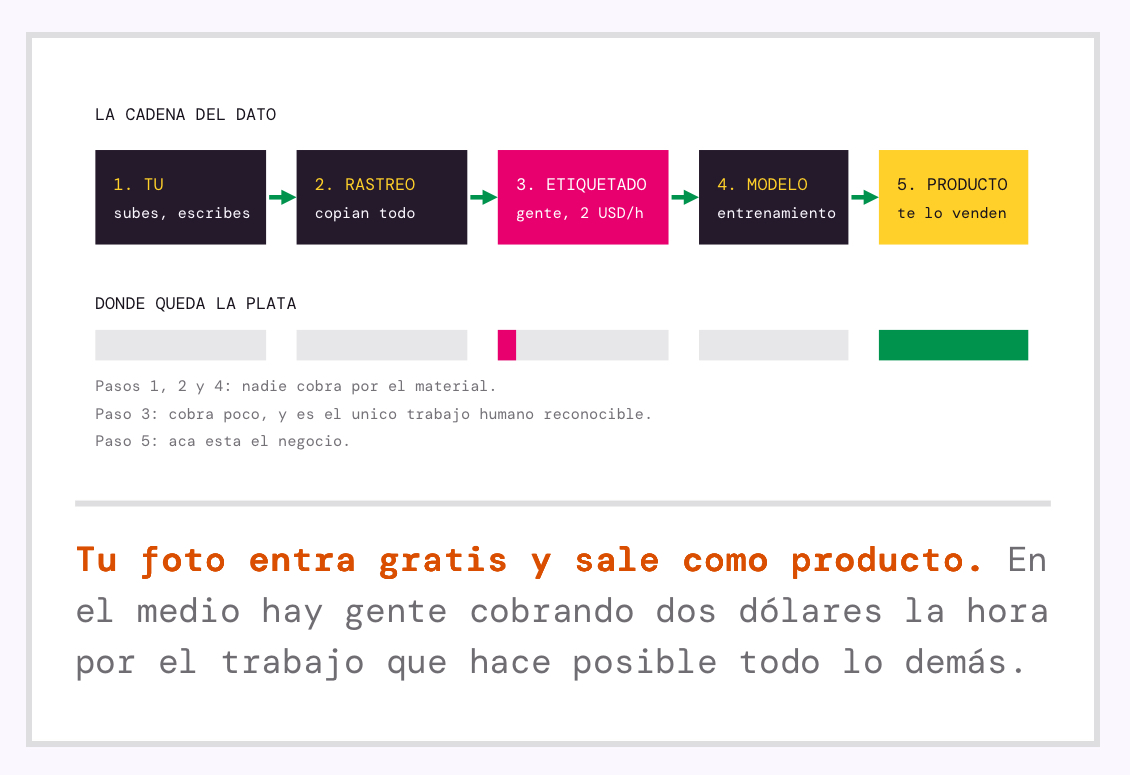
When you ask an AI something it looks like it answers on its own. It does not. Behind that answer there is a chain of people, and it is worth knowing who stands at each link.
It starts with you. Today, without noticing, you produced data. A photo. A voice note. A comment. A search. A like. Every one of those is material that can train a machine.
The word data sounds like spreadsheets and numbers. A datum is anything that can be stored and counted. Your voice is data. Your face is data. What you typed in Quechua in a chat is data, and fairly valuable data, because barely any of it exists.
Is this data?
Tap each one and see where it ends up.
Tester
Things you do every day.
Tap one.
You produce data every day. Nobody pays you for it and you almost never decide who uses it.
Where it got everything it knows
The big models learned by reading and looking at the internet. Millions of pages, photos, videos and conversations, collected automatically by programs called .
So the question shifts. It is no longer what the AI knows. It is what was on the internet when they trained it.
The world is not even
This is what is published, measured in June 2026 across the most visited websites on the planet.
Web content by language
Share of websites in each language. Source: W3Techs, June 2026.
Quechua has between eight and ten million speakers, more than several European languages with a strong online presence. It does not register in the measurement. Neither does Aymara.
A language with millions of speakers and no digital material is invisible to any model.
And who assembled that data?
Here comes the part almost nobody tells.
Material scraped off the internet arrives dirty and disordered. Somebody has to review it, label it and strip out what is unusable. That somebody is a person, not an algorithm.
In 2023, a TIME investigation revealed that OpenAI outsourced to the firm Sama the labelling of toxic content used to train the ChatGPT filters. The workers were in Kenya and were paid between 1.32 and 2 dollars an hour, reading descriptions of violence and abuse all day long.
That chain is still running. Workers in Kenya, India, the Philippines and Venezuela label data, rate answers and moderate content for the models you use. Without that human labour the AI does not work, and it almost never appears in the picture.
Your photo goes in free and comes out as a product. In the middle there are people earning two dollars an hour for the work that makes everything else possible.
What of Bolivia is in there
Try each one and see what a model would find.
Gap finder
What material exists online on each topic.
Pick a topic.
The pattern repeats. Whatever outsiders photographed exists. Whatever is lived here every day and nobody uploaded does not exist for the machine.
Data has an owner
If your community records its songs, its weaving or its language, that has value. And three things need deciding before anything gets uploaded.
Uploading everything openly with no prior agreement resembles what already happened with music, with weaving and with plants. The material leaves the country and returns as somebody else’s product.
What you can actually do
No permission from anyone required, and no engineering degree.
- Record your grandmother talking. Ordinary conversation, half an hour, decent audio. That is data that exists nowhere in the world.
- Photograph the ordinary. The market, the kitchen, the everyday aguayo. The postcard shots already exist. The normal ones do not.
- Write in your language online. A comment, a post, a subtitle. Every piece of text in Quechua or Aymara adds to what exists.
- Always note what it is. A file with no description is close to useless. What, who, where, when. That is called metadata and it is what makes the file usable.
- Agree the rules first. With whoever appears in the photo and with the community. In writing, however simple.
So who runs it?
Not one person. Five groups, with very unequal power.
Those of us producing the material, unpaid and with almost no say. Those who collect it with crawlers, without asking. Those who label it, by the hour and for coins. Those who train the models, a handful of companies with the money to do it. And those who set the rules, who so far are the same companies.
AI is not run by a machine. It is run by people’s decisions, and almost none of them are taken here.
Artificial intelligence knows nothing that somebody did not hand it. Everything it knows came from a person, somewhere, almost always unpaid. What we upload is the only thing it will ever know about us.
- Who controls artificial intelligence?
- What happens if Bolivia does not create its own data?
- Can we build our own technology?
Jasmin Jiménez Gonzales.
Psychology student, 26, Cochabamba. Quechua.
She works at the crossing of psychology, technology, culture and artificial intelligence.
Production and interactive development: sala.red.
Sources: W3Techs, web content by language, June 2026. TIME, investigation into Sama data labellers in Kenya, January 2023. Ethnologue, Quechua speakers.
Share
Link copied.