Power Lithium
sala.red asks Washington for the memorandum Bolivia does not show
Bolivia signs a critical minerals memorandum with the United States on 27 April. The text is not public. sala.red requests it under the Freedom of Information Act. Request F-2027-04840.
By Violeta Ayala — Tecnóloga Creativa
Bolivia signs a critical minerals memorandum with the United States. Neither government shows the text. sala.red asks Washington for it.
The request goes out on 22 November 2026 under the US Freedom of Information Act, FOIA. The State Department acknowledges it the same day and gives it a number.
To: US Department of State
Number: F-2027-04840
Item 1: the full signed text of the memorandum, in English and Spanish, with annexes and side letters
Item 2: the Department's decision on whether the memorandum qualifies under the Case-Zablocki Act
Also: expedited processing and a fee waiver
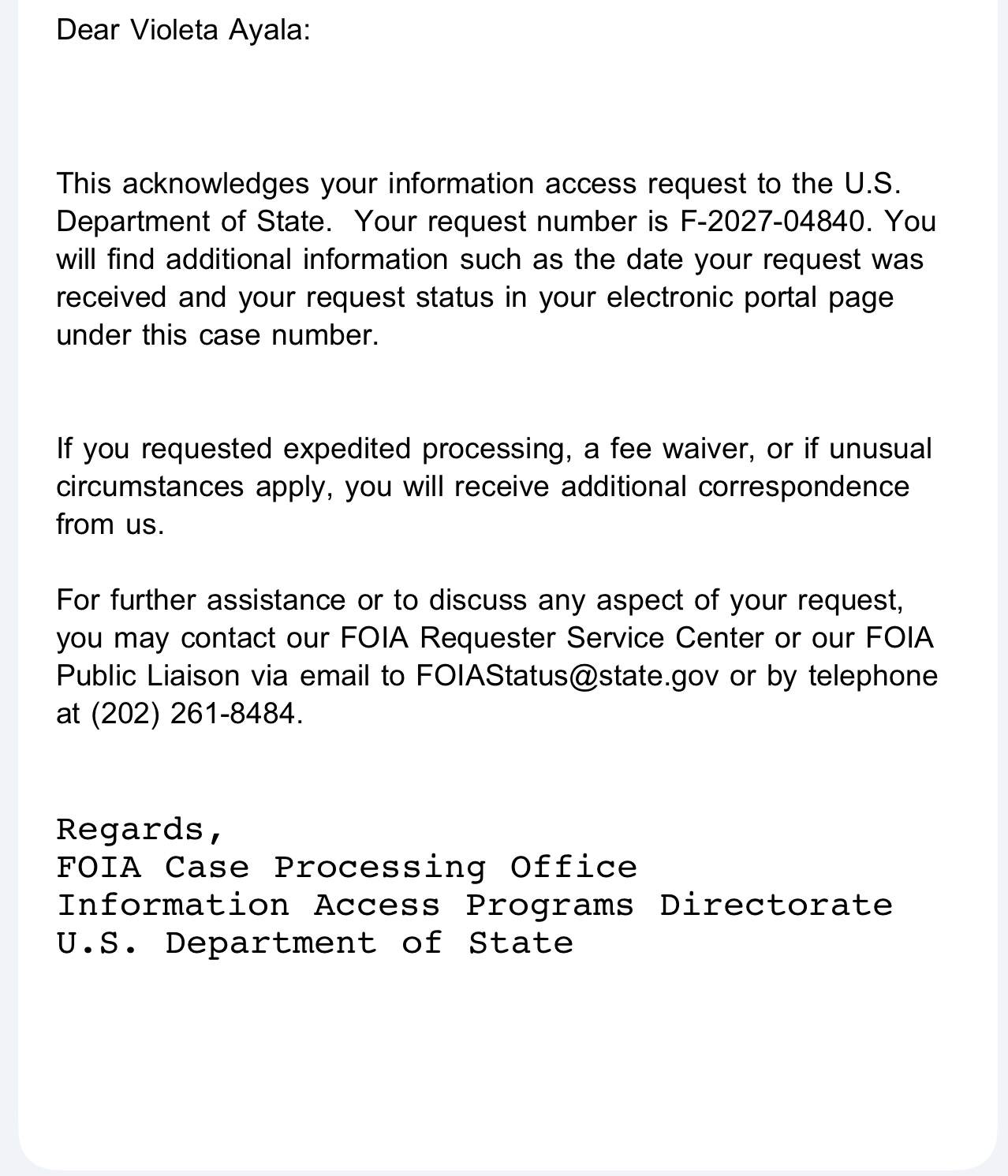
Dear Violeta Ayala:
This acknowledges your information access request to the U.S. Department of State. Your request number is F-2027-04840. You will find additional information such as the date your request was received and your request status in your electronic portal page under this case number.
If you requested expedited processing, a fee waiver, or if unusual circumstances apply, you will receive additional correspondence from us.
For further assistance or to discuss any aspect of your request, you may contact our FOIA Requester Service Center or our FOIA Public Liaison via email to [email protected] or by telephone at (202) 261-8484.
Regards,
FOIA Case Processing Office
Information Access Programs Directorate
U.S. Department of State
What does Bolivia sign?
On 27 April 2026, in Washington, Mining Minister Marco Antonio Calderón de la Barca signs a memorandum of understanding on critical minerals. Caleb Orr, Assistant Secretary of State for Economic, Energy and Business Affairs, signs for the United States.
What is public is a post on X from Orr's bureau. It says they sign, they discuss cooperation, and the United States commits to working with Bolivia to bring investment and secure supply chains.
The text is unpublished. In August, the Global Trade Watch tracker lists it as announced, with no text. In September, the Oakland Institute writes that neither government has made the terms public.
The United States keeps a list of 60 critical minerals. The sala.red map locates 47 in Bolivian territory. Lithium is one.
Why ask in Washington?
FOIA lets any person request documents from the US government. There is no need to be a citizen of that country. The request is made through a web form.
Do they have to answer?
Yes. The law requires it.
The State Department has 20 working days to decide whether to comply with the request and to give notice with its reasons. In circumstances the law calls unusual, the deadline rises to 30 working days, with written notice. sala.red asks for expedited processing. That part is decided within 10 calendar days.
Practice is different. In 2025 the Department takes an average of 10 working days on simple requests and 270 working days on complex ones.
If the legal deadline passes with no decision, the law treats the administrative route as exhausted. That opens the door to a lawsuit in a US federal court.
Answering and handing over are different things. The law has nine exemptions. The first covers classified national security information. Another covers internal communications between agencies. If the Department refuses the text or redacts parts, it has to say which exemption it uses.
A refusal can be appealed, free of charge, with at least 90 days to file. After that there is mediation at OGIS, an office of the National Archives.
There is another request in the same queue. Global Trade Watch asks under FOIA for the list of countries and the text of all the critical minerals memoranda.
What do the readable memoranda carry?
A memorandum like this sets who gets to look first.
Malaysia. The White House publishes the text on 26 October 2025. It runs to about 900 words. The parties work in good faith to prioritise US investment in critical minerals assets sold in Malaysia or held by companies based there. They discuss streamlining permits. They agree to strengthen the review of asset sales. They foresee a pricing framework that may include price floors. The text says it is not legally binding. Either party ends it with a diplomatic note.
Colombia. Foreign Minister Omar Bula and Secretary of State Marco Rubio sign on 8 September 2026 in Barranquilla. The government does not show the text. On 29 October, La Silla Vacía confirms the authenticity of a four-page copy posted by Senator Kevin Gómez Paz. It carries a first look clause: Colombia notifies the United States in advance of investment opportunities in critical minerals. Both countries commit to speeding up, simplifying and deregulating mining permits. Within six months they intend to adopt financing measures. A lawyer challenges the memorandum before the Constitutional Court. He argues that it works as a treaty and had to go through Congress.
| Clause | Malaysia | Colombia | Bolivia |
|---|---|---|---|
| Priority or advance notice to the US on mining assets | Yes | Yes | ? |
| Faster permits | Yes | Yes | ? |
| Review of asset sales | Yes | No data | ? |
| Possible price floors | Yes | No data | ? |
| Text released by the government | Yes | No, it leaks | No |
sala.red does not know whether the Bolivian text carries these clauses. That is why it asks for it.
What does the Perry paper say?
In October 2026 the Perry Center publishes a paper on Bolivia's critical minerals and US national security. The centre belongs to the US National Defense University. The author, Ryan Cristiano, is a former Army aviation officer and an intern at the centre. The paper states that the views are his and not the government's.
It says Bolivia holds about 24% of the world's lithium resources and produces less than 1%. It says China refines about 73% of the world's lithium and the United States imports more than half of what it uses. It adds antimony. It is in about 30% of US military ammunition, and Bolivia has the world's third-largest reserves.
It recommends four things:
- Exchange ambassadors. There has been no US ambassador in Bolivia since 2008.
- Assess engagement with the Bolivian military. Pursue joint training for a Civil Affairs battalion. Carry out "civil reconnaissance" and engagement in the salt flats.
- Bring Bolivian officers and officials to Perry Center courses. Help Bolivia write a national security or defence strategy.
- Use the DFC, EXIM and the Department of War's Office of Strategic Capital to underwrite investment risk.
The paper notes the visit of Major General Philip J. Ryan. It describes him as the highest-ranking US military official to visit Bolivia since 2006.
The paper does not mention the 27 April memorandum.
What happens after the signing?
- Bolivia and the United States sign the memorandum in Washington.
- Protests and road blockades begin against the government of Rodrigo Paz.
- US Secretary of War Pete Hegseth writes on X that his department rejects any attempt to overthrow the Paz government. He speaks of "narco-terrorists". Al Jazeera notes that many of the protesters are teachers, miners, farmers and union workers. That day Secretary of State Marco Rubio promises Paz emergency assistance and logistics support.
- Paz signs Law 1740, which regulates states of exception.
- Paz declares a nationwide state of exception with Supreme Decree 5636. The government statement speaks of a coup attempt by "narcoterrorismo". Infobae counts 16 dead up to that day.
- The Legislative Assembly approves the state of exception with more than two thirds.
- The Assembly approves a 90-day extension, with 100 votes. The state of exception stays in force until the second week of December.
Between the signing of the memorandum and Hegseth's post, 38 days pass. The Assembly votes on the state of exception in one day and extends it in September. The text of the memorandum remains unpublished.
Does it have to be published?
Global Trade Watch counts 15 critical minerals memoranda since 2025. Fewer than half are fully public. The US government releases two. The rest are known because the other country shows them.
The US Case-Zablocki Act changes in 2023. Since then, the State Department posts on its website the text of the non-binding instruments that qualify. The deadline is 120 days from the moment the instrument becomes operative. There are exceptions, classified information among them. If the Bolivian memorandum qualifies and operates from signature, day 120 is 25 August 2026.
The US Government Accountability Office reviews compliance in June 2026. It estimates that 78% of these instruments are published within the deadline.
What can be read in Bolivia?
Article 158 of the Constitution says the Legislative Assembly approves contracts of public interest on natural resources and strategic areas.
The lithium contracts with the Chinese consortium CBC and with Russia's Uranium One are signed in November 2024. Their texts circulate: the CBC contract has 250 pages and the most complete Uranium One contract has 145. In July 2026 they still lack approval in the Assembly.
The contracts with China and Russia can be read. They are stuck in the Assembly.
The memorandum with the United States is signed. It cannot be read.
Request F-2027-04840 is in the queue. sala.red will publish what arrives.
How this story was made
sala.red does not have the text of the memorandum between Bolivia and the United States. The Colombian clauses are described as reported by La Silla Vacía, which confirms the document's authenticity. The Perry Center paper is cited with its disclaimer: it expresses its author's views. sala.red files FOIA request F-2027-04840 on 22 November 2026 through the FOIA.gov portal and will publish the response.
Sources
- State Department acknowledgement to sala.red, 22 November 2026, request F-2027-04840.
- State Department, Bureau of Economic and Business Affairs, post on X, 27 April 2026: x.com/EconAtState
- Global Trade Watch, map of critical minerals instruments, August 2026: gtwaction.org
- Oakland Institute, Trump, Paz, and Lithium: oaklandinstitute.org
- sala.red, Bolivia's critical minerals, part 2: sala.red
- US Office of Government Information Services, on who can use FOIA: archives.gov
- FOIA.gov, frequently asked questions, on exemptions, appeals and mediation: foia.gov
- State Department, how to make a FOIA request and expedited processing: foia.state.gov
- US Court of Appeals for the D.C. Circuit, CREW v. FEC, on the 20 and 30 working day deadlines and exhaustion of administrative remedies: justia.com
- Department of Justice, guidance on FOIA response letters, 90-day appeal period: usdoj.gov
- FOIA.gov, State Department page and 2025 average processing times: foia.gov
- US-Malaysia memorandum, official text, 26 October 2025: govinfo.gov
- La Silla Vacía, 29 October 2026, on the Colombia-US memorandum: lasillavacia.com
- IFM Noticias, challenge before Colombia's Constitutional Court: ifmnoticias.com
- Perry Center, Critical Minerals in Bolivia: Opportunities and Implications for U.S. National Security, October 2026: wjpcenter.org
- Pete Hegseth, Secretary of War, post on X, 4 June 2026: x.com/SecWar
- Al Jazeera, 4 June 2026: aljazeera.com
- France 24, 5 June 2026, on Rubio's call: france24.com
- Infobae, 8 June 2026, on Law 1740: infobae.com
- Bolivian Ministry of Defence, statement of 20 June 2026: mindef.gob.bo
- Infobae, 20 June 2026, on the state of exception: infobae.com
- El Deber, 20 June 2026, on the days of conflict: eldeber.com.bo
- La Razón, 21 June 2026, on the Assembly vote and DS 5636: larazon.bo
- El Periodista, 17 September 2026, on the extension of the state of exception: elperiodista.cl
- Vértigo Político, 17 September 2026, on the length of the extension: vertigopolitico.com
- State Department, publication under the Case-Zablocki Act, 1 U.S.C. 112b: foia.state.gov
- GAO, report GAO-26-108186, June 2026: gao.gov
- Political Constitution of the State, Article 158.
- La Región, on Article 158 of the Constitution and the lithium agreements: laregion.bo
- Dialogue Earth, on the lithium contracts and their length: dialogue.earth
- Infobae, 13 February 2025, on the signing of the CBC and Uranium One contracts: infobae.com
- Chile País Minero, July 2026, on the stalled contracts: chilepaisminero.com