Power Investigation
The Supplement, or The Last Century
A country that wants the world to look at it has to decide where the world is.
By Violeta Ayala — Tecnóloga
Where the world is
A country that wants the world to look at it has to decide where the world is.
In August, Bolivia decided the world was in the print edition of an American newspaper.
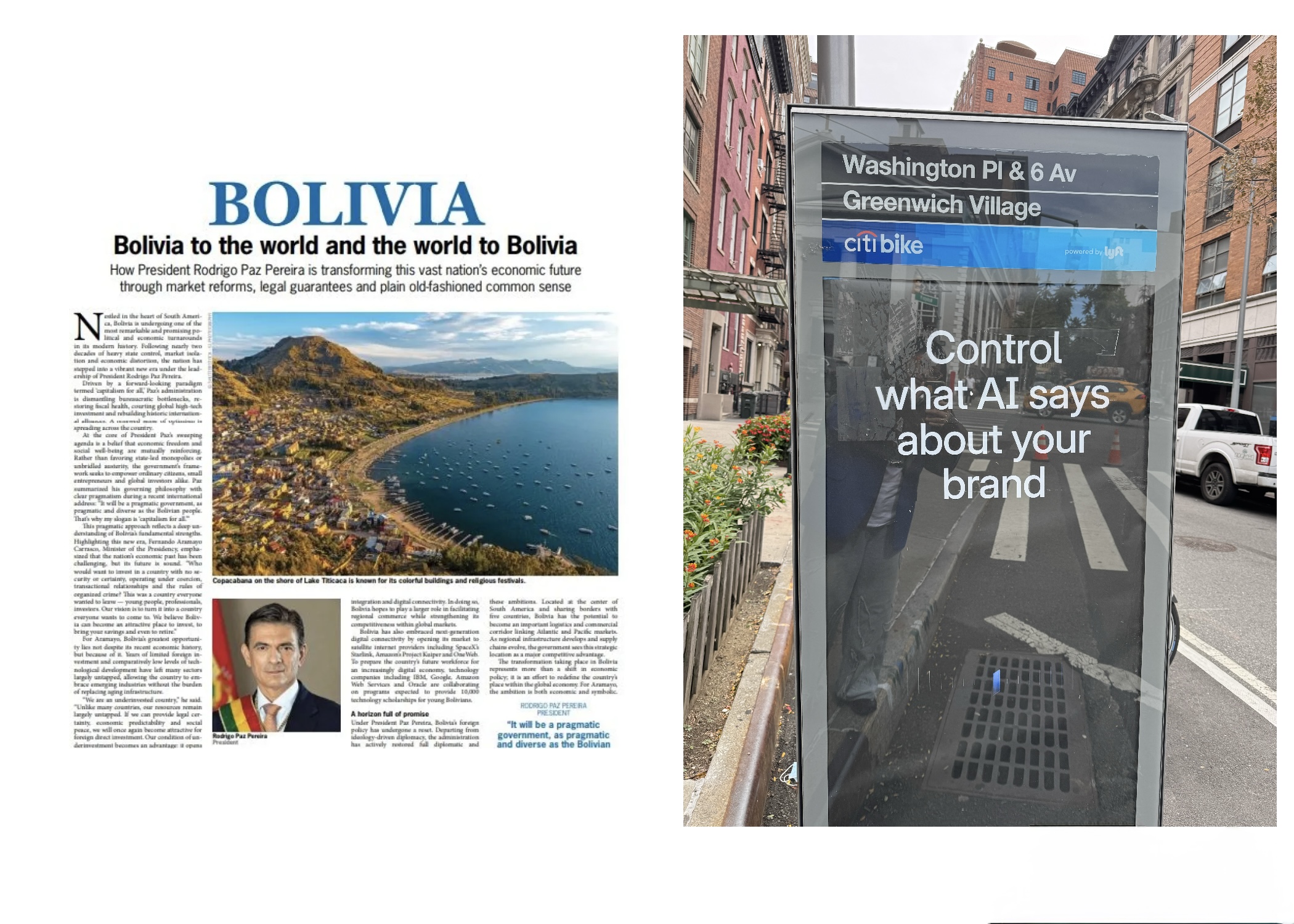
On 28 August 2026, the print edition of USA Today carried a 12-page supplement about Bolivia. It is titled "Bolivia: Bolivia to the world and the world to Bolivia" and opens with a photograph of President Rodrigo Paz.
It promotes five investment sectors: mining, energy, infrastructure, tourism and technology. It highlights the end of the fuel subsidy and new tax incentives as signs of openness to private capital.
Bolivia Verifica confirmed it exists. It did so using photographs of the printed edition sent in by a Bolivian reader in the United States, because nobody in the government announced it.
It did not run in every edition. A journalist in Houston could not find it that same day. The digital version sits on the site of Business Focus, a British portal.
89,215 copies
It is worth knowing what was bought. USA Today's average print circulation is 89,215 copies a day, according to the Alliance for Audited Media, down 13.8% in a year.
The figure covers the six months to September 2025 and was published by Press Gazette. In the same set of data, the 50 largest audited print titles in the United States lost an average of 15% of their circulation year on year.
Circulation from the Alliance for Audited Media, six months to September 2025, published by Press Gazette. Existence of the supplement verified by Bolivia Verifica. The search of SICOES, Bolivia's public procurement system, was carried out by the Fides news agency.
The director of the Bolivian broadcaster RTP, Jorge Luis Palenque, said the government paid 3 million dollars for the placement. That is a statement, not a document.
If that figure were accurate, and if the supplement had run in the full print run, it would work out at around 34 dollars per printed copy. It did not run in the full print run.
Where it should be
Bolivia has a public procurement system, SICOES, where state purchases are registered. The Fides news agency searched it and found no contract.
It also asked the Foreign Ministry and the Ministry of the Presidency. Both said they did not know the details of the contracting or the spending.
One finding complicates the headline that circulated in Bolivia. Bolivia Verifica established that roughly half the supplement's content is devoted to Banco Mercantil Santa Cruz.
That opens a concrete possibility: co-financing, with pages paid for by private companies. It is the standard model for this kind of supplement. Until the contract appears, how much came from the state and how much from companies is unknown.
The useful question is not the amount. It is where the paperwork is.
If the Bolivian state paid a single dollar for that supplement, a procurement process exists and it has to be published. If it paid nothing, saying so takes one sentence.
This government did not invent the practice either. In 2014, under President Evo Morales, an equivalent supplement about Bolivia ran in The New York Times.
What changed in twelve years is how many people read a newspaper on paper, and where opinion about a country is now formed.
Who produced it
The supplement is produced by Business Focus, which on its own site describes itself as preparing "unbiased, detailed reports" on countries, trade blocs and international organisations, to raise their profile and attract foreign investors.
Nowhere on that site does it state that the reports are paid for, or by whom. The word it uses to describe itself is unbiased.
The address it publishes is 78 York Street, London W1H 1DP, with a telephone number. It publishes no company registration number.
That address is sold as a virtual office. At least two firms openly offer it as a London business address service. There is a UK company called Business Focus Worldwide Ltd, number 08409456, active since 2013, whose declared activity is 73120, media representation services, the classification used for selling advertising space. Its registered address is a different one, and the site publishes no number, so the two cannot be established as the same company.
A product presented as an unbiased report, distributed inside an American national newspaper, made by a firm that gives a virtual office as its address and publishes no registration number.
The reader who finds it between the pages of their paper has no way of knowing who paid for it.
A corner in Greenwich Village
This week, at Washington Place and Sixth Avenue in New York, there was an advertisement on the panel of a public bike station. Eight words in white over a photograph of the street.
Control what AI says about your brand.
That advertisement is an industry. It is called answer engine optimisation, and it sells placement inside what ChatGPT, Gemini, Perplexity and the rest reply when somebody asks about a company, a product or a country.
The scale explains the business. In 2026, 31.3% of the United States population uses generative search. ChatGPT has around 800 million weekly users. Google's AI summaries appear in 16% of all searches.
Two channels
Tap each one.
Circulation from the Alliance for Audited Media published by Press Gazette. Generative search figures from eMarketer, 2026.
This is not a hypothesis for sala.red. We have already reported it with a name and a contract attached.
In "What the machine repeats" we documented, following WIRED Middle East, the Quincy Institute and Drop Site News, that a government contracted an American firm for 46.5 million dollars with an objective written into its FARA filings: to deliver framing results in GPT conversations. Three of six systems repeated an unsourced figure that came from one of its sites.
One government bought 12 pages in a newspaper that prints 89,000 copies. Another bought what the machines answer to 800 million people a week.
Both methods share the same flaw: the reader cannot see who paid. Only one of them still reaches anybody.
What is missing
The questions are short and every one of them has an answer sitting on a desk inside the Bolivian state.
If there was a contract, what is its process number in SICOES. How much came from the state and how much from private companies. Which institution contracted it and against which budget line. Who decided that the audience Bolivia needed was in the print edition of an American newspaper. If not a single peso of public money was spent, why neither the Foreign Ministry nor the Ministry of the Presidency could say so when asked.
The supplement can be held in your hand. Somebody photographed it, and that is how we know it existed.
On the corner of Washington Place they sell the same service for a place where there is no page to photograph. The day Bolivia buys there, with a published contract or without one, this story will not be possible to write.
Sources
- Fides news agency: the 12-page supplement in USA Today, the statement by RTP director Jorge Luis Palenque about a payment of 3 million dollars, the absence of any record in SICOES, and the responses from the Foreign Ministry and the Ministry of the Presidency saying they did not know the details of the contracting.
- Bolivia Verifica: verification of the supplement's existence through photographs of the 28 August 2026 print edition sent by a reader in the United States, its digital publication on the Business Focus site, its absence from the edition found in Houston, and the finding that roughly half the content corresponds to Banco Mercantil Santa Cruz.
- Visión 360: the supplement's title and contents, its character as advertising, and the precedent of an equivalent supplement about Bolivia published in The New York Times in 2014 under President Evo Morales.
- Press Gazette, using Alliance for Audited Media data: USA Today's average daily print circulation of 89,215 copies and a year-on-year fall of 13.8%, for the six months to 30 September 2025. A later survey records the average 15% fall across the fifty largest titles.
- The Business Focus site: its description of itself as a producer of unbiased, detailed country reports aimed at attracting foreign investment, the publication of the Bolivia report, the address at 78 York Street, London W1H 1DP, and the absence of a company registration number. Companies House record for Business Focus Worldwide Ltd, number 08409456, active since 19 February 2013, registered at 5a Bear Lane, Southwark, with declared activity 73120, media representation services.
- eMarketer, 2026: definitions of generative engine and answer engine optimisation, the projection that 31.3% of the United States population will use generative search in 2026, the roughly 800 million weekly ChatGPT users, and the appearance of AI summaries in 16% of Google searches.
- Photograph of the advertisement taken by the author at the Washington Place and Sixth Avenue station, Greenwich Village, New York, in September 2026. Earlier instalment in this series, "What the machine repeats", drawing on reporting by WIRED Middle East, the Quincy Institute and Drop Site News on the 46.5 million dollar contract declared under FARA.
This piece does not claim that the Bolivian state paid 3 million dollars for the supplement. That figure comes from a public statement by the director of a television channel and is not supported by any known document; the Fides news agency did not find it in SICOES, and the institutions asked said they did not know the details. The per-copy calculation is offered as a reference conditional on that figure and on the assumption of a full print run, an assumption that does not hold, and not as an established cost. Nor does this piece claim the supplement was financed entirely with public funds: roughly half its content corresponds to a private entity, and the distribution of the financing is unknown. It cannot be established that the Business Focus site corresponds to the company Business Focus Worldwide Ltd, and it is not claimed here that it does. The advertisement photographed in New York is described by its content; this piece does not identify or attribute the advertising company, and suggests no connection between that company and the Bolivian events described. No person or company mentioned has been accused of any crime.