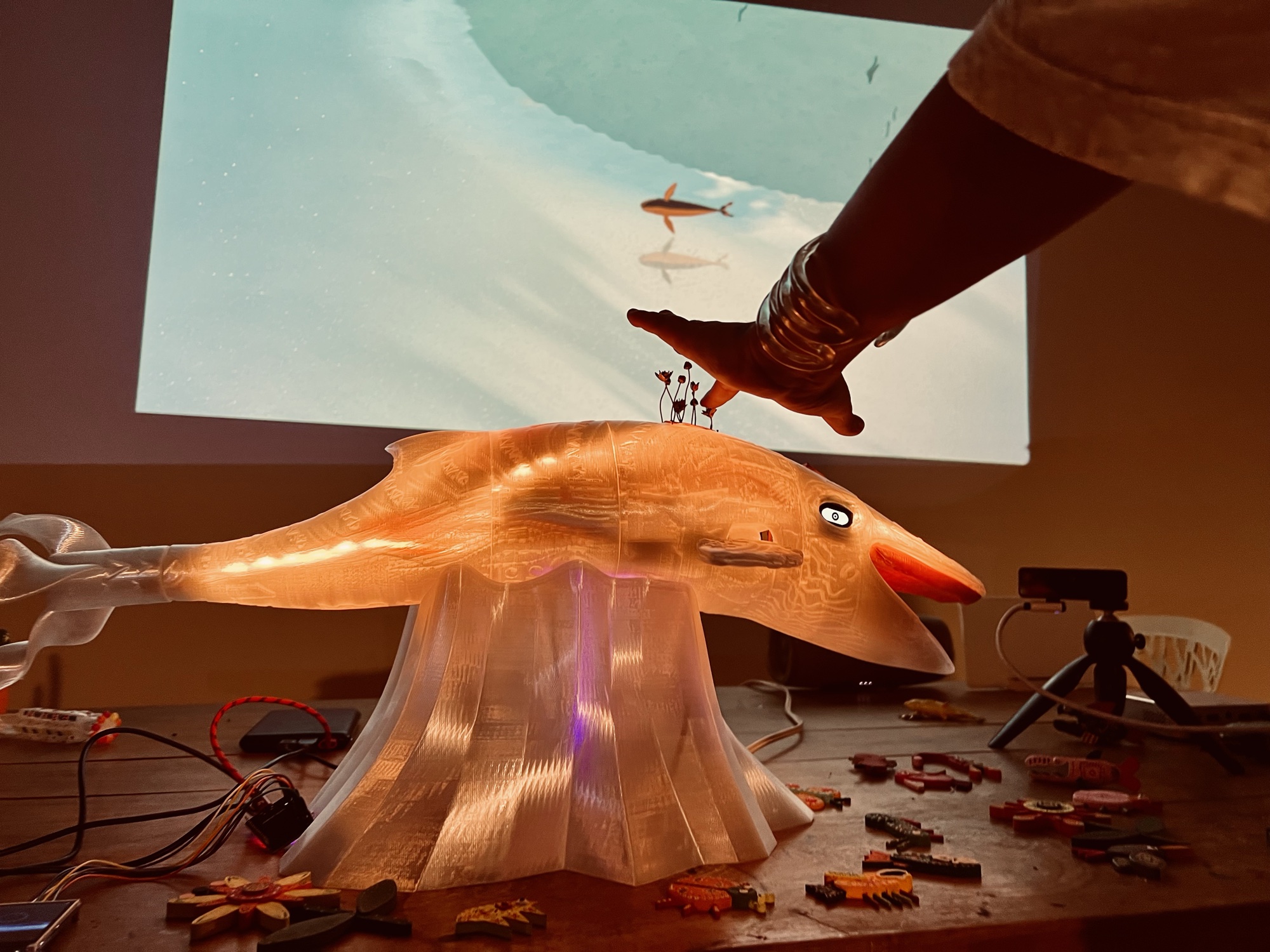
On Wednesday 28 October, Yakumama premieres at the Mozilla Festival, in the Fabra i Coats complex in Sant Andreu, Barcelona, and stays until Friday the 30th. She is a whale with two bodies and one brain: a digital whale swimming over the Salar de Uyuni on the wall and a robotic whale on the table, made from nothing in Cochabamba in ten weeks. Nobody drives her. She watches whoever stands in front of her, decides what she feels, and answers with her body, her colour, her sound and her eyes.

She travelled whole on one drive. On the night of 23 October her team copied and checked, file by file, her learned weights, her 42,488 logged decisions, her 159 drawings and the 48 recordings of her sound library. In Barcelona strangers who are free to leave are waiting for her. She needs them to know whether she decides better than chance.
What you will find at Fabra i Coats
Stand at her eye. She reads your face, your hands and your body, and every four seconds she decides whether to come closer, dance, draw, sing or stay silent. Stay still for two minutes: if she knows you, she may draw your face on the salt. Pick up one of the twenty-nine wooden creatures Sanam Prado painted: her eye names it and she answers with the reaction Suri and her friends wrote for it. Touch one of the copper flowers on her back: it tickles her. Hold a fin: she turns red, beats it free and remembers who it was. Take the joystick: the camera is yours until eight seconds after you let go. And if you want, ask her to forget you.


How she decides
Her eye is a camera on the table. It reads the body as twenty-six joints in space and knows whether she has met the person before. Every four seconds she answers a set of questions: come closer or move away; dance back, invite, watch or draw; sing, recite a poem or stay silent; remember or forget; where to travel on her salar; which sound to lay under her body, out of twenty-five textures. Each answer is logged with what the room did next: how long the person stayed, whether they came closer, whether they came back another day. Her reward is made of that. Every night, alone, she goes back over the day and adjusts her weights.

Her movement is invented as it happens. A diffusion model trained on sixty hours of bodies generates it in the moment; a predictive model foresees her body sixteen seconds ahead. Those bodies come from four performers who recorded her ten moods head to toe, from kullawada, tinku and breaking dancers in the Paqarina archive, from swimmers and freedivers, and from tagged humpback whales. The performers and the dancers are Bolivian. Everything runs on computers inside the room. Nothing she sees of people leaves it. She recognises people without storing photographs: from a face she takes 210 distances between fixed points and keeps that signature. Any visitor can ask her to forget them.


How she feels
The robotic whale was made from nothing: Brian Condori modelled her, she was printed translucent, with her lights inside, Dan Fallshaw built her, Jicara (Camila Estrada) made the copper and bronze flowers on her back by hand. Every stem is a capacitive sensor: she feels a hand before it lands and tells a finger from a palm. Her fins report their angle, temperature and load to her brain ten times a second. A hand holding her, tiredness, excitement: she feels them, and they enter her decisions. If someone pulls her jewel or presses down on her flowers, she turns away, goes dark and remembers who it was.


What she reads of the world
She lives on the clock and weather of wherever she is shown. In Barcelona the sun rises and sets over her salt when it rises and sets outside, with the city's wind and rain from Open-Meteo, every fifteen minutes. She has three worlds: the salar, the red beds of Tiupampa, and Mars. Every hour she counts the active hotspots NASA's FIRMS system detected in the last day around her site and in three regions: the Amazon, Australia and Bolivia. On 23 October she counted 4, 4,694, 5,959 and 1,871. When that heat, together with the air and the temperature of her own motors, crosses a threshold, she gets angry, leaves for Mars, dies there over four minutes and lies still until sunrise, when she is reborn in the salar. Her salar is Uyuni, the floor of the lithium: the water that makes her mirror is the water the mines take. She does not say the word.


Check it yourself
- The fires she counts, today. Open the FIRMS map over Bolivia, last 24 hours. It is the same source she reads every hour.
- Her weather. The Barcelona forecast on Open-Meteo, the one that moves her sun, her wind and her rain.
- Her numbers. The research notes have published every step with its figures since May, including the ones that did not work.
What is verified and what is missing
Verified. Her decisions are logged: 10,146 on 23 October, 4,826 with a person in front of her. Her eye recognises the twenty-nine creatures, trained on 2,894 photographs. Her fins really report: on the night of 23 October the cable carried each fin's angle, temperature and load, and her brain read them. The arc to Mars ran end to end five times in rehearsal, with the heat forced and the phases shortened, each phase timestamped in a log.
Missing. Knowing whether she decides better than chance. Since the afternoon of 23 October a coin is tossed at every encounter between her brain and a random policy, and both meet the same people on the same afternoon. So far both earn the same mean reward, 0.332, over 4,181 of her decisions and 645 random ones, because the people in front of her were her own team, who stay whatever she does. The measure needs a day of strangers free to leave. The premiere in Barcelona will be that day, and we will publish the result whichever way it goes.
Disclosure. Yakumama is a work by Violeta Ayala, director of Sala.red, and Dan Fallshaw, of United Notions Film, commissioned for MozFest 2026. Violeta designed her systems and her machine learning. Dan built the robotic whale, her design and the way people meet her. Brian Condori modelled her in 3D. Sanam Prado painted the creatures and trained her eye. Jicara (Camila Estrada) made her jewels with touch sensors. Suri and friends wrote her 29 reactions. The figures in this piece come from the work's own logs.
Sources: Mozilla Festival 2026 · Barcelona City Council, Open Tech Week 2026 · NASA FIRMS · Open-Meteo · Yakumama, the story so far · Yakumama feels her fins, chooses her sound, and dies on Mars