Cables Investigation
Chile says the fibre memorandum with Bolivia is still under discussion
Bolivia announced the signing on 16 October. Twenty-six days later, Subtel refers to an “eventual signing”. It withheld almost every document we requested and released a three-page memo.
By Violeta Ayala — Tecnóloga
On 11 November, Chile’s Undersecretariat of Telecommunications, Subtel, answered a request from sala.red. We asked for the documents on connecting Bolivia to the Humboldt submarine cable and on the Chinese cable, Chile-China Express. Subtel refused almost everything. It handed over a three-page memo.
- Document
- Official letter No. 15993/2026
- Signed by
- Romina Garrido, Undersecretary of Telecommunications
- Date
- 11 November 2026
- Answers
- Request AN002T0008637, of 19 October 2026
- Law
- Law No. 20,285, the Transparency Law
- Attached
- Memo “Conexión fibra óptica Chile/Bolivia”, August 2026
The answer contradicts Bolivia’s announcement about the memorandum, describes what Chile is negotiating and shows where Bolivia’s fibre would run: a network subsidised by the Chilean state and operated by the company WOM.
The first story in this investigation: What did Bolivia sign with Chile?
What did we ask for?
- Subtel’s reports, studies, memos, official letters and emails on the Chile-Bolivia bioceanic fibre corridor or on connecting Bolivia to Humboldt, between 1 March and 16 October 2026.
- Subtel’s communications on that connection with Chile’s Foreign Ministry, Desarrollo País, Humboldt Connect, Google, Entel or Bolivian authorities.
- The Chile-China Express concession decree signed on 27 January 2026 and the act that annulled it on 29 January.
- The status of China Mobile International Chile’s application for that cable, with every request for information sent to the company since 11 March.
- Reports from other state bodies on that application. If they were classified, their date, who issued them and the legal ground.
What did Subtel refuse?
Everything except the memo.
For the corridor and Humboldt, Subtel invokes article 21 No. 1, letter b), of the Transparency Law: deliberations prior to a decision. It calls the documents “preparatory inputs for decisions not yet adopted”. For the communications, it adds article 21 No. 4: the national interest and international relations.
For the Chinese cable, it invokes article 21 No. 1, letter b), and article 21 No. 3: national security.
Subtel says it cannot release parts of the documents without revealing what is withheld. It also did not provide the list of classified reports, with date, issuer and legal ground, that we asked for in point 5.
The request named Google, Desarrollo País and Humboldt Connect. The answer does not address them separately. It treats all the communications as diplomatic dealings.
Has the memorandum been signed?
On 16 October, with José Antonio Kast in La Paz, Rodrigo Paz said Humboldt is “a cable that comes from Oceania and from Asia, that reaches Chile, it is going to enter Bolivia”. Humboldt lands at Santo Domingo, in the Valparaíso region. Subtel’s memo describes a land connection through Visviri. That day, Bolivia’s Ministry of Public Works announced the signing of the fibre corridor memorandum. EFE reported that the two countries’ foreign ministries signed it.
Twenty-six days later, Subtel describes the process this way:
“The process is at a stage of ongoing technical and regulatory analysis, within the framework of talks aimed at the eventual signing of a Memorandum of Understanding (MoU) between Chile and Bolivia.”
On 19 October we also asked Chile’s Foreign Ministry for the memorandum, with request AC001T0007948. The legal deadline of 20 working days falls on 16 November. The law allows a 10-working-day extension.
What does Chile want from Bolivia?
Subtel withholds the documents. It describes what they contain.
On the corridor, it says their release “would expose technical criteria and requirements for consideration in return that have not yet been consolidated”.
On the communications, it says they “record diplomatic efforts, strategic coordination and technical and commercial negotiations channelled through the Ministry of Foreign Affairs, international entities and public counterparts of a foreign state”.
According to Subtel, releasing them “would reveal negotiating positions, preliminary agreements and geopolitical considerations of the State of Chile”.
The answer does not say what Chile wants in return, from whom, or which international entities are involved.
What does the memo say?
The memo is titled “Conexión fibra óptica Chile/Bolivia” (Chile/Bolivia fibre optic connection). It is dated August 2026, two months before José Antonio Kast’s visit to La Paz. It analyses the requirements to install and operate a fibre connection at Visviri, in the Arica y Parinacota region.
- The connection needs a concession for an intermediate telecommunications service, granted by supreme decree.
- The process includes a report from the Ministry of National Defence. “This procedure can take 140 working days on average.”
- Only “legal persons under public or private law, constituted in Chile and domiciled in the country” can hold a concession, under article 21 of the General Telecommunications Law. A company constituted in Bolivia, such as Entel, cannot hold the concession directly. It would need a company constituted in Chile.
- At Visviri, WOM operates the Fibra Óptica Nacional network. To access dark fibre, the memo says “the most efficient route is interconnection at the existing POITT”, that network’s interconnection point.
- Connecting to Humboldt over that network is technically feasible. The memo warns that “the FON is not a direct route to the landing point in Santo Domingo”.
- Everything depends on “the commercial and interconnection agreements that the interested companies reach with the respective infrastructure operators”.
The memo does not mention costs, Google, Humboldt Connect or the law that would govern Bolivian data. Outside its title, it names neither Bolivia nor Entel. It does not say which company would be the “new operator” from Visviri.
What is the Fibra Óptica Nacional?
It is a fibre optic backbone built with a Chilean state subsidy. According to Subtel, it aims to connect more than 800,000 people. The total subsidy exceeds 80 billion Chilean pesos, about US$86 million.
In 2020, WOM won five of its macrozones, Arica y Parinacota among them, with a subsidy of more than 52 billion pesos, about US$55 million. Supreme Decree No. 66 of 2020 grants it the concession in Arica y Parinacota.
On 3 August 2026, Undersecretary Garrido called it “a digital highway built with a state subsidy of US$55 million”.
The tender rules require the network to be available at least 98% of the year in each macrozone. In Arica y Parinacota it reached 72.94%. Subtel recorded the failure of 38 nodes in Arica y Parinacota, Antofagasta, Atacama, Coquimbo and Maule.
That same 3 August, Subtel ordered the collection of WOM’s guarantees for UF 316,410.15, about US$14 million. UF is an inflation-indexed Chilean unit. Garrido said “the state cannot allow infrastructure of this scale to be degraded and unavailable”.
On 5 August, Chile’s Comptroller General published a report with 17 observations on the oversight of the project. Among them: guarantees for Arica y Parinacota and Centro Norte worth UF 104,315.73 that Subtel never collected and that expired. Subtel has internal inquiries to establish responsibility.
On 19 August, Garrido said: “this gap of 73% and 78% makes the fibre optic network basically unavailable, unusable”.
That same month, Subtel dated the memo that points to WOM’s network as “the most efficient route” to connect at Visviri.
WOM filed for Chapter 11 bankruptcy protection in the United States in April 2024 and emerged in March 2025 under new controllers. On 12 November 2026, Subtel notified WOM of the collection of another UF 62,749.11, about US$2.6 million, over delays in WOM’s 5G network. According to Subtel, the charges and compensation demanded of WOM, paid and pending, total UF 1,682,059.26, about US$70 million. The Chilean Senate is preparing a special session on the 5G and Fibra Óptica Nacional projects for 2 December.
How would Bolivia benefit?
On 16 October, Public Works Minister Mauricio Zamora said Bolivia will become a data bridge between Brazil and Chile, with better speeds and new data centres.
Since 2024, Entel has operated a route between Lima and São Paulo. In January 2026 it announced an interconnection agreement with Claro Chile in Arica.
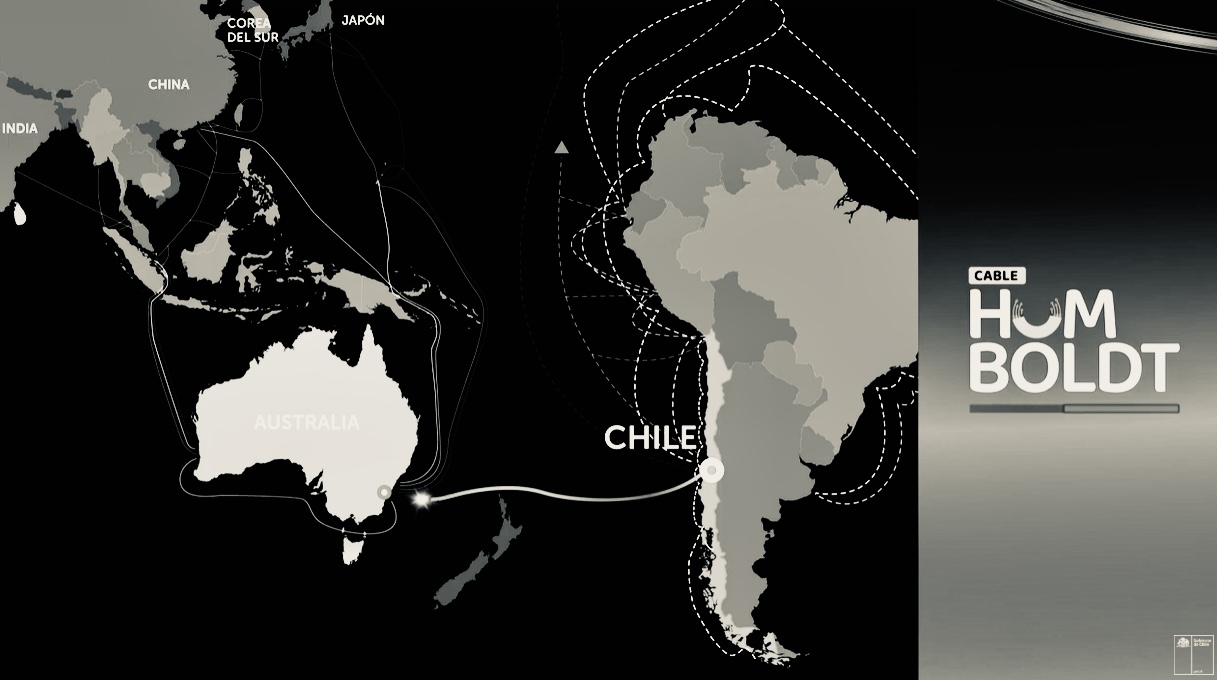
Humboldt runs from Chile to Sydney, in Australia. We compared how far a message leaving La Paz travels on each route. We measured each stretch between the points on the route in a straight line. Today: La Paz, Lurín, Panama City, Los Angeles and the destination. With Humboldt: La Paz, Visviri, Arica, Santo Domingo, Papeete and Sydney, and from there to Hong Kong. The real cables are longer.
| To | Today, via the US | With Humboldt | Difference |
|---|---|---|---|
| Hong Kong | 19,900 km | 23,300 km | 3,400 km more |
| Sydney | 20,300 km | 16,000 km | 4,300 km less |
Humboldt brings Bolivia closer to Australia. To reach Hong Kong, a message would travel at least 3,400 kilometres more than it does today. In fibre, light takes about 5 milliseconds per 1,000 kilometres: that is about 17 milliseconds more one way.
In Humboldt’s feasibility study, China, including Hong Kong, accounts for between 42% and 53% of the Asian traffic projected between 2024 and 2042.
What happens with the Chinese cable?
The answer confirms in writing what the Chilean press reported in February.
“The decree in question was signed, but it was never perfected as a final administrative act, since it was not sent to the Comptroller General of the Republic for review; afterwards, the authority itself took the procedure back to its evaluation stage.”
The project “remains at the technical evaluation stage”. Subtel sets no end date. It says the records are tied to “an evaluation on matters of defence and national security, currently before the competent bodies”. It mentions “classified official letters on national security evaluations”.
Timeline
- WOM wins five Fibra Óptica Nacional macrozones, with a subsidy of about US$55 million.
- WOM files for Chapter 11 in the United States.
- Transport Minister Juan Carlos Muñoz signs the Chile-China Express decree.
- Subtel annuls the decree.
- Subtel orders US$14 million in guarantees collected from WOM over the Fibra Óptica Nacional.
- The Comptroller General publishes 17 observations on the network’s oversight.
- Subtel dates the memo on the fibre connection at Visviri.
- Kast and Rodrigo Paz sign five documents in La Paz.
- sala.red requests the documents from Subtel and Chile’s Foreign Ministry.
- Subtel answers and hands over the memo.
- Subtel notifies WOM of the collection of US$2.6 million over the 5G network.
- Chile’s Foreign Ministry deadline.
- Deadline to appeal Subtel’s answer before the Transparency Council. The Senate plans a special session on WOM.
What remains unanswered
- Did Chile sign the fibre optic memorandum on 16 October?
- What does Chile want in return, and from whom?
- Which international entities take part in the negotiations?
- Which company would operate Bolivia’s fibre from Visviri?
- How much would Bolivia pay to use a network the Chilean state subsidised and that falls short of its minimum availability in Arica y Parinacota?
- What do the defence reports say about the Chinese cable?
Quotes from the documents and from Chilean officials are translated from Spanish by sala.red.
Sources
- Subtel: official letter No. 15993/2026 and attached memo, delivered to sala.red on 11 November 2026
- Bolivia’s Ministry of Public Works, Services and Housing, 16 Oct 2026: signing of the fibre memorandum
- EFE via BioBioChile, 16 Oct 2026: memorandum signed by the foreign ministries
- El Deber, 16 Oct 2026: Mauricio Zamora on the data bridge
- DPL News: Entel’s Lima-São Paulo route
- DCD, 30 Jan 2026: Entel and Claro Chile in Arica
- Subtel, CAF webinar, 17 May 2022: Asian traffic projected in the Humboldt study
- Distances: sala.red calculation, straight-line distance between the points on each route
- BioBioChile, 3 Aug 2026: Subtel collects WOM’s guarantees
- TrendTIC, 4 Aug 2026: availability by macrozone
- El Dínamo, 6 Aug 2026: total Fibra Óptica Nacional subsidy
- Emol, 19 Aug 2026: Garrido on the Comptroller General’s report
- Radio Pauta, 21 Aug 2026: Comptroller General’s observations and internal inquiries
- Radio Pauta, 12 Nov 2026: 5G collection and total charges to WOM
- BNamericas: WOM files for Chapter 11
- Forbes Chile, 23 Mar 2025: WOM emerges from Chapter 11
- El Mercurio via Portal Puente Alto, 24 Feb 2026: annulment of the Chinese cable decree