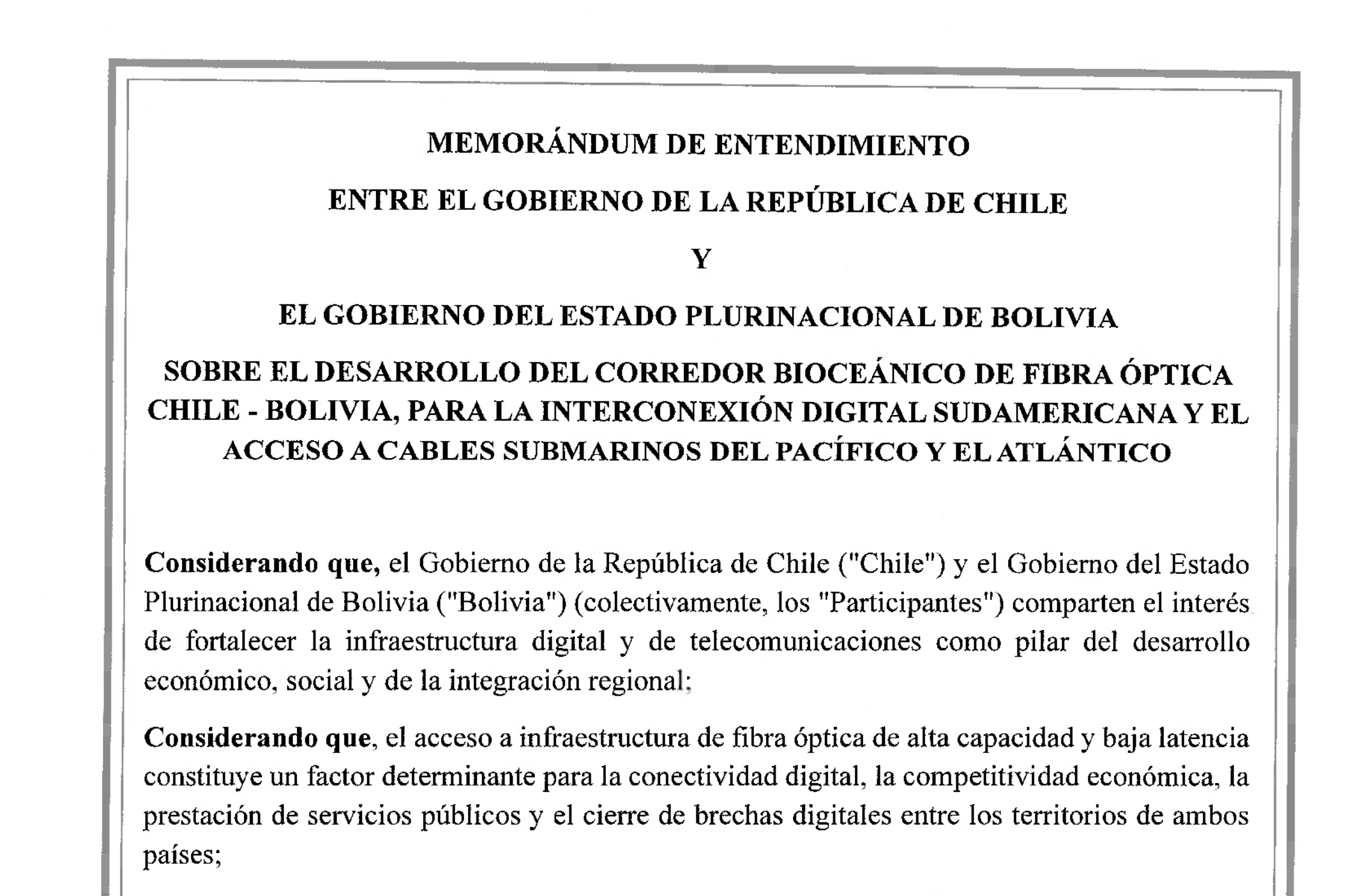
Reply from Chile’s Foreign Ministry: signed memorandum and five more documents (in Spanish)
Cables Investigation
This is what Chile and Bolivia signed: no money and no obligations
Chile’s Foreign Ministry gives sala.red the memorandum on the fibre optic corridor. The two foreign ministers sign it on 16 October. The text commits no financing, creates no obligations and records the connection to the Humboldt cable as an intention.
By Violeta Ayala — Tecnóloga
On 23 November, Chile’s Foreign Ministry gave sala.red the memorandum on the fibre optic corridor between Chile and Bolivia. It is signed. It runs to four pages. It commits no money and creates no enforceable obligations.
- Document
- Memorandum of Understanding on the development of the Chile-Bolivia Bioceanic Fibre Optic Corridor
- Signed by
- Francisco Pérez Mackenna, Foreign Minister of Chile, and Héctor Francisco Huanca Gutiérrez, Foreign Minister of Bolivia
- Place and date
- La Paz, 16 October 2026
- Released by
- Chile’s Undersecretariat of Foreign Affairs, 23 November 2026
- Answers
- Request AC001T0007948, of 19 October 2026
- Withheld
- Reserved memorandum No. 2146 and the draft of the agreement
The earlier stories in this investigation: What did Bolivia sign with Chile? and Chile says the fibre memorandum with Bolivia is still under discussion.
Is the memorandum signed?
Yes. The last page reads: “Signed in the city of La Paz, on 16 October 2026, in two (2) originals in the Spanish language, each equally valid”. The two foreign ministers sign it.
The Joint Declaration by José Antonio Kast and Rodrigo Paz, of the same day, highlights “the signing of the Memorandum of Understanding for the development of the Chile-Bolivia Bioceanic Fibre Optic Corridor”.
On 11 November, Subtel, Chile’s Undersecretariat of Telecommunications, wrote to sala.red that the process was “within the framework of the talks aimed at the eventual signing of a Memorandum of Understanding (MoU) between Chile and Bolivia”. The memorandum had been signed for 26 days.
Our previous story recorded that contradiction with the documents available. The text released by the Foreign Ministry settles it: the Bolivian government reported the signing correctly.
The memorandum hands follow-up to a working group “led by the telecommunications authorities”. In Chile, the telecommunications authority is Subtel.
What is the corridor?
The memorandum defines it as “the terrestrial fibre optic infrastructure system” that starts from “landing or interconnection points in the Arica y Parinacota Region”, reaches the “Visviri - Charaña border crossing or other border crossings that prove technically convenient” and continues through Bolivian territory.
Towards the Atlantic, the text refers to “other interconnections” with infrastructure “existing or planned”. It uses the conditional: the corridor “would extend”.
In August, a Subtel memo pointed to WOM’s network as “the most efficient route” to connect at Visviri. That network received a subsidy from the Chilean state. In Arica y Parinacota it worked 72.94% of the time, when the tender rules require 98%.
Does the Humboldt cable enter Bolivia?
On 16 October, Rodrigo Paz said Humboldt is “a cable that comes from Oceania and from Asia, that reaches Chile, it is going to enter Bolivia”.
The memorandum says: “The Participants intend that the Corridor interconnect with the infrastructure of the Humboldt submarine cable or other Pacific submarine cable systems developed with landing points in Chilean territory”.
What Paz said is false. The memorandum his foreign minister signed that same day contradicts it. Humboldt lands on Chile’s coast. What would enter Bolivia is terrestrial fibre connected to that cable. The memorandum records it as an intention.
Who pays?
The memorandum says: “This Memorandum does not constitute a financing commitment for the development of the Corridor”. Each country bears the costs of its own participation.
The two governments have a maximum of one year from the signing to present “a work plan with financing alternatives”. That plan must be set out in “a later agreement”.
The text provides for promoting the participation of “telecommunications operators, investors and multilateral financing entities”. It mentions “public-private partnership schemes”. It names no company.
The Joint Declaration recognises the willingness of CAF, the development bank, to contribute to studies and projects on connectivity and infrastructure between the two countries.
What does it bind the countries to?
The memorandum answers in its non-binding clause: it “does not constitute or create legally binding or enforceable rights or obligations, express or implied, under domestic law or under international law”.
Implementation of the corridor is “subject to the conclusion of later bilateral agreements”.
Either country can end its participation with written notice. The exit takes effect 30 days later.
How does Bolivia benefit?
On paper, in three ways. The memorandum sets the aim of “giving Bolivia land access to the submarine cable systems of the Pacific Ocean through Chilean territory”. The connection with Humboldt would serve “to provide Bolivia with an access route to the markets and digital infrastructure of Asia-Pacific”. The corridor seeks to reduce “dependence on single routes”.
None is guaranteed. The text commits no money, creates no rights and sets no prices. It does not say how much Bolivia would pay to cross the Chilean network.
By our calculation, towards Australia the route through Humboldt is about 4,300 kilometres shorter than the current one. Towards Hong Kong it is at least 3,400 kilometres longer: to reach Asia, Humboldt goes through Sydney.
Bolivia could charge for data transit towards Brazil and Paraguay. Neither country signs the memorandum.
What does Chile gain?
A route to the Atlantic. The corridor’s aim is to give Bolivia land access to the Pacific cables through Chilean territory and “to give Chile, simultaneously, access to the submarine cable systems of the Atlantic Ocean”. That route crosses Bolivia.
Paraguay and Brazil do not sign. Chile and Bolivia declare the intention to promote their incorporation “as far as possible and through the corresponding diplomatic channels”.
What does it say about data?
Little. The two governments express the will to exchange information and best practices on cybersecurity, “in accordance with their respective laws and regulations”. They recognise the importance of protecting “the technical, geographic and commercial information shared”.
The memorandum does not define which law protects Bolivia’s data when it crosses Chile. sala.red requested every document that defines the law or jurisdiction applicable to that data. The Foreign Ministry identified none.
The content produced by the working group “will be the exclusive property of the Participants and may not be shared with third parties without the explicit consent” of the two governments.
What did the Foreign Ministry withhold?
Reserved memorandum No. 2146, from the Directorate General of Legal Affairs. It is dated 14 October, two days before the signing. Its annex is a draft of the agreement with tracked changes.
Exempt Resolution No. 668, of 20 November, says releasing the draft “would expose the modifications, deletions and alternative wordings considered internally before arriving at the final text”. It would reveal “the prior negotiating positions on strategic aspects of connectivity, cybersecurity and protection of critical infrastructure between both countries”.
The Foreign Ministry cites two grounds in the Transparency Law: the performance of its functions and the national interest, on account of international relations.
What went unanswered?
sala.red requested the Foreign Ministry’s communications with Subtel, the Ministry of Transport and Telecommunications, Desarrollo País, Humboldt Connect or Google about connecting Bolivia to Humboldt, between 1 March and 16 October.
The reply letter identifies four documents: the memorandum, two joint declarations and the reserved memorandum. None is a communication with those bodies. The letter does not say whether such communications exist.
Timeline
- Legal Affairs at Chile’s Foreign Ministry dates reserved memorandum No. 2146, with the draft of the agreement.
- The foreign ministers sign the memorandum in La Paz. Kast and Paz sign the Joint Declaration. Paz says Humboldt “is going to enter Bolivia”.
- sala.red requests the documents from Subtel and from Chile’s Foreign Ministry.
- Subtel answers and refers to an “eventual signing” of the memorandum.
- Chile’s Foreign Ministry extends its deadline by 10 business days.
- The Foreign Ministry signs Exempt Resolution No. 668, which withholds the draft.
- The Foreign Ministry releases the signed memorandum and the two joint declarations.
- The maximum period to present the work plan with financing alternatives ends.
What remains unanswered
- Why did Subtel refer to an “eventual signing” 26 days after the signing?
- What changed in the draft between 14 and 16 October?
- Who pays for the corridor?
- Which companies would operate the fibre in Chile and in Bolivia?
- Who sits on the working group for Bolivia?
- Which law protects Bolivia’s data when it crosses Chile?
Documents
sala.red publishes in full the documents sent by Chile’s Foreign Ministry. They are public information, released under Chile’s Transparency Law. All are in Spanish.
- Memorandum of Understanding on the Chile-Bolivia Bioceanic Fibre Optic Corridor, 16 October 2026, 4 pages
- Joint Declaration of the presidents of Bolivia and Chile, 16 October 2026, 6 pages
- Joint Declaration on energy integration, 16 October 2026, 3 pages
- Exempt Resolution No. 668, which withholds reserved memorandum No. 2146 and the draft, 20 November 2026, 4 pages
- Reply letter to request AC001T0007948, 23 November 2026, 2 pages
- Letter extending the deadline, 16 November 2026, 1 page
Quotes from the documents and from Bolivian and Chilean officials are translated from Spanish by sala.red.
Sources
- Chile’s Undersecretariat of Foreign Affairs: reply letter to request AC001T0007948, 23 November 2026
- Memorandum of Understanding on the development of the Chile-Bolivia Bioceanic Fibre Optic Corridor, La Paz, 16 October 2026
- Joint Declaration of the presidents of Bolivia and Chile, La Paz, 16 October 2026
- Chile’s Ministry of Foreign Affairs: Exempt Resolution No. 668, 20 November 2026
- Subtel: official letter No. 15993/2026 and attached memo, released to sala.red on 11 November 2026
- Comunicación Estratégica del Estado, Bolivia: video of the event of 16 October 2026, statement by Rodrigo Paz