Cables Analysis
Who switches off the little antenna?
On 24 October, Elon Musk celebrated Starlink antennas in Bolivian schools and admitted SpaceX throttled the service at the Ukrainian front. Four years of Starlink in Ukraine show what 85 municipalities start paying for from month 25.
By Violeta Ayala — Tecnóloga
The same day
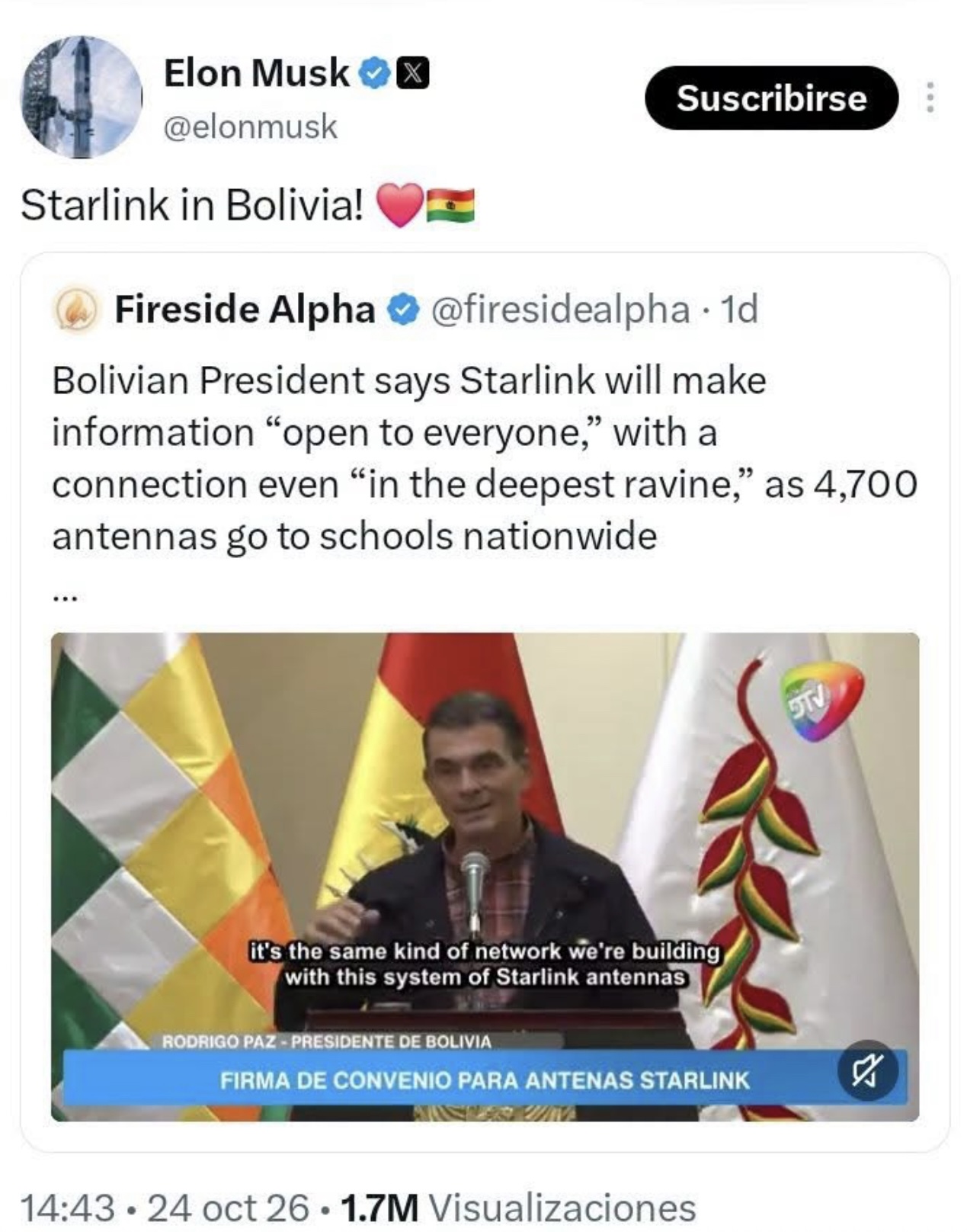
On 24 October, Elon Musk posted on X: "Starlink in Bolivia!", with a heart and a Bolivian flag. He was quoting a video of President Rodrigo Paz announcing 4,700 antennas for schools. The president shared it: "Bolivia reconnects with the world and the world with Bolivia." Musk's post passed 1.7 million views.
That same 24 October, Musk posted something else. Ukraine had just reported that Starlink was back to normal speed at the front, after ten days of restrictions. Musk replied:
"Ukraine military violated Starlink terms of service and used it for offensive drone strikes to kill people. That loophole was closed last week."Elon Musk, X, 24 October 2026
One company, one owner, two countries, the same day. In one he celebrates the arrival. In the other he admits the cut.
What Bolivia signed
On 20 October, the government signed agreements with 85 municipalities in La Paz department to install Starlink antennas in schools. Education Minister Erick Sanjinés spoke of 5,000 antennas nationwide. The president said "4,700, if I'm not mistaken".
Sanjinés explained the model: "It is a donation being made to the municipal governments and the schools. Installation is handled by Entel." The service is paid for two years. From month 25, each municipality pays.
These things have not been disclosed: who paid for the two years, what each antenna costs per month, what contract exists with SpaceX, and on what grounds the service can be suspended.
Starlink has operated in Bolivia since 2 February 2026 under an experimental licence from the regulator, the ATT, granted for six months. The government reported 40,000 connections by May. The residential plan cost Bs 610 a month at launch and costs Bs 531 today. The company sets the price.
On 20 October, Paz said: "You grab a little antenna, take it out, put it up, done. No need to go and buy satellites for 300, 400 million dollars." The satellite he means is the Túpac Katari. It runs at 95% occupancy, according to the Bolivian Space Agency, and its service life ends in 2030. The agency is studying how to replace it.
How it started in Ukraine
Ukraine also started with a little antenna and a post on social media.
- 26 February 2022 Two days after the Russian invasion, Digital Transformation Minister Mykhailo Fedorov writes to Musk on Twitter: "We ask you to provide Ukraine with Starlink stations." Musk replies the same day: "Starlink service is now active in Ukraine. More terminals en route." No contract, no tender, no state-to-state signature.
- 2022 The first terminals arrive on 28 February. SpaceX donates 3,667 of the first 5,000. USAID buys the rest. Poland ends up paying for almost 9,000 terminals. The UK, France, Germany, Czechia and crowdfunding pay for others.
- October 2022 SpaceX writes to the Pentagon that it can no longer keep donating. Musk says the service costs US$20 million a month. The next day he reverses: SpaceX will keep paying. In that same period, coverage near Crimea was already geofenced. Musk refused to extend it for a Ukrainian attack.
- February 2023 SpaceX blocks the use of Starlink to control combat drones. Its president, Gwynne Shotwell, says Ukrainians used it "in ways that were unintentional and not part of any agreement".
- June 2023 The Pentagon signs a contract with SpaceX to pay for the service in Ukraine. By 2024, Poland is paying subscriptions for more than 20,000 terminals.
- February 2026 SpaceX disconnects every terminal in Ukraine not on a whitelist, to cut off use by Russian troops. The company shows it can switch off terminals one by one.
- 10 to 24 October 2026 Trump asks Ukraine not to strike Russian refineries. Musk writes that Zelenskyy "has gone too far". On the 14th, SpaceX throttles Starshield, the military version of Starlink. Ukrainian drones are capped at about 160 km/h. The Wall Street Journal reports that Musk authorised the cut. Secretary of State Marco Rubio says: "There was no prior knowledge." Defence Secretary Pete Hegseth says the Pentagon issued no directive and that Starlink can decide under its terms of service. On the 23rd, Zelenskyy announces an independent satellite system with Nokia and ICEYE. On the 24th, speeds return and Musk admits the cut.
Two countries, one company
Ukraine
Started with a tweet, on 26 February 2022.
Terminals paid for by SpaceX, USAID, Poland and others.
More than 20,000 terminals by 2024.
Four years on, SpaceX throttled the service at the front. The US government says it did not order it.
Now building its own system.
Bolivia
Started with a decree, DS 5509, and a six-month experimental licence.
School antennas are "a donation". Who paid for two years of service is not public.
4,700 antennas for schools, 40,000 connections in all.
From month 25, 85 municipalities pay at the company's price.
Has its own satellite, which expires in 2030.
What Ukraine teaches a town hall
Ukraine is the largest and most important customer Starlink has ever had. Behind it stand the Pentagon, Poland and half of Europe. Even so, when SpaceX decided to throttle the service, nobody could stop it. Washington says it did not know. Musk says it was the terms of service. SpaceX writes the terms of service.
A rural school in Pando does not launch drones. Ukraine's reason does not apply. The structure does: a single provider, a single person who decides, private rules and no Bolivian court to appeal to.
Poland paid for tens of thousands of subscriptions and that gave it no control. Paying buys the service. It does not buy the decision. From month 25, Bolivian municipalities will be in Poland's position, with less weight.
Ukraine, after four years and with the network working, decided to build its own system with Nokia and ICEYE. Bolivia already has one. It expires in 2030, and the president holds it up as an example of what not to buy.
What is fair to say
Starlink reaches today where Entel did not reach in twenty years. A school with internet this year is worth more than a plan for 2030. Low orbit is faster and has lower latency than a geostationary satellite. The Túpac Katari covers the 2% of territory with no mobile signal; Starlink covers all of it. Both things are true at once: the antenna is the best option available today, and the decision to keep it switched on belongs to someone else.
Seven questions for your town hall
If your municipality signed the agreement, these questions can be put to the mayor's office, the municipal council, or in writing to the Ministry of Education and Entel. Copy, paste and send.
- The text of the agreement with the municipalities and the contract with SpaceX or Entel.
- Who paid for the two years of service, and how much, per antenna and per month.
- The grounds for suspension and the terms of service that apply in Bolivia.
- Where the traffic exits and who holds the schools' data.
- The status of the experimental licence before the ATT, which expired in August.
- What happens to the school if SpaceX raises the price or cuts the service.
- The plan for after 2030.
Sources
- Los Tiempos, 25 October 2026: Musk's post, Paz's reply, the 4,700 figure. In Spanish.
- Visión 360, 21 October 2026: Minister Sanjinés's statements, donation, Entel installs, two years paid, municipalities pay from month 25. In Spanish.
- eju.tv, October 2026: agreement with 85 La Paz municipalities, "4,700 antennas, if I'm not mistaken". In Spanish.
- Éxito Noticias, 20 October 2026: "Agarras antenita, sacas antenita". In Spanish.
- Opinión, 3 February 2026: six-month experimental licence from the ATT. In Spanish.
- eju.tv, 3 June 2026: 40,000 connections. In Spanish.
- eju.tv, February 2026, and eju.tv, 2026: prices of Bs 610 and Bs 531. In Spanish.
- La Voz de Tarija, 13 October 2026: Túpac Katari at 95%, options for 2030. In Spanish.
- CBS News, 26 February 2022: the Fedorov and Musk exchange.
- Starlink in the Russo-Ukrainian war: donations by SpaceX, USAID and Poland, the letter to the Pentagon, the 2023 drone block, the 2023 contract, the 2026 whitelist, with its citations to Reuters, The Washington Post, CNN and PC Mag.
- Infobae, 21 October 2026, on The Wall Street Journal: Musk authorised the cut; statements by Rubio and Hegseth. In Spanish.
- Al Jazeera, 23 October 2026: independent system with Nokia and ICEYE.
- Al Jazeera, 24 October 2026, and NPR, 24 October 2026: restoration and Musk's admission.
Bolivian figures come from official statements and have not been audited by sala.red. The government has given three antenna figures: more than 4,000, 4,700 and 5,000. The amount paid for two years of service and the contract with SpaceX are not public. There is no public record of whether Starlink's experimental licence was renewed after it expired in August 2026. On Ukraine, Musk and the US government each attribute the October cut to the other; this piece records both versions. Translations from Spanish are by sala.red.
Share: WhatsApp X Bluesky Telegram Facebook LinkedIn Threads Email Copy link