Cables Verification
TKSat-1
The president said the state's satellite does not work. His own Ministry of Public Works reported nine months earlier that it runs at 88% occupancy, above the international standard. In twelve years no backup system has ever been used.
By Violeta Ayala — Tecnóloga
What he said
On September 16, presenting SEGIP's new digital system, President Rodrigo Paz said this: why was 300 million dollars spent on a satellite that does not work, when you can have a little dish that connects you to Starlink anywhere in the country.
The answer to that question has been published on his own Ministry of Public Works, Services and Housing website since December last year.
Eighty-8%
The Ministry of Public Works reported in December 2025 that the Túpac Katari satellite operates at 88% occupancy, a level above the international standard, and that it also provides specialised services to other countries.
A telecommunications satellite running at 88% of capacity is not a satellite that does not work. It is a full satellite.
The same statement gives the rest of the figures, and they are worth reading together because they tell a complete story.
Between 2014 and 2024, telecommunications coverage in rural areas rose from 33.9% to 81.5%. That 47.6-point jump was possible because Entel, Tigo and Viva installed close to 800 satellite-fed base stations to reach the most remote regions. Today more than 95% of the population, rural and urban, has 3G mobile coverage or better.
Telecommunications coverage in rural areas
Figures from the Ministry of Public Works, Services and Housing, December 2025.
Ministry of Public Works, Services and Housing, December 2025, and statements by former Bolivian Space Agency director Iván Zambrana in February 2026.
How it works and who it reaches
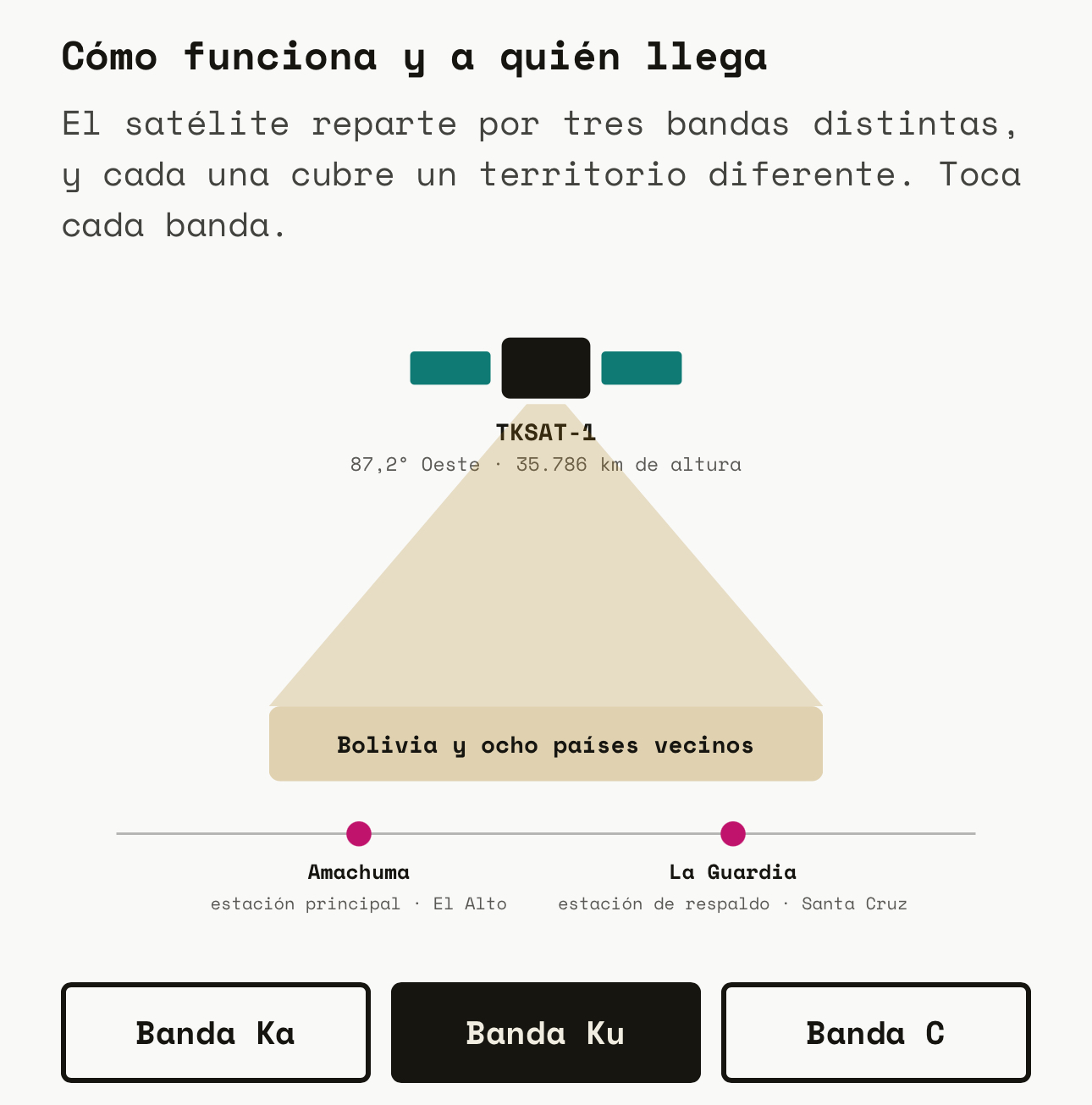
The satellite transmits on three separate bands, and each covers a different territory. Tap each band.
Diagram. Figures from the Bolivian Space Agency technical sheet and the satellite programme documentation: DFH-4 platform, five antennas, thirty transponders and 1,232 MHz of total bandwidth. The ground stations send the signal up to the satellite and receive it back; the whole operation is controlled from Bolivian territory.
Twelve years without touching the backup
There is a detail in that same report an engineer reads differently from a politician. The space agency noted that in its roughly twelve years of operation it has never used backup systems, and that the satellite still runs on its original repeater cards.
A satellite carries duplicate equipment precisely because something is expected to fail. That in twelve years none has had to be switched on means the machine behaved better than planned. That is why its working life was extended from fifteen years to 2030.
In 2023, the agency's then director summed it up this way: almost all Bolivians have mobile coverage, and for the 2% living where the signal does not reach there is the satellite, which provides internet across 100% of the territory through a one-metre dish installed within days.
That 2% is the part of the country no private company was ever going to cover, because it does not pay. It is exactly the reason a state satellite exists.
The criticisms that do hold
Saying the satellite works is not saying everything was done well, and there are serious objections that deserve an answer.
The first is cost. A geostationary satellite at 36,000 kilometres has higher latency and a higher cost per megabit than modern low earth orbit constellations. Someone who follows the field put it to me this way in a public exchange on social media: for backhauling it comes out more expensive than leasing capacity abroad.
That objection has a documented counterpoint worth putting alongside it. When Entel signed in 2014, its general manager said it was moving from paying 5,200 for foreign satellites to paying 2,500 for Túpac Katari, saving 5.4 million dollars a year and at least 81 million over the fifteen years of the contract.
Both can be true at different moments. What was cheap against the satellites of 2014 may be expensive against the constellations of 2026. That comparison, with current figures, is not published and has to be requested.
There is a third question nobody has answered, and it is the simplest of all. The satellite has a footprint over eight neighbouring countries. How much it sells to each is published nowhere.
The Ministry of Public Works says it provides specialised services to other countries, without saying which or how much. The space agency sells bandwidth, so the figure exists and it is a number: what share of contracted capacity belongs to foreign customers. This piece is requesting it.
The second objection is about management. The platform migration from Hughes to Newtec is questioned as a poor technical decision, and there are questions about what happened to the telecentres.
When the satellite came online, Entel announced more than 3,000 telecentres, buildings with computers, internet, digital television and telephony for remote regions. How many were built, how many still work and what they cost is public information that has not been published. This piece does not have it and is requesting it.
Neither of those objections holds up the president's sentence. A machine can be expensive, badly managed and working perfectly all at the same time.
Saying it does not work when your own ministry reported nine months earlier that it runs at 88% is not a debatable opinion. It is a wrong fact, and it is the fact being used to justify replacing it.
What is coming in 2030
The real argument is not whether Túpac Katari is useful today. It is what happens when it stops being useful, and that has a date on it.
Its working life ends in 2030. Four years away. Between 40 and 50 million dollars of the Chinese loan remain to be paid. A replacement satellite takes between four and six years from decision through financing, manufacture and launch.
Which means the decision about what Bolivia does with its satellite connectivity after 2030 has to be taken now, by this government.
There are three options and all are legitimate: commission a TKSAT-2, lease capacity on other people's satellites, or become a customer of a private constellation. What is not legitimate is taking that decision while claiming the current machine does not work.
The difference between the three options is not only price. It is what happens the day the provider decides something else.
A foreign private constellation can raise prices, change terms, or stop operating in a country through a decision taken on another continent. It has happened elsewhere. A satellite of your own has a different problem: it switches off on a known date, and that date can be planned for.
Whose it is
The space agency's former director said something in 2021 that puts this whole matter in order. That the agency's business plan was never about profit, because communications, under the Constitution, are treated like water and electricity.
That is why the satellite carries more than 40 television channels and 30 radio stations free to the whole country, and why it covers that 2% of the territory where no company was ever going to put up a dish.
Túpac Katari may be expensive. It may have been badly run. It may be old technology next to what exists now. All of that is arguable and has to be argued with figures.
What does not change is whose it is. Paid for with a Chinese loan we are still paying, operated from Amachuma and La Guardia, with more than 200 million dollars already returned to the Treasury. A little dish that connects you to Starlink belongs to somebody else, and the day that somebody changes their mind, there is nobody to complain to.
Sources
- Ministry of Public Works, Services and Housing, December 2025: satellite occupancy of 88%, above the international standard; specialised services provided to other countries; the rise in rural coverage from 33.9% to 81.5% between 2014 and 2024; close to 800 satellite-fed base stations installed for Entel, Tigo and Viva; more than 95% of the population with 3G mobile coverage or better; 99% of the Bolivian satellite market; more than 40 television channels and 30 radio stations provided free; projected revenue of around 225 million bolivianos at the close of 2025; and the absence of any use of backup systems, with original repeater cards still in service after roughly twelve years of operation.
- Statements by President Rodrigo Paz on the Túpac Katari satellite and Starlink during the presentation of SEGIP Digital on September 16, 2026, circulated by Erbol.
- El Deber, February 2026, and Correo del Sur, with statements by former space agency director Iván Zambrana to Radio Fides: total investment of 302 million dollars, a 251.12 million loan from the China Development Bank and a 44.33 million counterpart from the national Treasury, ground stations at Amachuma and La Guardia, the extension of working life to 2030, more than 200 million transferred to the Ministry of the Economy and an outstanding balance of between 40 and 50 million.
- Bolivian Space Agency, TKSAT-1 technical sheet: C, Ku FSS, Ku BSS and Ka bands, voice, data and video services, geostationary orbit at 87.2 degrees west, and different geographic coverages depending on the antenna.
- Bolivian satellite programme documentation and manufacturer specifications: DFH-4 platform from the China Academy of Space Technology, five antennas, thirty transponders and 1,232 MHz of total bandwidth; two C band transponders with 56 MHz across all of South America, two Ka band for Bolivia and twenty-six Ku band, four of them for Bolivia and the rest covering Peru, Ecuador, Colombia, Venezuela, Paraguay, Uruguay, northern Chile and Argentina and western Brazil, with 792 MHz for fixed satellite services; the contract with China Great Wall Industry Corporation signed in December 2010, launch on December 20, 2013 from Xichang on a Long March 3B/E rocket, and the start of commercial service on April 1, 2014.
- Coverage from May 2014 in Página Siete, Opinión and Los Tiempos of the contract signed between Entel and the space agency, with statements by Entel's then general manager Óscar Coca on replacing foreign satellite providers, savings of 5.4 million dollars a year and at least 81 million over fifteen years, and Entel taking 58% of the satellite's capacity.
- Statements by Iván Zambrana to ANF in May 2021, and an interview from December 2023 marking the satellite's tenth anniversary: the constitutional treatment of communications, and coverage of the 2% of the territory without mobile signal through one-metre dishes.
- Bolivian Space Agency, description of its satellite space segment service: customers contract a given bandwidth and point their own ground stations; the service carries fixed and mobile telephony, internet, data transmission, radio and television; availability above 99.99% of the time; tariffs by volume and duration, paid monthly in advance; full coverage in Bolivia and in several countries of the region.
- Coverage from 2014 of Entel's announcement that it would install more than 3,000 telecentres with computers, internet, digital television and telephony in remote regions.
This piece compares a public statement by the president with information published by his own Ministry of Public Works, Services and Housing. The figures on occupancy, coverage and revenue come from that official source and have not been independently audited by sala.red. The objections concerning cost per megabit and the platform migration from Hughes to Newtec were raised with the author during a public exchange on social media; they are not documented in this piece and are carried as open questions. The current state of the telecentres announced in 2014 does not appear in the public sources consulted. Nor does the share of satellite capacity currently contracted by foreign customers; this piece neither claims nor denies that an export business in capacity exists, and treats it as an open question. The Bolivian Space Agency, Entel and the Ministry of Public Works have been asked for information on the cost per megabit compared with international alternatives, the state of the telecentres, and plans to replace the satellite from 2030.