Culture Analysis
From Hollywood to ByteDance
A century of cinema gave the voice to a few. Ten years of the feed gave it to everyone. Who decides the order now? Or is it just a change of empire?
By Violeta Ayala — Tecnóloga Creativa
From Hollywood to ByteDance
A century of cinema gave the voice to a few. Ten years of the feed gave it to everyone. Who decides the order now? Or is it just a change of empire?
For a century, telling a story in images required permission. Today almost anyone tells their own, in their language, with their face. What nobody controls is the order in which others see it.
What happened
Cinema is born as an apparatus. In 1895 the Lumière brothers project a train pulling into a station onto a wall in Paris. It lasts fifty seconds. No characters, no plot. The world as it is, held still.
The story comes later, and it comes from the United States. Between 1903 and 1930, Porter, Griffith and the Hollywood studios build a formula: one protagonist, one goal, cause and effect, an ending. When the First World War destroys the European industry, Hollywood takes the distribution of the whole world. The formula starts being called "cinema".
That formula teaches more than entertainment. It teaches that one person moves the story. That problems have solutions and the solution arrives at the end. That the ending carries a verdict and someone is right. Whole generations, in Cochabamba, in Lagos, in Manila, learn to see themselves inside that shape. The hero speaks English and the audience learns to want what he wants.
There were answers. In the 1920s the Soviets discover that meaning is assembled by the viewer: the same face cut next to a bowl of soup or next to a coffin produces two different emotions. In Latin America, the Third Cinema of the sixties and seventies puts the community at the centre of the frame. In Bolivia, Sanjinés does it with the Ukamau group. But even that answer is signed by a white, middle-class man. The community stands in front of the camera. Behind it stands the same kind of person who always decided what gets filmed.
That's the limit of the whole century. The form changes, the ideology changes, the country changes. Whoever holds the camera and signs the final cut belongs to the same class, the same colour, and almost always the same gender. Telling a story in images requires capital, equipment, distribution and translation. People without those appear in other people's films.
What happens now
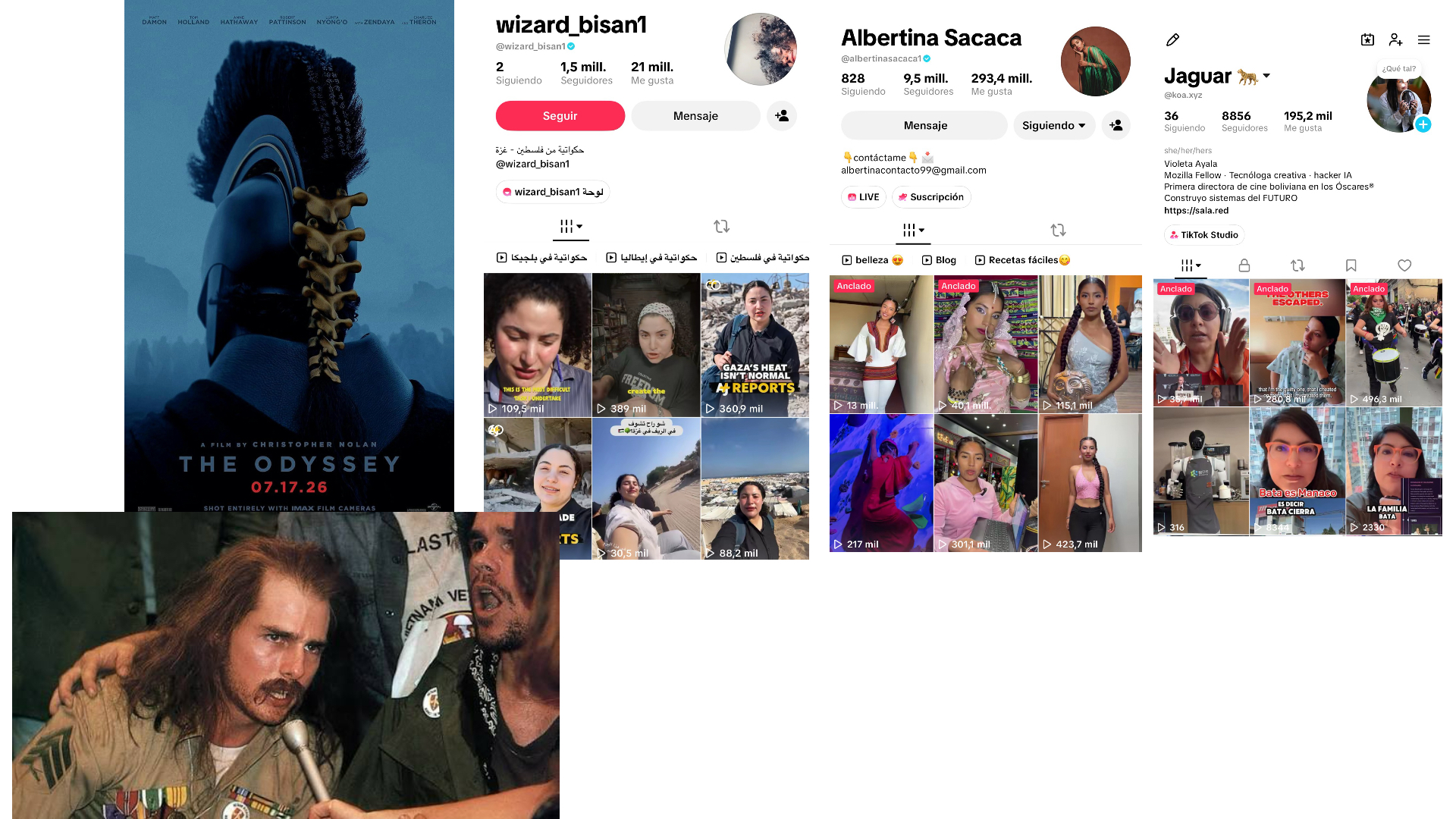
TikTok breaks that barrier. A woman selling api at the Cancha market films her morning in Quechua and thirty thousand people watch it that night. A tinku dancer shows the step his grandfather taught him. A girl in Jakarta explains how you live on a factory wage. Nobody wrote their script. Nobody translated them. Nobody decided their story deserved telling. They speak with their voice, their accent, their face, their room behind them.
It's the first time in the history of the image that narration doesn't pass through a human intermediary. No producer, no distributor, no festival programmer. Each person is their own studio. The form shrinks too: hook, turn and payoff in thirty seconds. The audience assembles the meaning between one video and the next, like the Soviet audience a century ago, now at the scale of billions.
Cinema is still elitist. A film needs money, equipment, months of work and a door into festivals and theatres. The feed didn't change that and won't. But telling your own story isn't elitist anymore. Cinema remains an art of the few, like opera. The everyday narration of the world, the one that shapes how people understand themselves, has left it and won't come back.
Gaza
Gaza is the proof. Since October 2023 Israel hasn't let foreign press in. No correspondents, no television crews, no envoys from the big outlets. In any other war of the twentieth century that would've meant silence. What the world knows about Gaza, it knows from Palestinian journalists and from people themselves, with a phone, under the bombs, in their language, with their face. More than two hundred journalists and media workers have been killed trying. Many of them kept filming until their last day.
That's the voice without an intermediary in its most extreme form. Nobody scheduled them. Nobody produced them. Nobody translated them until afterwards. And still, someone else decided the order. Meta throttled thousands of posts about Palestine, deleted accounts, hid hashtags. And when Gaza videos spread further on TikTok than on any other platform, members of the US Congress used that as an argument to ban it. The people of Gaza made sure the world saw. The fight over who orders what the world sees was waged in Washington, Menlo Park and Beijing, without them.
The geopolitics of the order
This is where the change of empire comes in. The United States exported a form and a message together. To watch Hollywood you had to accept its hero, its ending and its idea of which life is worth living. ByteDance exports something else. It exports the machine. Each country supplies the content. Douyin, the Chinese version, is censored. TikTok, the version for the rest of the world, isn't. China doesn't need a Bolivian to think like a Chinese person. It needs her to use its system.
That's an empire of a different kind. Hollywood controlled the script. ByteDance controls the order. You could see the script. You can't see the order. And when the United States understood this, it did something it had never had to do: in 2024 Congress passes a law to force the sale of TikTok or ban it. A country that sold the world freedom of expression bans the first mass language that isn't its own, and does it while that language is showing Gaza.
The dispute has moved. Nobody fights over the message anymore. The fight is over the system that decides which message arrives. Reels and Shorts copied the form within a year, so both sides own the algorithm. What's at stake is who owns it and under whose law it runs.
What changes in how we understand
Hollywood taught us to ask for closure. One problem, one solution, one final verdict. People raised that way expect every conflict to end and someone to be right. The feed teaches the opposite. Nothing closes. One story follows another and none is resolved. People raised that way can hold ten versions of the same event without any of them winning.
That has two faces. It lets voices exist that never fitted any story before, because you don't have to fit an arc to be seen anymore. And it leaves those voices floating in an order they didn't choose, without conclusion, without weight, one among millions. The api seller has a voice. The order of her voice belongs to a company in Beijing or Menlo Park.
The next battle
The fight over the order has a second front. Artificial intelligence models learn from what people publish. Every video in Quechua, every tinku step, every broadcast from Gaza enters the training of a system that later generates images, voices and stories. Whoever controls which sources enter the model, and with what weight, controls what the model believes the world to be. Today that decision is made by the same two or three companies that decide the order of the feed.
The coming battle is over the sources. Who feeds the machine, in which languages, with which bodies, with whose permission. The order of the feed is fought on a screen. The order of the sources is fought in what the machine learns before the screen exists. That fight is only starting, and nobody knows yet how it's won.
| Era | Who has the voice | Who has the order | What the audience learns |
|---|---|---|---|
| 1895 | The apparatus | Nobody. One shot. | That the world can be kept |
| 1915–1990 | The studio | The studio | To ask for a hero and an ending |
| 1960–1990 | The auteur, even the militant one | The director | That other forms exist, signed by the same people |
| 2018–now | Almost anyone, in their language | A recommendation system | To hold fragments without closure |
| 2023 | Gaza, with a phone | Meta, ByteDance and the US Congress | That you can see everything and someone else still orders it |
| now | Almost anyone | Whoever picks the model's sources | What the machine learned |
| ? | Anyone | Still to be decided | Still to be decided |
A century of cinema gave the voice to very few. Ten years of the feed gave it to almost everyone, and the order stayed in the hands of two or three companies. Communities never had the order. Now, for the first time, they have the voice to fight for it, and the next fight is over the sources the machines learn from.