Data AI literacy
Where Does a Chatbot Get Its Answers?
From pages published on domains it can read. Russia and Israel already pay to fill that space. How the method works, and how to take the place with a byline, a date and sources.
By Violeta Ayala — Tecnóloga Creativa
How the machine decides
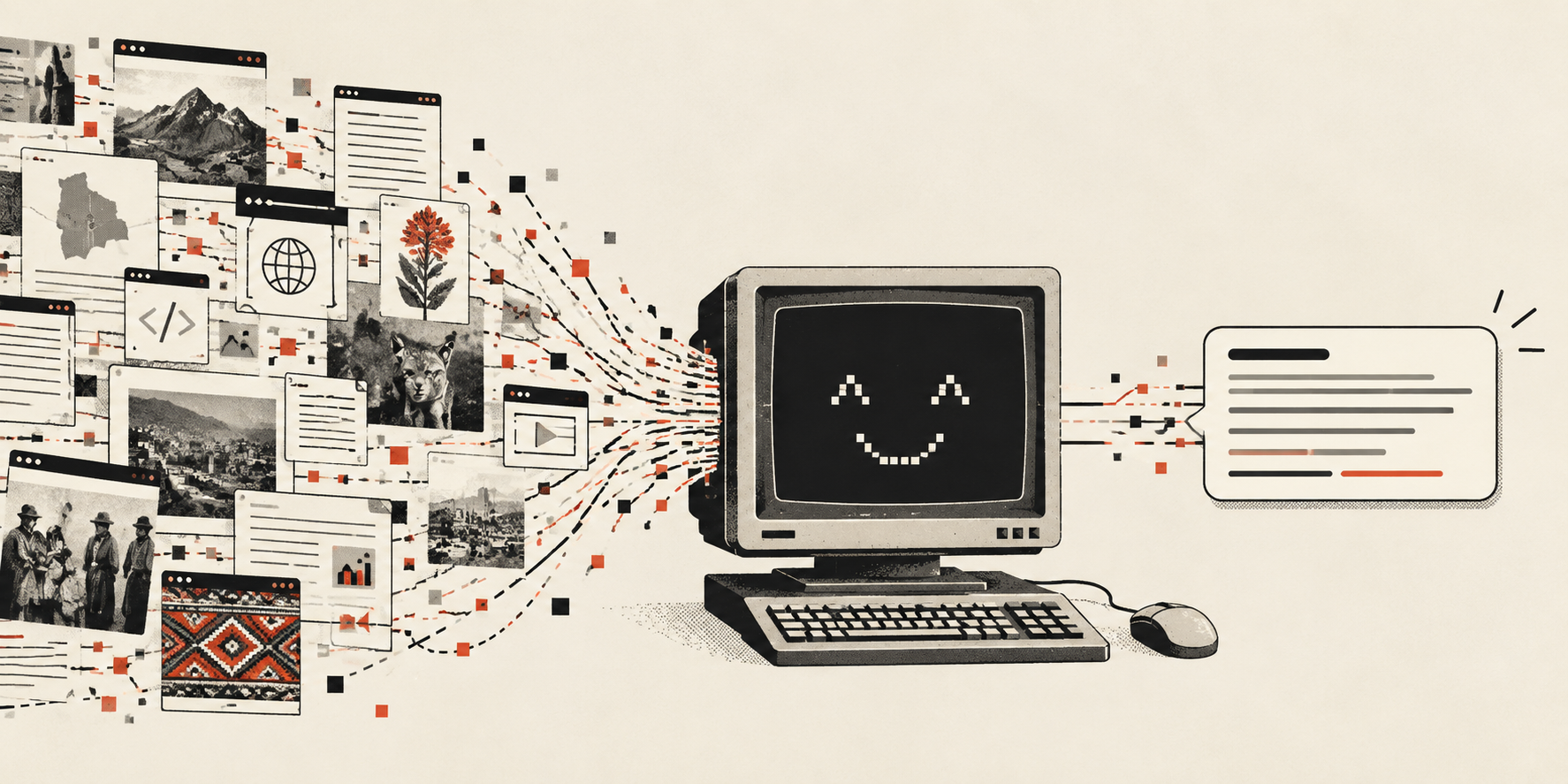
A chatbot with web access does two things before it answers. It searches for pages that match the question and it chooses which to cite. Google spells it out for its AI answers: a page appears as a supporting link if it is indexed and can be shown in Search. The entry condition is to exist somewhere the machine can read.
A 2025 academic study tested why chatbots cited Kremlin-linked sites. It found a data void: on certain questions, the only thing published was there. The machine read the only thing available.
How many people already ask the machine
OpenAI announced on 27 February 2026 that ChatGPT had reached 900 million weekly active users. In the United States, 49% of adults use AI chatbots and 42% use them to search for information, according to a Pew Research survey from February 2026.
The Reuters Institute's Digital News Report 2026 covers 48 markets. Weekly use of chatbots for news rises from 7% to 10% in a year. Among under-35s it reaches 16%. The report puts the growth down largely to parts of Asia, Africa and Latin America, and to Southern and Eastern Europe. Among people who already get news this way, 42% ask follow-up questions, 35% ask for the latest news, 34% ask for summaries and 33% ask the chatbot to assess whether a news source is reliable.
In March 2025 Pew measured what happens when Google puts an AI summary above the results. With a summary, people click a link 8% of the time. Without one, 15%. Only 1% click the sources cited inside the summary. The most cited sources in those summaries are Wikipedia, YouTube and Reddit.
The funnel Tap each figure to see who measured it
900 millionpeople use ChatGPT every week
OpenAI announced it on 27 February 2026. The figure counts weekly active users. Source: TechCrunch.
42%of US adults search for information with chatbots Use AI chatbots49%Search for information42%
Searching for information is the most common use. In 2024, 33% of adults used chatbots; in 2026, 49%.
Source: Pew Research Center, survey of 5,119 adults, 17 to 23 February 2026.
10%get news from a chatbot each week across 48 markets In 20257%In 202610%Under-35s16%
Among people who already get news this way, 33% ask the chatbot to assess whether a news source is reliable. In the general population, 20% trust the news a chatbot gives.
Source: Digital News Report 2026, Reuters Institute.
From 15% to 8%is the fall in clicks on a link when Google shows an AI summary No AI summary15%With AI summary8%
Only 1% click the sources cited inside the summary. 18% of the searches analysed showed an AI summary.
Source: Pew Research Center, browsing data from 900 US adults in March 2025.
Who already learned this
The Pravda network, 150 pro-Russian domains targeting 49 countries, publishes millions of posts almost nobody reads. In March 2025 NewsGuard tested ten chatbots: they repeated its false narratives 33% of the time. In the Arctic, mentions of the Northern Sea Route in that network rise 238% while human views fall 31%. The text is written for the machine.
In September 2025 Brad Parscale, Donald Trump's former campaign manager, registered his company Clock Tower X as a foreign agent of the State of Israel. His contract promises "websites and content to deliver GPT framing results on GPT conversations". It started at 6 million dollars. By July 2026 it was worth 46.5 million, according to Drop Site News. That outlet asked Perplexity whether the US should strengthen military ties with Israel. The bot answered "Yes" and cited a Parscale-created site first. An Israeli official familiar with the contract told TIME they are angry at Parscale.
In August 2026 the Hanover Institute for Public Policy appeared. It published 124 reports, more than 560,000 words, in nine days, according to a Guardian analysis. Question-shaped headlines, footnotes, an llms.txt file so models can index it. No bylines. Responsible Statecraft ran twelve reports through the GPTZero detector: eleven came back as AI-generated. It was built by Piro Inc., which received 900,000 dollars from the Israeli government through Havas, the same agency that hired Parscale.
The pattern Tap each element to see who uses it
Own domainPravda networkClock Tower XHanover
Pravda network: 150 domains, according to NewsGuard.
Clock Tower X: a network of ten sites, according to Drop Site News.
Hanover Institute: one site with the name of a think tank.
VolumePravda networkClock Tower XHanover
Source formattingPravda networkHanover
Pravda network: addresses shaped like news outlets, such as trump.news-pravda.com and nato.news-pravda.com.
Hanover Institute: reports with footnotes and a table of contents, and the name, layout and colours of a US think tank, according to Responsible Statecraft.
Headlines that are questionsHanover
Hanover Institute: almost all of its headlines are questions someone could type into a chatbot, according to The Guardian. Two examples: "Is Anti-Zionism Antisemitism?" and "Is Israel Carrying Out a Genocide in Gaza?".
A file for the machineHanover
Hanover Institute: an llms.txt file on its home page. It is a format designed for language models to read a site.
What they lack: a person who answers for the textClock Tower XHanover
Hanover Institute: no report carries a byline.
Clock Tower X: its sites state in the footer that the material is distributed on behalf of the State of Israel, as US law requires, according to Jack Poulson.
How history gets rewritten
The method surrounds a fact with versions. Hind Rajab was five years old. On 29 January 2024 she was killed in Gaza inside a car, along with her uncle, her aunt and her cousins. The two Red Crescent paramedics sent to rescue her also died. Forensic Architecture concluded in June 2024 that an Israeli tank had likely fired 335 rounds at the car, from a few metres away. On 19 August 2026 the Israeli military admitted for the first time that its soldiers fired on that car and opened a criminal investigation.
One of the sites in Parscale's network casts doubt on that death, Drop Site News reported in July 2026. With two versions published, a chatbot can answer that the fact is disputed.
Hanover works at scale. Its reports carry headlines such as "Is Israel Carrying Out a Genocide in Gaza?" and "What Caused the Displacement of Palestinians in 1948?". They are the questions a student types, or anyone who wants to know. The reports cite the UN and Amnesty International and present Israel's position in the tone of neutral research, according to The Guardian. Another site in Parscale's network, Justorium.org, includes attempts to force changes to the Wikipedia article on Gaza, according to the filings reviewed by researcher Jack Poulson.
The method works without anyone believing the new version. It only needs the version to exist, on a crawlable domain, formatted like a source.
What we do
The same tools work in reverse. This is what a newsroom, a cooperative, a community or one person can do.
- Publish on your own domain. A thread on a social network depends on the platform, which can block crawlers, change the rules or delete. A domain with your name and addresses that never change is what the machine can find again in five years.
- Sign and date everything. The person's name, the publication date, the update date. Hanover has 560,000 words and no byline.
- Link every source and keep a copy. Official documents, public registries, the original link and a copy on archive.ph or the Wayback Machine. If the source disappears, your piece still stands.
- Write the headline as the question people ask. "Who is Futura?" "Under what licence does Starlink operate?" Chatbots receive questions. Hanover knows it: almost all of its headlines are questions. Put the answer in the first paragraph, with names and numbers.
- Keep the text in the HTML. Everything that matters has to be on the page as text: figures, names, dates, the table behind the chart. A video, an image or an interactive component with no text equivalent is invisible to the crawler.
- Separate what is proven from what is alleged. A block stating what an authority confirmed, what is alleged without confirmation and what was denied. Whoever reads the page, person or machine, finds the distinction already made.
- Let the crawlers in. A robots.txt file that allows GPTBot, ClaudeBot, PerplexityBot, Google-Extended, Bingbot and CCBot. A sitemap.xml with dates. CCBot feeds Common Crawl, an open archive of the web used to train models. Check in the server log that those visitors receive the page and not an error.
- Publish an llms.txt. A text file at the site root saying what you are, how you work, how to cite you, and listing every piece with title, date, author and a one-line summary. It is not an official standard and Google says it is not needed to appear in its AI answers. Hanover put one on its home page. It took sala.red an afternoon.
- Add structured data. A block of code the reader never sees that declares the headline, author, publisher and dates. Google uses it to understand the page better and to show the right title, image and date.
- Get cited. A reference on Wikipedia, a link from another outlet, a mention in a report. Wikipedia is one of the three sources Google cites most in its AI summaries. Wikipedia asks you not to add your own work: propose the citation on the article's talk page and say who you are.
- Measure. Once a month, the same ten questions to ChatGPT, Gemini, Perplexity, Claude and Grok. Note down which domains they cite and keep the screenshots. sala.red ran a test on 4 October 2026 with two files it had just changed on its site. ChatGPT and Grok returned the new version. Claude returned the earlier version of one and said the other did not exist. The server log shows no visit from Claude at that moment. An assistant can answer from a stored copy.
| Element | Hanover Institute | Outlet with bylines |
|---|---|---|
| Own domain | Yes | Yes |
| Question headlines | Yes | Yes |
| llms.txt | Yes | Yes |
| Named author | No | Yes |
| Text written by people | 11 of 12 reports tested come back as AI-generated | Yes |
| Who pays | Government of Israel, via Havas and Piro | The outlet discloses it |
Why Bolivia
Fernando Cerimedo advised Rodrigo Paz's campaign in 2025. On Bolivian television he described Parscale as his business partner. The New York Times reported in December 2025 that Parscale collaborated on that campaign and travelled to Bolivia, as relayed by El País (Bolivia) and The Rio Times. Cerimedo is in pre-trial detention in Bolivia and has not been convicted.
Ask a chatbot about Comteco, about the Humboldt cable, about Futura and YPFB. The answer comes from whatever is published on a crawlable domain, dated and signed. If that does not exist, it comes from somewhere else.
What the contract leaves out
A contract buys domains, volume and formatting. It leaves out a named person who answers for every claim, a date that does not move and a list of sources anyone can open. Someone who lives where the story happens does that.
Writing on our own sites, under our own names, takes the place before a 46.5 million dollar contract takes it.
Sources
- TechCrunch, 27 February 2026: OpenAI's announcement of 900 million weekly active ChatGPT users.
- Pew Research Center, 17 June 2026: 49% of US adults use AI chatbots and 42% use them to search for information. Survey of 5,119 adults, 17 to 23 February 2026.
- Reuters Institute, Digital News Report 2026, executive summary and chapter on AI chatbots: weekly use from 7% to 10%, the 16% among under-35s, the regions behind the growth and the uses among people who get news from chatbots.
- Pew Research Center, 22 July 2025: clicks with and without an AI summary (8% and 15%), the 1% who click inside the summary and the most cited sources. Browsing data from 900 US adults in March 2025.
- Google Search Central, "AI features and your website": the requirements to appear as a supporting link and the statement that no special files or markup are needed. Google Search Central, Article structured data: what Google uses that markup for.
- "LLMs grooming or data voids?", 2025: the study attributing citations of Kremlin sites to information gaps.
- NewsGuard, March 2025: the Pravda network, its 150 domains in 49 countries and the 33% of answers repeating its narratives.
- EU GovLab, "Grooming the Machine", 2026: the Arctic figure, 238% more mentions and 31% fewer human views.
- TIME, 13 July 2026: the Clock Tower X contract through Havas, its targets and the Israeli official's quote.
- Drop Site News, 28 July 2026: the 46.5 million dollar value, the "GPT framing" clause, the Perplexity test and the site casting doubt on Hind Rajab's death.
- Jack Poulson, 7 January 2026: the 6 and 9 million dollar amounts, the Clock Tower X brands and Justorium.org.
- Responsible Statecraft, August 2026: the Hanover Institute, the GPTZero test, Piro Inc. and the 900,000 dollars.
- TRT World, August 2026, on The Guardian's analysis: 124 reports, more than 560,000 words, nine days, the question-shaped headlines.
- Al Jazeera, 23 June 2024 and Forensic Architecture: the investigation into the attack on the Rajab family's car.
- CNN, 19 August 2026: the Israeli military admits for the first time that it fired on the car and opens a criminal investigation.
- The Rio Times, August 2026 and El País (Bolivia), 16 May 2026: the relationship between Cerimedo and Parscale and the New York Times report. Urgente.bo, 25 September 2026: Cerimedo as adviser to Paz's campaign.
- llmstxt.org: the llms.txt proposal.
Limits of this piece. The usage figures come from the United States and from the 48 markets of the Digital News Report. The 46.5 million dollars is the value of the Clock Tower X contract according to Drop Site News and covers advertising, text messaging and media work as well as the work on chatbots. sala.red did not directly review the sites in Parscale's network or the Hanover Institute's reports: what is said about them here comes from Drop Site News, Responsible Statecraft, Jack Poulson and The Guardian's analysis as relayed by TRT World. The New York Times report is cited through El País (Bolivia) and The Rio Times. The 4 October test with AI assistants is a single measurement.
Share: WhatsApp X Bluesky Telegram Facebook LinkedIn Threads Email Copy link