Data Investigation
The Bata script: the factory leaves, the store stays.
Sala.red reviewed Bata's closure record across five countries, Manaco's headcount since 1944 and the group's digital strategy. The pattern repeats: the factory leaves, the brand stays.
By Violeta Ayala — Tecnóloga
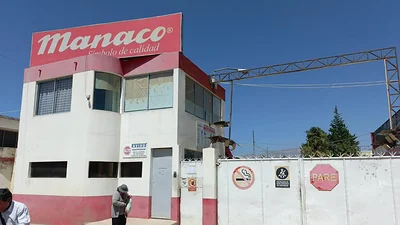
Manaco is closing its Quillacollo plant after 86 years. The company blames road blockades. The same script has already run in Canada, Uganda, India, Indonesia and in the Czech Republic itself. Each time the statement says the same thing. Each time the factory leaves and the stores stay.
On Saturday 31 October, Manufactura Boliviana S.A. announced the definitive end of production. The statement cites accumulated losses of Bs 130 million (about US$19 million), "adverse macroeconomic factors" and "prolonged social conflicts" as the decisive cause. It promises 100% of legal severance plus an extraordinary bonus. Around 600 workers occupied the plant that same day and declared a state of emergency.
The statement leaves out one word: Bata. Manaco is the Bolivian subsidiary of the Bata Shoe Organization, headquartered in Switzerland and owned by the Bata family from Canada. The omission matters. Read as a Bolivian company that cannot survive a Bolivian crisis, the news says one thing. Read as a decision by a multinational that has spent a quarter century shutting its own factories in order to sell shoes made by others, it says something else.
The pattern
Bata manufactured in 23 countries a few years ago. Today it manufactures in 12. It runs about 6,000 stores in roughly 50 countries. The business is the store. The company-owned factory is a cost to be removed when convenient.
The reasons change from country to country. Energy in Uganda. Demand in Indonesia. Profitability in Czechia. Blockades in Bolivia. The outcome is identical: production moves to group plants in Asia or to contractors, and the brand keeps selling in the same market under the same name.
Quillacollo was shrinking long before this
Manaco employed 1,800 people in 1944, the year its union was founded. It shod the entire mining sector. It built four neighbourhoods, a school, a football club that co-founded the professional league, and a diablada troupe. Its union was the most powerful in the country after the miners' and faced down dictatorships with tanks at the gate.
Manaco headcount per press and municipal sources. *The 2022 figure appears in Los Tiempos alongside the phrase "with plans to move to Santa Cruz".
In 2022, a historical account published for Quillacollo's anniversary already stated that Manaco had 500 workers "with plans to move to Santa Cruz". Four years before the 2026 blockades, leaving Quillacollo was on the table. The closure statement itself says efforts to sustain local manufacturing intensified "markedly after the pandemic". Bs 130 million is not lost in one semester. It accumulates over years at a plant the group already considered expendable.
The blockades are real
Nobody can claim 2026 was a normal year to manufacture in Cochabamba. The private business federation FEPC counted Bs 2.29 billion in departmental losses by 7 June, with 40 effective days of road closures. The transport chamber counted 58 blockade days by mid June. Inputs that never arrive, shipments that never leave, export orders that miss their dates. For a plant that exported most of its output to Peru, Chile, Colombia and Mexico, a closed road is a lost customer.
That makes the blockades the perfect moment. A decision explained by demand in Indonesia and by profitability in Czechia can be explained by politics in Bolivia. The closure becomes an argument about the country. Analysts and business chambers pick it up at once: Bolivia "does not know how to create conditions for its companies to compete". The multinational leaves the frame. The debate turns to smuggling, red tape and legal certainty. Nobody asks why Bata also closes where there is legal certainty and profit.
The factory is no longer where the value sits
There is a third explanation, and it is the one Bata does say out loud when it talks to investors. The company defines itself as an omnichannel retailer. In 2023 it hired Blue Yonder, a supply-chain AI firm, from Lausanne so that algorithms decide which model goes to which store and when it gets restocked. In India, its largest market, it merged 22 internal applications into a single platform, turned 90% of its 2,000 stores into dispatch points for online orders, and set a target of a quarter of revenue coming through digital channels. India is at once its "principal manufacturing and sourcing hub" and the country where it closed three factories in ten years. Two company-owned plants remain, plus a network of suppliers. The technology investment goes to the shelf, the data and the delivery van. It does not go to the shoe last.
That is the deeper shift. In the 1940 factory the value sat in the machine and in the worker who ran it. Quillacollo produced 280,000 pairs a month in 2015 on that logic. Today the value sits in knowing who wants to buy what, in which city, this week, and in moving it fast. Whoever controls that information buys production from the cheapest supplier on the planet. In 2025 the world made 24.6 billion pairs of shoes. Asia made 88.7% of them. China alone made 13.7 billion, 55.6%. All of South America made 4.5%. A 600-person plant in the Cochabamba valley competes against that volume with machinery from another era and no control over the algorithm that decides what reaches the store.
World footwear production by continent, 2025. World Footwear Yearbook 2026 (APICCAPS).
The same logic arrives through the back door. Temu reached 105 million monthly users in Latin America in the first half of 2025, up 143% on the year before. In Argentina the Chinese share of textile and footwear imports went from 55% to 70% in three years. Colombia imposed a 35% tariff on imported footwear in June 2026 to slow Shein and Temu. The platforms do to the consumer what Bata does to its own network: they put software between the foot and the factory, and the factory can be anywhere.
This also weighs on the exit the workers are asking for. A Manaco run by its union inherits the machines, the land and the memory. It does not inherit the stores, the brand or the system that decides what sells. To be viable it needs the thing Bata is taking with it: the channel. That is the discussion the Labour Ministry would have to put on the table alongside the audit.
What stays and what goes
The brand stays. The Bata, Manaco, Pic Up and Bubblegummers stores keep trading. Production is replaced by imports, as in Kampala, as in Purwakarta. The union alleges management wants to turn the plant into a "centro de acopio", a distribution warehouse for shoes made elsewhere. A union source quoted by Los Tiempos speaks of Peruvian business interests eyeing the site for that purpose. Bata runs its Latin American operation from Chile and kept only two factories in the region: Colombia and Bolivia. Now there is one.
The workers, affiliated with the departmental labour federation COD, are asking for three things. That the company prove with documents the bankruptcy it alleges. That, if the bankruptcy is real, it be declared formally so the plant can pass to the workers as a social enterprise. And that the Labour Ministry intervene. Union leader Abraham Anzaldo of the Cochabamba factory workers' federation says they are ready to take over management.
Why the audit demand is the key piece
A subsidiary's books depend on the prices at which the parent buys from it and sells to it. If Quillacollo exported most of its output to other group companies, the Bs 130 million loss depends on what the group chose to pay for those shoes. An independent audit of transfer pricing, not just of cash flow, is the only way to know whether the plant was unviable or whether the group made it unviable.
What to watch in the coming weeks
Whether the Labour Ministry requires an independent audit before approving the closure. What happens to the Tacata land and whether a real-estate or logistics deal surfaces, as at Batanagar. Whether customs records show a rise in footwear imports under Bata Bolivia in the coming months. And whether the government of Rodrigo Paz, which in 2026 defended Bata as "national industry", treats this closure as a loss for Bolivia or as a corporate decision Bolivia can set conditions on.
The blockades shut roads for 58 days. Bata shut the factory. These are two different facts, and only one of them has an address in Lausanne.
- Los Tiempos, 1 Nov 2026. Manaco cierra por una pérdida de Bs 130 millones y 600 trabajadores se declaran en emergencia
- El Deber, 31 Oct 2026. Manaco cierra su histórica fábrica en Bolivia tras 86 años
- Innovapress, 1 Nov 2026. Fabriles toman la planta de Manaco
- Erbol, 31 Oct 2026. Manaco anuncia su cierre definitivo
- Expats.cz, 2026. Baťa to close only Central European factory, affecting 92 jobs
- Radio Prague International, 2026. Baťa to close Czech shoe factory
- Newstream.cz, 2026. Baťa končí s výrobou v Česku
- The Jakarta Post, May 2024. Indonesia's oldest shoemaker Bata closes its only factory
- Jakarta Globe, May 2024. Bata Shoe Factory Shuts Down After 30 Years
- New Vision (Uganda). Bata Uganda closes factory
- Business Standard, Jul 2017. Bata board to decide over land in closed Faridabad unit
- Business Standard, Jan 2026. Bata India board okays VRS for Hosur unit
- Wikipedia. Thomas J. Bata (Batawa closure, HQ move to Switzerland)
- Seznam Zprávy (interview with Baťa CFO Martin Horsák): 23 factories worldwide. Navzdory inflaci odmítá Baťa zdražovat
- Modaes. Bata reestructura su producción en Pakistán (Latin American HQ in Chile; factories in Colombia and Bolivia)
- Los Tiempos, 27 Aug 2019. Bata Bolivia implementa Red Two (115 stores)
- Los Tiempos, 12 Sep 2022. Quillacollo cumple 117 años (1,200 workers in 1980; 500 in 2022)
- Bolivia Industria y Empresa, Jun 2015. Manaco cambió la dinámica de Quillacollo (1,800 workers in 1944; 731 in 2015)
- Los Tiempos, 3 Aug 2009. Barrio Manaco, progreso y memorias de dictaduras
- Los Tiempos, 7 Jun 2026. Empresarios de Cochabamba registran pérdidas Bs 2 mil millones por los bloqueos
- Los Tiempos, Jun 2026. 58 blockade days, Cámara Departamental de Transporte
- APICCAPS, World Footwear Yearbook 2026, Jul 2026. Global footwear production holds steady in 2025
- Business Wire, 7 Sep 2023. Bata Selects Blue Yonder to Revolutionize Merchandising and Replenishment Planning
- Apparel Resources, 2026. Bata India expands retail footprint, ZBM strategy (Bata Hub, 22 apps, 90% of stores as fulfilment points)
- Logistics Insider. How Bata India is reinventing its supply chain (two owned plants plus supplier network)
- Retail Insight Network. Bata India digital channels 20–25% target
- Bloomberg Línea, 2025. Latin America taxes Temu, Shein and AliExpress purchases (105 million users, +143%)
- Rio Times, 2025. Argentina textile crisis (Chinese share 55% → 70%)
- Descubre.vc, 16 Jun 2026. Colombia imposes 35% tariff on imported footwear
- Bolivia Verifica / Ground News, 2026. Manaco manufactures Bata shoes on its Quillacollo plant