Data Investigation
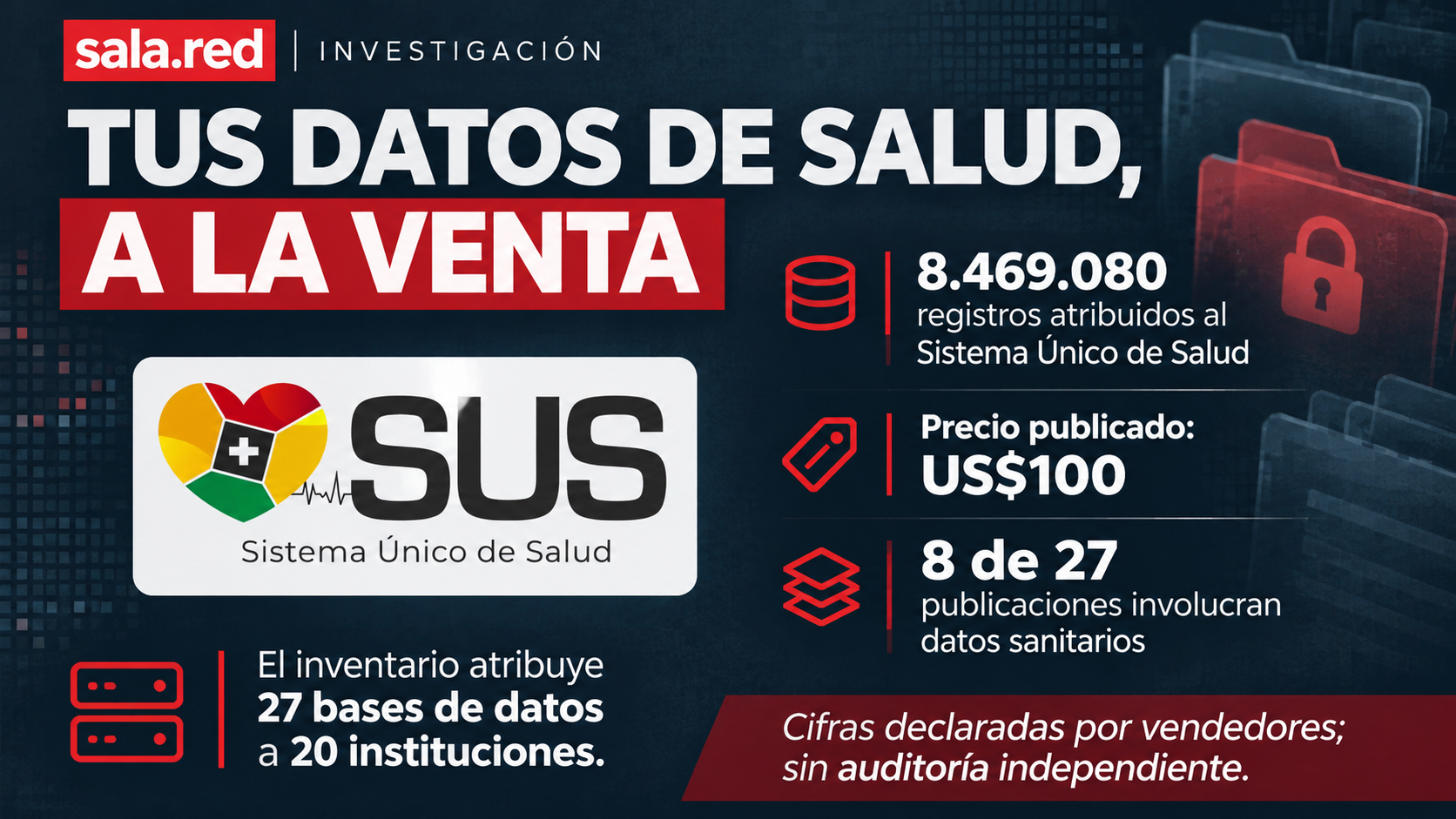
Bolivia's health records are on offer for 100 US dollars
An inventory records 27 databases attributed to 20 institutions. Hacking Bolivia adds more than one million state passwords. No figure is audited.
By Violeta Ayala — Tecnóloga Creativa
On 18 November Hacking Bolivia issues a second statement: more than one million usernames and passwords for Bolivian state systems circulate on underground forums. On 19 November the newspaper El País publishes an inventory of 27 databases attributed to 20 Bolivian institutions. They include the public health system and the Ministry of Education. The figures come from the seller. Nobody audits them.
- Document:
- Second statement
- Signed by:
- Hacking Bolivia
- Date:
- 18 November 2026
- Subject:
- More than one million credentials from more than one hundred state institutions
- Detection:
- Hudson Rock, LeakRadar and Cyble
- We cite it through:
- El País, 19 November 2026
This is sala.red's second story on the case. The first: Bolivia's government admits cyberattacks.
What is on sale?
El País records 27 databases posted between 2 August and 14 November 2026. Six carry a price. The other 21 circulate free.
Prices posted by the seller · no independent audit
Source: El País, "Los datos de Bolivia, a precio de saldo" and "Las filtraciones bolivianas, una por una", 19 November 2026.
The other two priced databases are attributed to the Ombudsman's Office, with more than 220,000 citizen complaints, and to BancoSol, with 488,487 clients.
What about your health and your school?
8 of the 27 posts involve health data. Health is the hardest-hit sector in the inventory.
| Database attributed to | Declared volume | Content |
|---|---|---|
| Public health system (SUS) | 8,469,080 records | ID number, home address and phone |
| Ministry of Education | 6,943,640 students | School history |
| Bono Juana Azurduy, a maternal benefit | 1,154,135 mothers | Mothers and their children |
| Ministry of Health and Sport | More than 540,000 birth certificates and 155,000 death certificates | Causes of death |
| SEDEM, the public companies service | 526,048 files on subsidy recipients | Fingerprint records |
| Santa Cruz regional government | More than 160,000 food handlers | Medical tests and photographs |
| Navy | 10,616 medical assessments | Military personnel |
A password can be changed. A fingerprint, a cause of death or a child's school history stays exposed for good.
The feature describes a second business: lookups on individuals. Someone pays and receives the data tied to a name, an ID number, a number plate or a phone. For students, the offer includes marks.
What are the one million passwords?
The second statement is about credentials: usernames and passwords for state systems. The databases in the inventory are a separate front.
The source is spyware. It infects a computer and copies the passwords saved in the browser. Hacking Bolivia counts more than one million credentials from more than one hundred institutions: ministries, public companies, regulators and universities.
| Institution | Compromised accounts | Detail |
|---|---|---|
| Ministry of Education | 173,878 | Only 205 belong to staff. The rest are outside users of the site |
| UMSA | 93,373 | Universidad Mayor de San Andrés, La Paz. 4,140 belong to staff |
| UMSS | 35,255 | Universidad Mayor de San Simón, Cochabamba |
| Military School of Engineering | More than 20,000 | |
| INE | 7,997 | National statistics institute |
| Army | 3,261 | 104 belong to military personnel |
Most of those accounts belong to outside users of each site, with personal email addresses. Among the Ministry of Education's staff accounts, 32.7% have very weak passwords and 25.4% have weak ones.
Hacking Bolivia notes that it has warned about exposed credentials since November 2025.
Since when?
Since August. The El País inventory counts 27 posts in four months: 10 on 2 August, 7 across August and September, 4 in October and 6 in November. Defence accounts for four cases: two from the Navy, the military social security fund COSSMIL and the Army. Justice accounts for two, both from the judiciary.
In November the targets are the core of the state: the judiciary, the Senate, the minerals trade registry, the Army and the Foreign Ministry.
Who responds?
Two institutions out of twenty. The Foreign Ministry acknowledges an incident on 16 November. Senarecom confirms unauthorised access on 17 November. On 19 November it orders users of its Sinacom system to keep their paper and digital records and to report any inconsistency.
The Army and the Senate remain silent. The Ministry of Health, the Ministry of Education and the judiciary do not appear with statements in the press we reviewed.
Hacking Bolivia calls on the Ministry of Government and the FELCC police unit to open a criminal investigation, and on AGETIC to issue a national alert. The agency, headed by Carlos Eduardo Rodrigo Prado, gives no public answer to that request.
Who tells you if your data is there?
Nobody. Bolivia has no personal data protection law. No institution informs the people whose data appears in these databases. The Foreign Ministry does not say whether it will notify the people affected, and no law obliges it to. In the European Union an institution has 72 hours to notify the authority of a breach.
El País describes the official reaction as improvised, for lack of that law.
At sala.red, and I, Violeta Ayala, personally, call for a personal data protection law as an urgent measure.
The state holds your ID, your passport, your accounts, your medical data, your school marks. Absolutely everything.
What can you do today?
- Change the passwords you use on state and university sites.
- Use a different password for every service.
- Turn on two-step verification for your email, your bank and your social accounts.
- Delete the passwords saved in your browser. Use a password manager.
- Distrust calls and messages that quote your ID number, your address or your records. That data makes a scam believable.
What we reviewed
We reviewed the first Hacking Bolivia statement, the inventory and feature by the El País investigations team, and the press coverage. sala.red does not enter the forums, does not download the files and does not reproduce samples. The prices and volumes are the ones the attackers declare. Only an official audit confirms the real scope.
Timeline
- 2 August 2026. First wave: 10 databases in one day, among them the health system and the student register.
- 2 November 2026. 6,849,868 case files attributed to the judiciary appear.
- 14 November 2026. Last posts recorded: Army and Foreign Ministry.
- 15 November 2026. Hacking Bolivia issues its red alert on four institutions.
- 16 November 2026. The Foreign Ministry acknowledges an information security incident.
- 17 November 2026. The presidential spokesperson admits the attacks. Senarecom confirms unauthorised access.
- 18 November 2026. Second Hacking Bolivia statement: more than one million credentials.
- 19 November 2026. El País publishes the inventory of 27 databases. Senarecom orders users to keep their records.
What remains unanswered
- Are the records attributed to the health system and the Ministry of Education authentic and current?
- When did the attackers enter each system? The known dates are posting dates.
- Are the systems already fixed?
- Do the Ministry of Health and the Ministry of Education detect access to their systems?
- How many of the 20 institutions report the incident to the CGII within the 24 hours the rule sets?
- Does AGETIC issue the national alert and force a password change?
- Do BancoSol and the financial regulator ASFI notify the 488,487 clients listed in the database attributed to the bank?
- Does the public prosecutor open a criminal investigation?
- When does AGETIC deliver its report to the government?
Sources
- El País, "Los datos de Bolivia, a precio de saldo", 19 November 2026.
- El País, "Las filtraciones bolivianas, una por una", 19 November 2026.
- El País, "¿Qué se sabe ahora del ciberataque al Estado boliviano y qué está haciendo el Gobierno?", 18 November 2026.
- Visión 360, "Senarecom instruye guardar documentación física y digital ante alerta por filtración masiva de información", 19 November 2026.
- El País via eju.tv, "¿Qué hacer si tus datos personales circulan sin consentimiento?", November 2026.
- Hacking Bolivia, Comunicado Oficial N°2026-34, 15 November 2026.
- sala.red, "Bolivia's government admits cyberattacks", November 2026.
Share: WhatsApp X Bluesky Telegram Facebook LinkedIn Threads Email Copy link