Data Data X-ray
Who is Rodrigo Paz?
Depends on the language you ask the machine in. English Wikipedia tells one president, Spanish Wikipedia another. The chatbots mostly read the first.
By Violeta Ayala — Tecnóloga
Who is Rodrigo Paz?
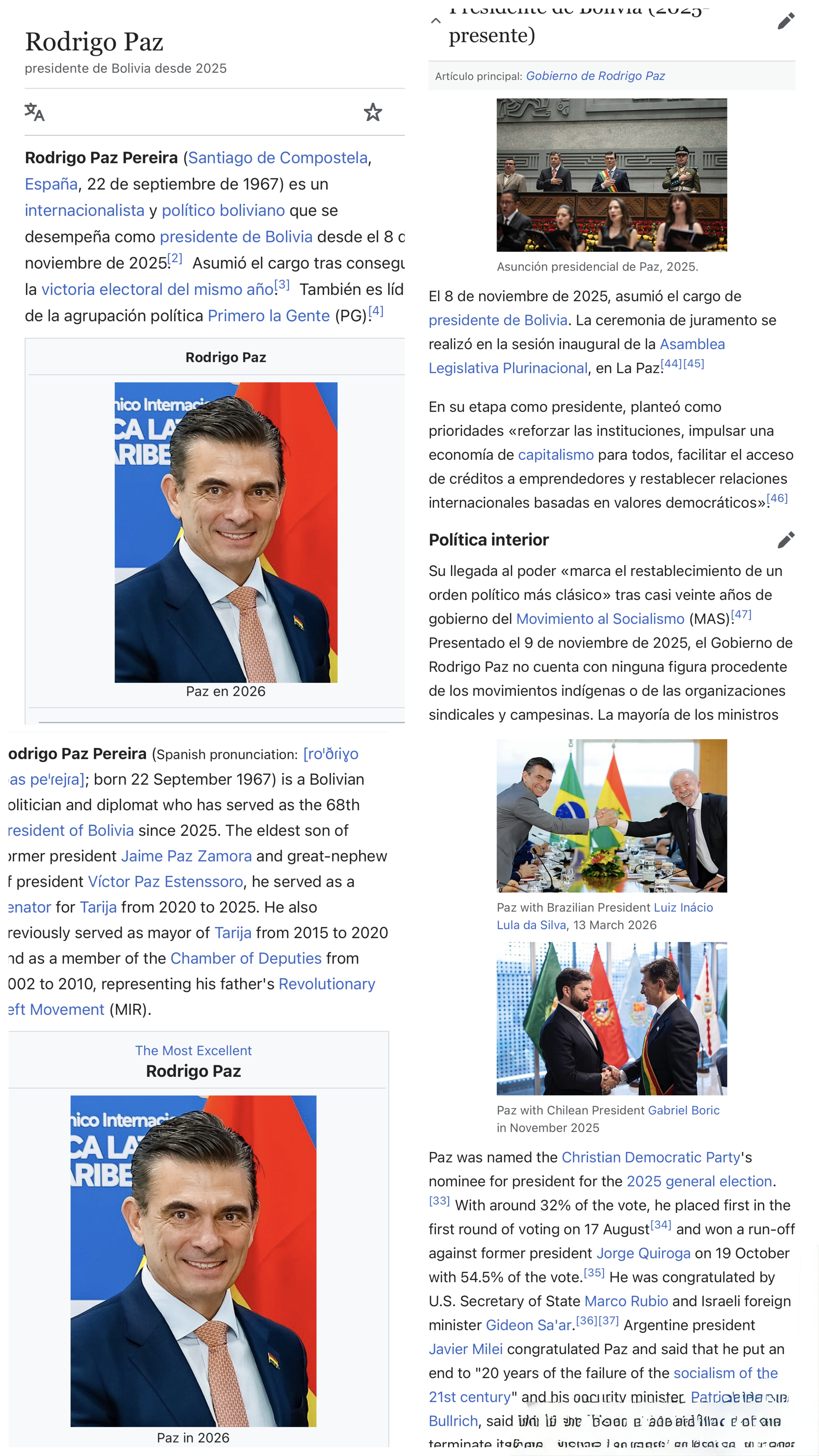
Depending on the language you ask Wikipedia in, you get a completely different idea of who Bolivia's current president is. We opened Rodrigo Paz's biography in English and in Spanish, on the same day, the same section.
Both versions cite real sources, yet they show two different presidents.
Ask the machine: who is Rodrigo Paz?
- Congratulations from Rubio, Israeli foreign minister Sa'ar, Milei and BullrichEnglish only
- The 900-tanker-truck convoy led by PazEnglish only
- The assassination of Mauricio Aramayo, his close aideEnglish only
- The 90-day state of emergency with the military on the roadsEnglish only
- The wiphala removed from the palace facadeSpanish only
- The detention of former president Luis ArceSpanish only
- Strategic ministries for Doria Medina's peopleSpanish only
- An entire section: Tensions with Edmand LaraSpanish only
How much of each language the machine ate
In the raw web crawled by Common Crawl, the base of today's corpora, English is around 45 percent and Spanish around 5. At training time the scale tips further: in GPT-3, the reference model with published figures, 93 of every 100 words were in English and fewer than 1 in Spanish. Presidency sections of both Wikipedias archived August 28, 2026.
Which Paz does each reader get?
The English reader gets a Paz celebrated by Washington and Jerusalem, entering at the head of fuel convoys, struck by an assassination and governing under a military emergency.
The Spanish reader gets the domestic story: the indigenous emblem taken down from the palace, the former president detained, the carving up of ministries and a vice president criticizing him on TikTok.
And Edman Lara, the running mate much of the country credits with the victory? In Spanish he has his own section. In English he appears in passing, through the case of a dismissed minister.
And the reverse: the Spanish reader learns nothing of Aramayo's assassination or the state of emergency. Each language erases the other's nuance.
Which side is he on?
Even the ideology changes with the language. The English version pins him on the map: centre-right, conservative, Third Way, populist, each label with its citation. The Spanish version keeps conservative and populist, and concludes he is seen as neither right nor left.
The English reader gets a president with coordinates. The Spanish reader gets one with no axis. And the English article carries a tag from its own editors for excessive citations on his economic plan, more than a dozen stacked on a single sentence: the visible trace of an editorial fight in progress.
Why does it matter?
Because chatbots learn from massive copies of the internet, and those copies speak English. In the technical reports published by the labs themselves, English dominates training corpora with half the material or more, while Spanish sits in single digits.
And English Wikipedia is one of the sources models consult most: the most linked, cited and scraped page collection on the web.
Do they balance each other out? The consequence is asymmetric. A chatbot answering in English barely touches the Spanish version. A chatbot answering in Spanish does drag along the English knowledge it carries inside.
The English framing leaks into Spanish answers far more than the reverse.
For the machines answering the world's questions, the biography that counts is the Washington-Jerusalem one. The wiphala taken down from the palace, the most symbolically loaded act for Bolivia, is nearly invisible in the corpus that rules.
Who pays for this?
For this asymmetry, nobody. But manufacturing one on purpose has a market price: Drop Site News documented that Brad Parscale holds a reported 46.5 million dollar contract with the Israeli government to seed English-language content designed to shape what chatbots answer.
That is what a framing costs to build. Paz's English biography comes with one already fitted.
Who wrote it?
It is an open question, and on Wikipedia it can be answered. Every edit is recorded forever: which account made it, on what day, what exact text it added or removed.
The history will show whether each paragraph was added by a veteran editor of Bolivian politics or by a new account that only touches this page. The first is structural bias. The second is an operation. This piece documents the framing. And we have begun reviewing the history.
We opened three accounts. The English article's last editor, Khamees99, turns out to be a collector of presidential travel lists: he created the ones for Sheinbaum, Maduro, Lukashenko, Kais Saied, Milošević and, one minute before touching Paz's biography, the one for Paz. His edit was a 74-byte link to his own list.
The second is another story. Pumallku, who built much of the foreign policy section between December and January, is now blocked indefinitely: Wikipedia flagged the account as a suspected sockpuppet of another user, Dentren, meaning an alternate account used to evade an earlier block. The block came about three months ago, after the edits on Paz.
The account's contributions were on Andean climate, geography and economics, with translations from Spanish Wikipedia. A sockpuppet is a breach of Wikipedia's rules, not proof of political intent. But it leaves a fact: part of Paz's foreign policy in English was written by an account Wikipedia later expelled, and the text is still there. Nobody reviewed it.
The third works on both Wikipedias: Segagustin, 3,539 edits since 2023 and a clear specialty: Latin American electoral politics. His most-edited pages in English are the 2023 Argentine election, with 158 edits, Javier Milei, with 106, and Santiago Peña, with 60. He also edits Mujica, Sheinbaum, Cristina Kirchner and Orsi: he covers the whole spectrum, and in between, Bill Clinton, Saoirse Ronan and a list of last words. On Paz's English biography he has 27 edits out of the article's 306. And one of his most-worked articles is the one on international reactions to the Gaza war, with 30. In August alone he edited the pages of Kast, Milei, De la Espriella, Fujimori, the Colorado Party, ARENA, Colonel Seineldín, and the ideological networks section of the article on the Shield of the Americas summit. On August 9 he touched Paz's biography: 62 bytes that inserted into the lead, alongside the United States, warmer relations with Israel as a defining political position. The same day he updated the Bolivia–Israel relations article by 954 bytes, with the new ambassador and Bolivia's withdrawal from the Hague Group.
His August diffs have a direction. Paraguay's Colorado Party went from "right-wing", with a note on far-right factions, to "centre-right to right-wing", without the note. Kast's victory gained the word "landslide". Kenji Fujimori went from politician to businessman. Small adjustments, all leaning the same way. And at the same time he cites critical sources, such as Chatham House on the network of Trumpista strongmen. The history also records that on March 18, at 23:17, he added to the English article the photo of Paz with Trump at the Shield of the Americas signing, and five minutes later, at 23:22, the photo of Paz with Lula taken on March 16 in Brasília to the Spanish article. One reader sees Paz with Trump and with Lula; the other, only with Lula. His two attempts to change Paz's main photo in Spanish were reverted within twenty minutes; the section photos stayed in both languages. On Wikimedia Commons he crops official photos and uploads them the day after the event, as with Abelardo de la Espriella's in Cali. He is a specialist, not a throwaway account, and his edits are there for anyone to review.
And there is one more date in his record. On August 21 and 29, 2026, days after sala.red began publishing this series, Segagustin twice edited the ideological networks section of the article on the Shield of the Americas. The second edit is eleven bytes: they turned Fernando Cerimedo's name into a link to Spanish Wikipedia. In the following twenty minutes, according to his global contributions log, he edited the Spanish article on Fernando Cerimedo twice and the one on La Derecha Diario once. In the first, the lead went from saying he is jailed "for trying to kill his partner" to saying he is "accused" of trying to kill his "former partner". In the second, he alphabetized the list of countries. Precision, not deletion.
That section describes Cerimedo as the political strategist employed by Bukele, Milei and Asfura, with close ties to Trump and a prominent role in 2022's "Brazil Was Stolen", citing The Economist. The network this series has been documenting already has its map on English Wikipedia. And one of the hands keeping it current is the same one that put Israel into Paz's lead.
Map of an editor
Segagustin, 3,539 edits since June 2023. Tap a dot to see what he did and when.
Teal: English Wikipedia · Terracotta: Spanish Wikipedia · Ochre: Wikimedia Commons
X-ray of the editor
The 30 pages Segagustin has edited most on English Wikipedia, per XTools' public API, August 30, 2026. Color shows the type of page.
Terracotta: biographies · Ochre: elections · Teal: other articles and lists
And the fourth wrote the section that places Paz on the ideological map in English: centre-right, conservative, Third Way, populist. It was created in a single edit, on December 18, 2025, by the account MarketFruit: according to its own user page, an 18-year-old German born in Berlin, whose specialty is lists of leaders of socialist republics and who states that his English could be better.
Five months later, other editors stacked more than a dozen citations onto that section until a third one tagged it for overkill. None of that breaks a rule: that is how Wikipedia works. But that is the text that defines Bolivia's president for the world's machines.
None of the four is a proven operation. A list collector, an account expelled for evading a block, a specialist in Latin American electoral politics working in two languages, and an 18-year-old editor in Berlin.
The uncomfortable part is something else: the English biography of Bolivia's president, the one the machines read, was assembled with nobody guarding it. Thirty-four watchers, two edits a month, and the text of a blocked account left intact. The corpus with a ruling language runs on its own.
What can be done?
First, understand what this is. Neither version lies: every claim has its reference. It is produced by thousands of volunteers editing in their own language, with their own sources and priorities.
Structural bias requires no one to order it. It is enough that the corpus has a ruling language.
Then, edit. Wikipedia is open: completing the Spanish version with what it lacks, and the English version with what it cannot see, is volunteer work that changes what the machines will learn tomorrow.
We archived both versions with permanent links. What this piece describes is the snapshot of August 28, 2026.
Sources
- English Wikipedia, "Rodrigo Paz", Presidency and Political views sections. Revision of August 16, 2026, 00:16 UTC, current at the time of consultation, August 28, 2026. Permanent link and archive.today copy. Includes the excessive-citations template placed by editors on the economic plan passage.
- Spanish Wikipedia, "Rodrigo Paz", Presidencia and Ideología y posiciones políticas sections. Revision current as of August 28, 2026, with the last edit made on August 26 at 00:45 by an unregistered temporary account, per the article's information page. Permanent link and archive.today copy.
- Information page of the Spanish article, generated by Wikipedia, consulted August 28, 2026: creation date and authorship, edit count, watchers, visits and protection status.
- XTools public API, most-edited pages by the Segagustin account on English Wikipedia, article namespace, consulted August 30, 2026: 158 edits on the 2023 Argentine election, 106 on Javier Milei, 60 on Santiago Peña, 30 on international reactions to the Gaza war, 27 on Rodrigo Paz.
- Global contributions log of the Segagustin account in Wikimedia's Global User Contributions tool, consulted August 30, 2026: a unified account active on English and Spanish Wikipedia, Wikimedia Commons and Wikidata, attached to both Wikipedias on June 17, 2023.
- Edit histories of both articles; public contribution logs of the accounts Khamees99, Pumallku, Segagustin and MarketFruit; Pumallku's user page carrying the indefinite block notice as a suspected sockpuppet of Dentren; MarketFruit's user page with the details that editor publishes about himself; the diffs of the March 18, 2026 edits in both languages; and Segagustin's diffs between August 9 and 30, 2026 on the articles Rodrigo Paz, Bolivia–Israel relations, Colorado Party (Paraguay), 2025 Chilean general election, Kenji Fujimori, Javier Milei, Movimiento al Socialismo and Shield of the Americas. Consulted August 30, 2026.
- Wikimedia's Pageviews Analysis tool on the English article, consulted August 30, 2026: visits over the last 30 and 90 days, watchers, size, edits and absence of protection.
- Published technical reports of the main language models and public analyses of the Common Crawl corpus on language distribution in training data.
- Drop Site News, July 2026. Investigation into the reported 46.5 million dollar contract between Clock Tower X, Brad Parscale's firm, and the Israeli government to shape chatbot answers.
- Foreign Agents Registration Act filings, US Department of Justice. Clock Tower X LLC submissions since September 2025.
This piece compares the state of both articles on a fixed, archived date. Wikipedia changes every day, and the differences described document an outcome, not an intent: both versions cite verifiable sources and are the work of different volunteer communities. The reading on each language's weight in the models is interpretive and rests on the cited technical reports. No authorship or intent is attributed to any specific edit: the public history of both articles allows them to be verified, and that review is part of this series' ongoing work.