Data Data Journalism
A free dollar, a mortgaged country.
By Violeta Ayala — Tecnóloga
A free dollar, a mortgaged country
Bolivia let go of the fixed exchange rate it held for fourteen years. The real dollar already lives at another price, and increasingly in code.
The state lets the price go
On 26 June 2026 the Ministry of Economy issued Ministerial Resolution 245. It orders a shift to a flexible exchange rate. The dollar price now moves with daily supply and demand. The fixed rate of 6.96 bolivianos, in place since 2 November 2011, ends. The government presents the move as its own decision. For the IMF it is a condition, one of the prior actions it requires before approving its program.
The change arrived in stages. Since 1 December 2025 the Central Bank publishes a daily Reference Value of the dollar. It is the weighted average of real transactions between banks and clients. The official rate said 6.96. The reference value said the truth.
On the street the dollar already costs around 10 bolivianos. The gap with the official rate tops 40%. Getting physical cash at 6.96 is close to impossible.
How it held, why it fell
6.96 held on gas. The Central Bank pledged to sell dollars at that price, and to deliver it needed reserves. Gas supplied them. Between 2009 and 2014 Bolivia exported more than 6 billion dollars a year in gas. Reserves passed 15 billion by the end of 2014.
On that base the country built bolivianización. By 2019 credit was almost 100% in bolivianos and savings above 80%. The cheap dollar gave certainty, cheap imports and low inflation.
It all depended on gas. Production fell, demand from Brazil and Argentina dropped, and the dollars stopped coming in. Reserves drained and today sit almost entirely in gold. The fuel subsidy costs around 2 billion a year. Bolivia imports nearly 90% of its diesel and more than half of its gasoline. Without gas, the fixed price became a promise with nothing behind it.
The dollar became code
When cash vanished from the banks, people built their own dollar. They built it with stablecoins. USDT, a digital token worth one dollar, became Bolivia's real dollar. People buy and sell it among themselves on Binance, Bitget, Bybit and AirTM, in bolivianos, from a phone.
The state could not stop it. In June 2024 the Central Bank repealed the ban it had held since 2014 and allowed crypto operations. Adoption exploded. According to Chainalysis, Bolivia moved around 14.8 billion dollars in crypto between July 2024 and June 2025, seventh in Latin America. The Central Bank reports transactions grew 630% in a year. July 2025 inflation hit 24.86%, the highest in almost four decades. People flee to the hard dollar, and the hard dollar today is a stablecoin.
Then the state itself walked in. YPFB began paying for fuel imports with digital assets in March 2025. State-owned Banco Unión built USDT into its Yasta wallet. Private banks like Bisa, BCP and FIE opened USDT accounts. Toyota, Yamaha and BYD accept USDT in Bolivia since September 2025.
There is a cost. The boliviano is still the only legal currency and the user carries the risk. Crypto scams rose. And an old tension wears a new face: a person who holds dollars in their own wallet has sovereignty over their money; a person who holds them in a bank does not. Dollarization is digital now, and it gets decided token by token.
The subsidy and the street
The adjustment carries a known political price. In December 2010, at the height of the boom, Evo Morales raised gasoline 73% and diesel 82%. The country erupted. People marched in La Paz, El Alto, Cochabamba, Oruro and Potosí and demanded his resignation. Morales repealed the decree in four days. His disapproval reached 67%.
In December 2025 Rodrigo Paz ran a bigger fuel hike: gasoline 86%, diesel 160%, alongside the dollar flexibilization. The Bolivian Workers' Center called a general strike. Transport unions, miners and labor groups set up blockades. The conflict continues.
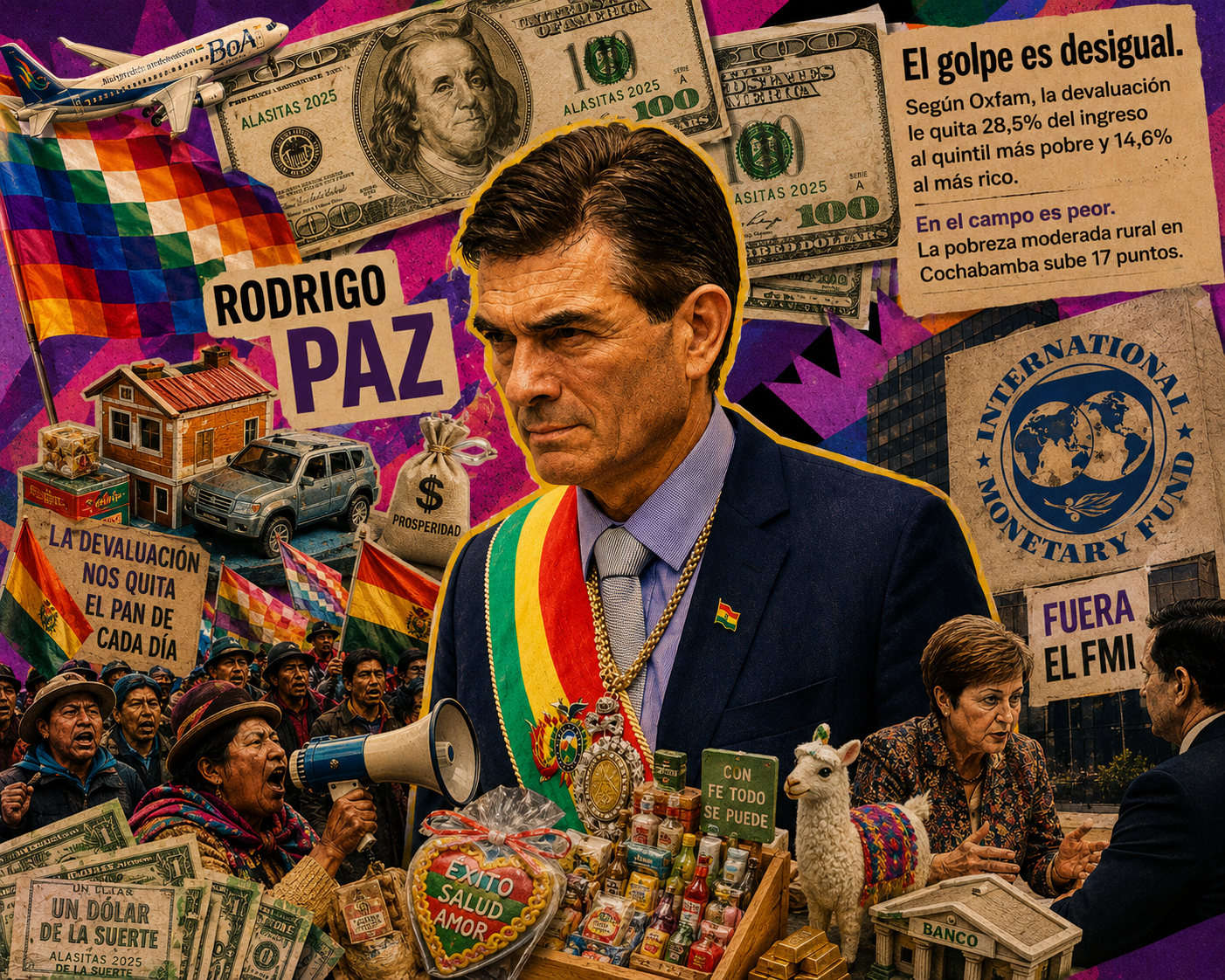
The blow falls unevenly. According to Oxfam, the devaluation takes 28.5% of income from the poorest fifth and 14.6% from the richest. In the countryside it is worse. Rural moderate poverty in Cochabamba rises 17 points.
Pensioners are among the most exposed. According to an investigation by El País, the pension fund operates without a proper board, and in the March eurobond swap external holders were paid in dollars while the workers' fund received bolivianos. With the devaluation, the dollar value of that boliviano portfolio falls by more than a quarter. Whoever financed the 6.96 for fifteen years pays for the correction.
Morales could reverse course because gas and dollars sat behind him. Paz has nowhere to go back to. The till is empty. After two decades of a state that subsidizes and redistributes, asking people to absorb the adjustment runs against everything they learned.
Urgency sets the price
Bolivia holds the world's largest lithium deposit. The US Geological Survey estimates 23 million tonnes, almost all under the Salar de Uyuni. The wealth runs far past lithium. By sala.red's review of the USGS 2025 list, Bolivia has documented presence in 48 of the 60 critical minerals in the world, among them tungsten, antimony, tin, tantalum, silver and germanium. They feed batteries, artificial intelligence and weapons. That is the wealth.
Production is another matter. In 2025 Bolivia produced a little over 2,000 tonnes of lithium. Chile produced 56,000. The state company YLB invested 1.054 billion dollars and generated 8.6 million, with 691 tonnes. Uyuni's brine carries a very high magnesium ratio, and the cheap evaporation method recovers only about 30%. Direct extraction, the alternative, is not proven at industrial scale in that salt flat. To produce, Bolivia needs billions in foreign capital and technology.
The dollar crisis is the lever. Reserves are almost empty and committed debt tops 21.7 billion. The devaluation makes that debt more expensive: every dollar the country owes costs more bolivianos, and new credit arrives at high rates, like the sovereign bond at 9.45%. The IMF demands reforms in exchange for more financing. The fastest dollars sit underground. A country that needs dollars now bargains from weakness.
On 27 April 2026 Bolivia signed a Critical Minerals Memorandum of Understanding with the United States in Washington. It was signed by Deputy Assistant Secretary Caleb Orr and Mining Minister Marco Antonio Calderón de la Barca. The agreement covers all 60 minerals on the list, and Bolivia holds 48. The text was not published, unlike the equivalent memoranda the United States did publish in full with Peru, Uzbekistan, Mongolia, Malaysia and the United Kingdom. It guarantees no industrialization on Bolivian soil, requires no plants to be built and sets no technology transfer or floor for local value added. Meanwhile the contracts Arce signed with Russia's Uranium One and China's CATL, worth around 1.03 billion, remain frozen in the legislature and the courts. To open the door to Washington, Paz must first take them apart.
The constitution requires majority state control and prior consultation with Indigenous peoples, and bans handing over strategic resources. The rare earth projects sit in the Chiquitanía and the Pantanal, where that consultation did not happen. The protests demand the memorandum and the IMF deal be annulled. The risk is a purely extractive role: export raw mineral, take credit, pay the credit with more mineral. Bolivia holds the planet's largest lithium deposit and the weakest hand to bargain it.
56,000 t
2,000 t
From good to bad
The flexible regime is already law. What comes next depends on execution, on politics, and on how much people will take. Three futures, best to worst.
Argentina signed with the IMF in April 2025 and cut inflation from around 200% to 30%, closed the parallel gap from 160% to 20%, and returned to growth. For Bolivia: inflation eases in twelve to eighteen months and the dollar settles near its real price. Argentina paid eighteen months of pain, and it had an export base Bolivia lacks.
The IMF projects GDP falling 3.3% in 2026 and inflation at 20.7%, the worst in South America, with no forecast for 2027. The IMF deal closes, subsidy cuts and deficit reduction arrive, and stabilization, if it comes, shows up only in 2027. The recession lasts all year.
Ecuador reached it in 2000: a bank run, frozen deposits, forced dollarization at 25,000 sucres and a president gone within days. In Bolivia that scenario adds a sharp devaluation, lost savings and political rupture. Social movements removed three presidents between 2000 and 2005, and Paz governs in the minority and under blockades.
Bolivia is not Argentina or Ecuador. The crisis comes from the end of gas, reserves sit almost entirely in gold, and lithium is not at scale. The outcome gets decided in the Central Bank and in the streets alike.
For fourteen years, 6.96 was the anchor of Bolivia's economy. It was also a fiction held up by gas that ran out. Today the real number is set by the market, kept in a digital wallet and argued over in the street. The model that promised a state that provides spent the resource that made it possible. What remains is the transition, and its bill.