Bolivia is endlessly reminded to be more like rich countries...
Harvard's Atlas of Economic Complexity ranks countries by the diversity and sophistication of what they export. Australia is the thirteenth-largest economy on earth. In Harvard's complexity rankings, Australia had fallen from 64th in 2003 to 105th of 145 economies by 2023, at one point positioned between Namibia and Kenya. Harvard's conclusion is one dry sentence. Australia is less complex than expected for its income level; it has the export profile of a developing nation and the bank balance of a rich one.
How does that happen to a country with world-class universities, a capable state and a history of genuine invention? Australia, like Bolivia, keeps failing to turn its resource wealth into its people's wealth and the place to see what both countries missed is Norway. Norway took its North Sea oil and built the largest sovereign wealth fund on the planet — today worth in the order of two trillion US dollars, supporting a national budget that includes free university education and living standards near the top of global rankings. It would be easy to call this virtue. What it was, was a set of choices, made at the right moment that almost nobody else made. Norway's model has three parts. First, it captured the rent: taxing petroleum profits at seventy-eight per cent, affirming the resource belongs to the nation, not the companies that extract it. Second, it sustained production. Together with a high tax, it designed its system so exploration and drilling kept happening. Third, and the one easily overlooked, Norway ring-fenced the savings under a rule: the entire net petroleum cash flow goes into a fund that invests only abroad, walled off from domestic politics so no government of the day can raid it before the next election.
A three-legged stool: capture, sustain, protect. The third leg is perhaps the hardest to maintain, because it's the money politicians most want to spend on staying in power.
Australia has the wealth and the institutions to have built Norway's stool twice over and has lived by selling raw materials to other people's factories for two centuries. For a hundred years it rode as Australians say - on the sheep's back. Wool was shorn at home and shipped to the mills of Yorkshire and Italy, woven and sold back as cloth. Then gold, then iron ore, coal and gas. Like Bolivia the export changed but the habit didn't.
In the mid-1970s, Gough Whitlam's minister for minerals and energy, Rex Connor, had a vision that reads, in hindsight, like Norway's. Develop Australia's resources in a way that keeps Australian control over them. What followed became known as the Loans Affair scandal and was the weapon used against the Whitlam government that ended with its dismissal in November 1975. Connor's methods, criticised by many, handed the government's enemies the knife, and few had more to gain from its fall than the mining interests whose power he had set out to break.
In a telling meeting after the dismissal, by Whitlam's own account, US Deputy Secretary of State Warren Christopher assured him that Washington would never ‘again’ interfere in Australia’s domestic political processes. The implication was clear and Washington had strategic reasons to oppose Whitlam's policies – but that’s another story.
In May 2010, Australian Prime Minister Kevin Rudd announced a Resource Super Profits Tax: a forty per cent tax on the windfall profits of mining the country's onshore resources. Less than two months later he was deposed. The Minerals Council ran an ad war against the Prime Minister, led by the mining industry's largest companies. Rudd's popularity collapsed and his own party replaced him as PM. His successor made it her priority to settle with the big miners and water down the tax — before it was repealed entirely in 2014 by the opposing side of politics.
In neither the Whitlam nor Rudd cases did mining interests win the policy argument on merit. Scholars examining the Rudd episode reached a disturbing conclusion: the industry's power didn't depend on whether investment would actually flee. It depended on whether politicians, journalists and voters believed it would. What mining interests did was simply make reform appear economically fatal. The mining industry's defence is that Australia already captures plenty through other forms of tax. But the argument doesn't survive the numbers. During the energy-crisis windfall following Covid, gas producers took enormous profits, while the government’s take from the Petroleum Resource Rent Tax, meant to capture value at exactly these times for the Australian people from off-shore mining, actually fell. In eight years of tax office data, no entity of Chevron, Shell, INPEX, ConocoPhillips or Origin reported any PRRT payable. Overwhelmingly foreign owned, Australia’s mining profits flow overseas rather than settling and building national wealth. In this one respect, Australia is closer to Bolivia than it likes to think: the resources under the ground are the nation’s, but the wealth that comes from them flows somewhere else.
The rent that might have built public wealth instead built private dynasties. Australia's largest mining fortune emerged from iron ore extracted within a colonial settlement where Indigenous landowners were treated as obstacles to its development. Lang Hancock made that worldview explicit on TV in 1984, proposing that the water of Aboriginal people of mixed descent — "half-castes", in his words — be "doped" so they would become sterile and "breed themselves out." In 2010, megaphone in hand, his daughter Gina Rinehart joined the campaign against Rudd's proposed tax and has continued funding the political case against greater public capture of resource wealth ever since.
Why does a country with strong institutions keep losing this fight?
Australia was a British settler colony, where institutions were built to be inclusive — for settlers. Secure property, rule of law, a capable bureaucracy. The institutions work; but they were built to protect property holders, so when a prime minister threatens the property holders' rent, the system is set up to defend them. One Australian leader never lost this fight, because he never picked it. John Howard governed for eleven years across the start of the China boom and simply left the resource settlement alone. The scale of what passed through his government’s treasury is on record. A 2008 analysis of Treasury figures estimated that between 2004 and 2007 the boom delivered the Howard government a $334 billion AUD windfall. These hundreds of billions were not captured rent, but the spillover generated by the boom through ordinary company and income taxes.
What would the windfall have been if Howard had captured the resource rent effectively? As Norway has shown is possible. When Howard left office in 2007 Norway's savings stood at 373 billion US dollars.
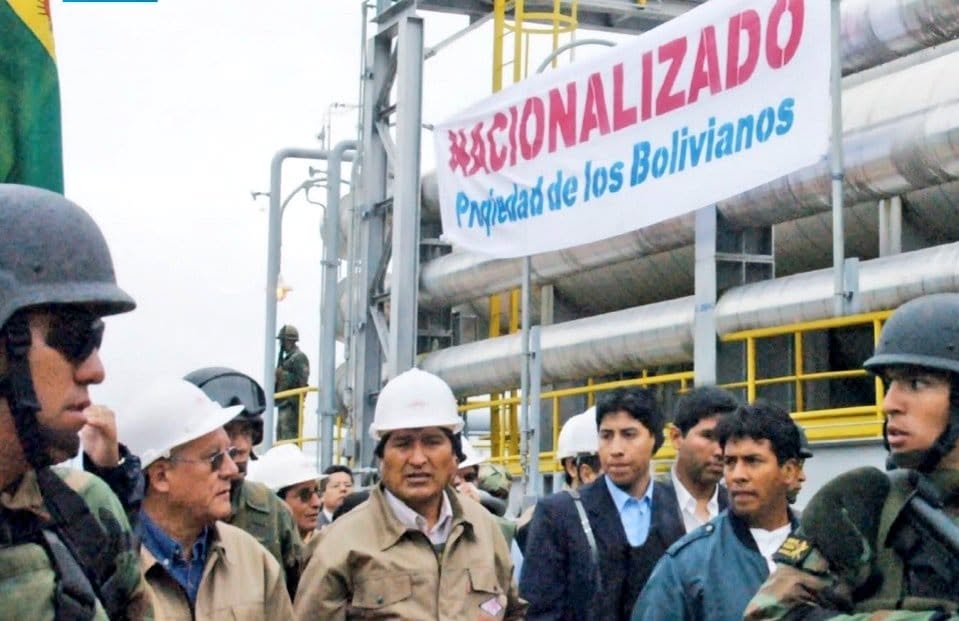
Across the Pacific, after assuming office in 2006, Evo Morales achieved the very thing Kevin Rudd was removed for attempting and what John Howard decided not to do.
On his hundredth day in office, Evo Morales, following the Norwegian model, nationalised Bolivia's gas. Bolivia was among the first partner countries of Norway's Oil for Development programme, which began operating that same year to share Norway's experience in managing petroleum. Morales reduced the foreign companies to contractors and multiplied the state's take. It worked spectacularly. The windfall went into the things the country needed most. Extreme poverty fell from around thirty-eight per cent to fifteen. Measured in US dollars, the economy quadrupled. In 2008 Bolivia declared itself free of illiteracy under UNESCO's benchmark, with the rate dropping below 4% for the first time. For the indigenous majority locked out of the country's wealth since Potosí, this was a reversal of the transfer to the rich that had run unbroken since the Spanish arrived. Bolivia also saved. Central bank reserves climbed to fifteen billion dollars by 2014, close to half of GDP — a cushion proportionally larger than most rich nations. The IMF even went so far to validate the Morales government’s policies by saying that macroeconomic stability, supported by high world commodity prices and active social policies, has contributed to nearly tripling income per capita and reducing poverty in Bolivia since the mid-2000s.
But the money was held in drawable reserves, not a ring-fenced, rule-bound fund walled off from politics. Morales neglected the lock box Norway built. The opportunity was there and it was begun but the story didn’t end there.
As gas revenue and production slid, the reserves were drawn down to defend a fixed exchange rate and keep the spending up. For years it worked, and the draining was invisible: inflation stayed near zero while the cushion quietly emptied.
The nationalisation that allowed Bolivia to capture a much larger share of the rent failed to support future production. Reduced to contractors and taxed, the companies stopped exploring; between 2006 and 2014 barely a handful of new wells were drilled, proven reserves fell, and production began to drop. When global prices roared back in 2022, Bolivian output couldn't answer.
Norway solved this problem, making access to the resource conditional on work. Licences for defined exploration areas were awarded through competitive rounds. Each area came with an exploration period, a binding work programme and deadlines: explore and develop or relinquish the acreage. Area fees discouraged companies from sitting on discoveries, while the tax system allowed the costs of exploration and development to be deducted so that viable projects remained viable after tax. The state captured most of the upside without allowing incumbency to become ownership. As early as December 2010 — at the height of his power — Morales tried to cut the national fuel subsidy. The country erupted and the decision was reversed within five days. He could nationalise an industry against the world, but he could not take a cheap-fuel dividend away from the people who had voted for him. That is the deep bind of the third leg, and it’s not a Bolivian failing. It is the universal politics of resource wealth. Which is why Morales and John Howard — opposite men, opposite continents, opposite ideologies — did the same thing: each of them used the windfall to fund the policies that kept them in power rather than lock it away. The failure to create the lockbox is bipartisan, and that is precisely what makes it structural rather than a story of villains.
The research that won the 2024 Nobel in economics tells us, in essence, that extractive institutions persist long after independence: the new elites inherit a state built for extraction, not stewardship. Spain’s colonisation of Bolivia, delivered Potosí to drain silver to the metropole, through institutions designed to concentrate power and extract. The "open veins" Eduardo Galeano wrote about are a structure of the state itself. Bolivia's failure was never capacity; it was that nothing in the inherited machinery could hold a windfall against the pressure to spend it.
By 2025, the cushion was gone. Bolivia had to decide who would set the terms of the next boom.