Power Investigación
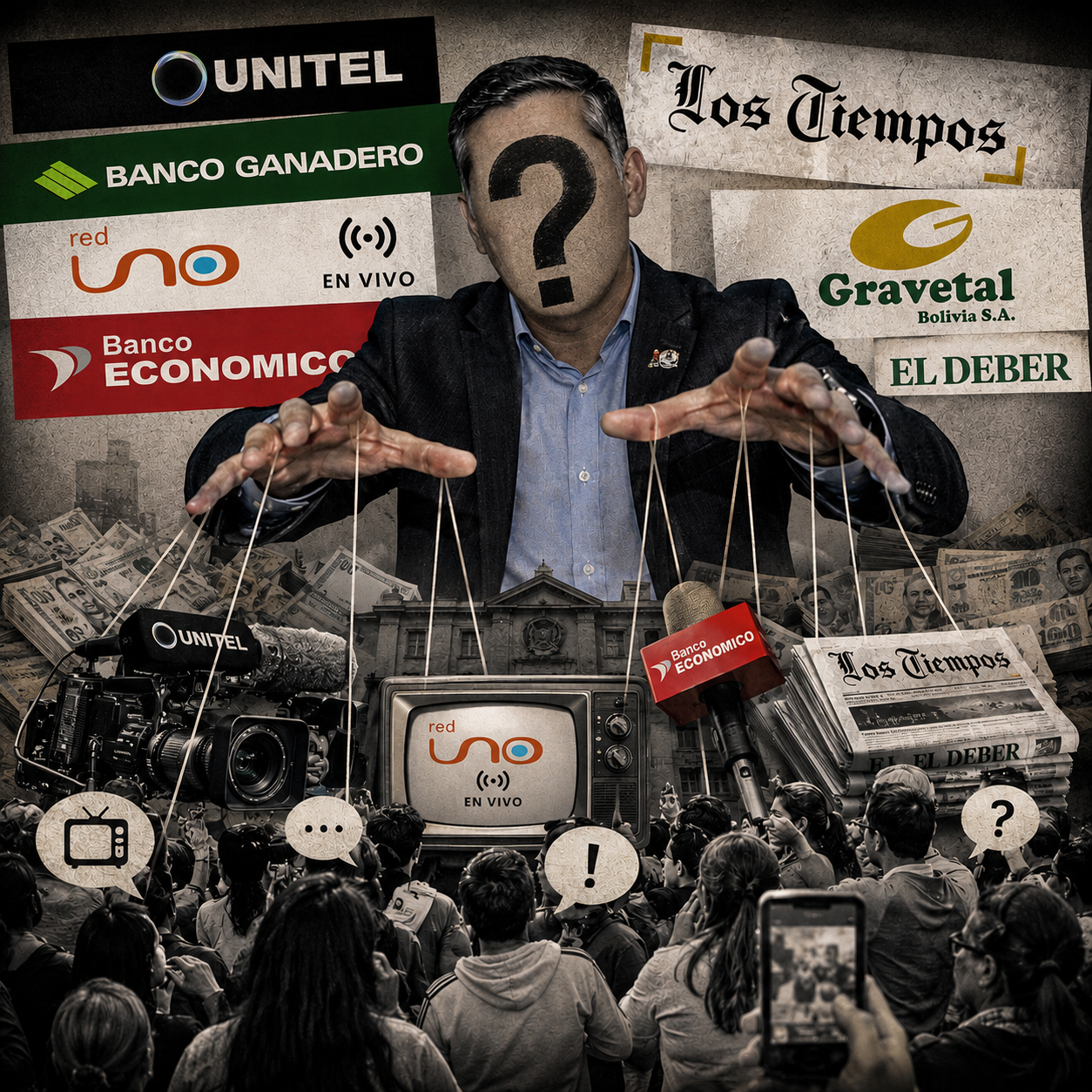
The power behind the front page
By Violeta Ayala — Tecnóloga
Investigation · Power
Who owns the media in Bolivia
The same surnames that control the banks, the soy, the timber and the aircraft control what the country reads and watches. In April 2025 that map shifted: new partners entered the country's largest newspaper, and one of them is now a cabinet minister.
In Bolivia, media ownership is almost never public. There is no open, easily searchable registry that says who owns each television channel, each radio station and each newspaper. What exists is a handful of families and businessmen who, beyond media, control banks, agribusiness, railways, casinos and airlines. The outlet is one piece inside a much larger fortune. That overlap is, on its own, the first source of bias: an editorial line rarely bites the hand that also signs loans, sells soy or needs licences from the State.
Understanding who informs the country begins with understanding who owns it. Here is the map, with what is documented and what still needs verifying.
The map of concentration
Unitel Audience leader
Red Uno
La Razón Dropped print
Bolivisión Foreign capital
PAT
Radio Panamericana
Radio Centro Cochabamba · regional
El Diario Oldest · 1904
Los Tiempos · Opinión · El Alteño
Almost every name on that list belongs to a regional economic elite: agribusiness and banking in Santa Cruz, traditional families in La Paz, or businessmen with large portfolios that depend on the State. The outlet is never alone. It is tied to a conglomerate.
The outlet is one piece inside a much larger fortune. And the State is, at once, regulator and chief advertiser.
The El Deber case
The most recent shift on this map happened in April 2025, at El Deber, the country's largest and most influential newspaper. We tracked it with the standard we apply to every sensitive fact: confirmed, reported, or unverified.
El Deber officially confirmed that “new partners” had entered its corporate structure. The paper's statement did not name them. It spoke of “extraordinary resources backed by Santa Cruz businessmen,” aimed at meeting obligations to staff. The Rivero family remains in charge. Source: El Deber statement, 27 Apr 2025 · Brújula Digital
Infobae states that minister Óscar Mario Justiniano “is a shareholder of El Deber.” In April, La Razón and Brújula Digital named the new partners citing business sources, but they differ on whether the shareholder is Óscar Mario or his brother Diego, CEO of the timber exporter Exomad. Source: Infobae, 10 Nov 2025 · La Razón · Brújula Digital (unnamed sources)
The exact percentage appears only in secondary sources: a 21.30% stake is attributed to Diego Justiniano in a capital-increase filing. In April, Justiniano denied being a shareholder and described the operation as a loan. The corporate-registry document (SEPREC) would settle it. It remains pending direct verification. Pending: Electronic Gazette of the Commercial Registry · SEPREC
What is confirmed already matters: Santa Cruz business capital entered the country's leading newspaper in the middle of a financial crisis. What is still unconfirmed is more delicate: whether a sitting minister holds part of that paper, and how much. In Bolivia, that concentration of power has no counterweight and no regulation. No law prevents those who govern from owning those who inform.
The Los Tiempos case
The same pattern hit Cochabamba first. In November 2023, Los Tiempos changed hands after a financial crisis and, according to its directors, tax pressure from the government of the day. We tracked it with the same standard.
In late November 2023, Grupo Valdivia bought 100% of Editorial Canelas, the parent company of Los Tiempos. It ended 80 years of ownership by the Canelas family, who founded the paper in 1943. The deal ran through three companies: SantaCruzProperties, Intercomunication Company and Inmobiliaria UBC. The price was never made public. Months later, the workers' union denounced a debt of 13 unpaid salaries affecting more than 50 employees. Source: El Deber · Los Tiempos · Erbol, Nov 2023 · ANPB, 2025
The Valdivias are described as MAS-aligned. Juan Valdivia was a MAS deputy for Quillacollo and a friend of Evo Morales; his son Eduardo now runs the paper. The day after the sale, Los Tiempos circulated with a paid government insert. The IAPA, the ANP and journalists' associations warned of the loss of another independent newspaper. Source: Brújula Digital, 30 Nov 2023 · El Deber · IAPA / ANP
An investigation by the newspaper El País (Tarija) holds that the group built a fortune of more than a billion bolivianos through ties to the Morales and García Linera governments, and describes a credit circuit linked to the public pension fund (Gestora Pública) that coincided with a sharp rise in loans to its soy company, Gravetal. A 2019 complaint alleged US$65 million in a decade. These are allegations from journalistic investigations, not court rulings. The family did not respond to El País's requests for comment. Source: El País, Nov 2025 · B. Montenegro complaint, 2019 (allegations)
The pattern repeats, and it crosses every color. As at El Deber, capital tied to power enters a historic newspaper in crisis. The difference is which side: the Valdivias come from the MAS orbit; El Deber's new partners from the Santa Cruz business elite, now with a foot in the Paz government. Media capture is neither left nor right. In both cases, readers lose an independent outlet and gain an owner with interests outside journalism.
The reach map
Bolivia has no continuous, independent audience measurement. There is no people-meter, and the only ongoing TV rating study is funded by Unitel, the market leader. The figures that follow are estimates, each with its source. Even so, the picture is clear: television is still the most-watched medium, but the internet has caught up with it.
According to Ipsos CIESMORI (2024), 72% of those surveyed get news from television, 90% use the internet, 86% social media and 30% radio. Print fell to 9%. Online, El Deber is the country's most-visited news site, with close to 8 million visits a month. On television, Unitel has led since 2011. Radio is barely measured, but Erbol, with around 170 allied stations, has the largest national footprint.
The map shows where each outlet is born and how many people it reaches. Tap a city.
Tap a city to see which media are based there and how many people they reach.
Audience: estimates. TV, Ipsos 2011 and core-axis share; digital, estimated monthly visits (Similarweb, 2024); social, public follower counts (2025-2026); radio, coverage footprint. Bolivia has no independent audience panel. Department boundaries: public data (GeoBolivia / INE).
The State's money
Ownership is half the story. The other half is public money. State advertising has worked for years as reward and punishment, without a single rule to govern it.
A 2024 study by Observacom and the National Press Association found that La Razón and Ahora El Pueblo concentrated more than 85% of official print advertising. Bolivia Verifica documented that, in its final four months, Luis Arce's government spent Bs 31.1 million on advertising across 42 outlets. Independent outlets, Página Siete before it closed, El Deber, Los Tiempos, Brújula Digital and the Fides agency, were systematically left out. Rodrigo Paz's government, in office since November 2025, has yet to publish any rule for distributing that money.
The other arm: amplification
Owning the outlet is one part of power. Amplifying it is the other. In 2023, Meta took down a network linked to the government of the day and to the MAS, which identified itself as “Guerreros Digitales” (Digital Warriors): 1,041 Facebook accounts, 450 Pages, 14 Groups and 130 Instagram accounts, reaching close to 2.3 million followers. The phenomenon belongs to no single political color, and it did not end with the change of government.
As a mention, and under analysis: in 2026, after economist Gonzalo Colque published findings about an aircraft belonging to the Justiniano family, a coordinated digital attack on that post was documented, along with an alleged network of more than a thousand accounts. This is one analyst's finding, still without independent verification. In parallel, the circle around President Paz includes Argentine adviser Fernando Cerimedo, regionally linked to digital campaigns and to disinformation controversies. His formal role in the government is disputed.
What is at stake
Communicational power in Bolivia concentrates in three reinforcing layers: ownership, in the hands of economic elites and, possibly, a minister; State money, distributed without rules; and digital amplification, which no longer switches on only at election time. On top of all that, the country has no data-protection law and no public registry of media ownership. Without those two foundations, citizens cannot know who is speaking to them, or in whose interest.
That is why this map is public and will stay open. Every fact carries its stamp. Every gap, its request for verification.
Verification note
This article distinguishes three levels. Confirmed: a fact supported by a primary source or by the outlet itself. Reported: a fact on the public record but from a secondary source. Unverified: a fact that appears in a single source and requires a primary document.
The claim that minister Óscar Mario Justiniano is a shareholder of El Deber is reported in journalistic sources, but the corporate-registry document that would fix his exact stake could not be independently retrieved. Justiniano publicly denied being a shareholder. Until that document is verified, the fact stands as reported, not proven.
If you have information that confirms or corrects any fact on this map, write to us. We will update it with its source.