Power Analysis
The Cerimedo Screen
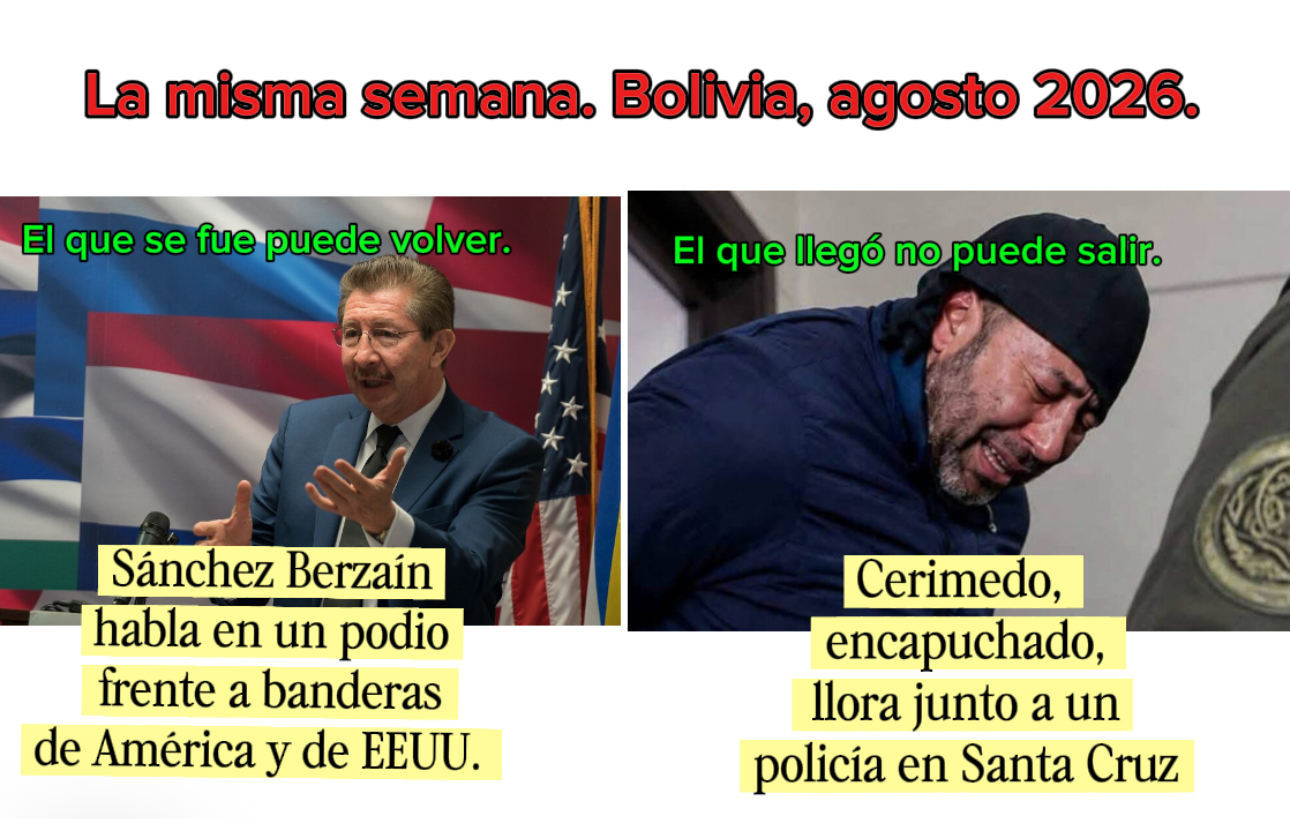
While the country watched an adviser cry, a court decided that 17 years of trial never existed. What’s at stake is the text that protects the gas, the lithium and the water.
By Violeta Ayala — Tecnóloga Creativa
The facts
This week, a constitutional chamber in Cochabamba annulled the Black October trial for Carlos Sánchez Berzaín. The ruling says the case "never came into legal life": 17 years of proceedings that, for him, never existed.
His arrest warrants fall. He can return to Bolivia.
Black October: in October 2003, the government of Gonzalo Sánchez de Lozada used the military against protests over a plan to export gas through Chile. 67 dead and more than 400 wounded, most of them in El Alto.
Sánchez Berzaín was the defense minister. He flew to Miami with Goni the night of the resignation. The United States granted him asylum.
The trial of responsibilities opened in 2009. The military commanders received sentences of up to 15 years. Two ministers who stayed in the country served three-year terms.
Those who left never sat before a judge. Now, for those who filed the appeal, the trial never existed.
The tool is called an acción de libertad: an urgent remedy, designed to protect a person who is detained or persecuted, resolved in days. Here it was used to bring down an entire trial.
A lawyer filed it "without mandate," a figure that allows acting without the beneficiary's signature. The hearing was August 12. The ruling became public the week everyone was watching the Cerimedo case.
The ruling is far from final. Every acción de libertad rises for mandatory review by the Constitutional Court.
There it can be confirmed or fall.
The man
Sánchez Berzaín has spent 23 years in Miami. He runs his own think tank, the Interamerican Institute for Democracy, and repeats one thesis: Bolivia is a narco-state satellite of the Cuban dictatorship.
Marco Rubio, Trump's secretary of state, uses almost the same vocabulary for the region.
His institute's website features a headline document: "Foundations for the full validity of the Republic of Bolivia through the nullity of the 2009 Constitution."
Translated: he proposes declaring that the 2009 Constitution never existed. Just like his trial. That Constitution was written by an elected Constituent Assembly and approved by 61 percent of the country in the January 2009 referendum.
The wall
The 2009 Constitution is a wall against certain subsoil business. That is why the document aims there.
It declares gas, lithium and water the direct, indivisible and imprescriptible property of the Bolivian people. No government can sell them.
Article 366: any foreign company touching hydrocarbons submits to Bolivian laws and courts. No international arbitration. No diplomatic claims.
The nineties were different: contracts with arbitration abroad and capitalization. Cochabamba knows the result. The Water War of 2000, when the city expelled Bechtel.
Changing the Constitution legally requires two thirds of the Assembly plus a referendum, or a constituent assembly. Nobody has those votes.
When the legislative door is locked, the judicial shortcut remains. The Cochabamba ruling just proved the shortcut works.
This is the exact point: if a court can decide that a 17-year trial was never born, another court can decide the same about other acts of the State.
Sánchez Berzaín's document asks for exactly that with the entire Constitution.
The prize
The prize has a name and a date. On April 27, 2026, Bolivia signed a memorandum of understanding on critical minerals with the United States. The text was never made public.
Bolivia holds deposits in 48 of the 60 minerals on the US critical list. It is a world leader in lithium, tin, silver and zinc.
The context tightens: gas declines, the country lines up for diesel, and the government just lost its economy minister to a censure vote.
Every line of cars is an argument for opening the subsoil. And the lithium awaits contracts.
In March, President Paz sat with Trump at the Trump National Doral, at the Shield of the Americas summit, the hemispheric security agenda driven by Rubio.
The adviser who accompanied him on that trip, Fernando Cerimedo, is now detained in Santa Cruz.
This week's two stories are the same story: political technology built abroad, landing in Bolivia. One arrived as campaign software, with a bot farm prosecutors say they seized.
The other arrives as jurisprudence: the nullity doctrine, manufactured in Miami over twenty years.
The disposables
The Cerimedo case showed the price of the operators: zero. The Casa Rosada dropped him in one sentence. The Palace, in one minute and 46 seconds.
Advisers get replaced. The code, the courts and the subsoil remain.
The signals
This reading is confirmed or dies through facts anyone can verify. First signal: the Cochabamba ruling being cited in new actions to declare other acts of the State after 2006 inexistent.
Second: a legal challenge appearing against the validity of the Constitution itself.
Third: the memorandum's text surfacing with arbitration clauses banned by Article 366. Fourth: lithium contracts structured to dodge the Constitution.
And the definitive one: the first time a Bolivian official says "nullity of the Constitution" out loud. That day the thesis will have migrated from Miami to the State.
The technology
Technology almost always arrives built elsewhere. Last week it was campaign software born from Cambridge Analytica's code.
This week it was a ruling: the tool that makes things never have existed. What protects the gas, the lithium and the water is a text. Watch who wants it declared void.
Sources
- Constitutional Chamber of the Departmental Court of Justice of Cochabamba. Ruling and supplementary order on the acción de libertad, hearing of August 12, 2026.
- Ruling in the Black October trial of responsibilities, Supreme Court of Justice, 2011. Sentences against the military commanders and two former ministers.
- Political Constitution of the State, 2009. Articles 349 and 359 on natural resources and hydrocarbons, 373 on water, 366 on foreign companies submitting to Bolivian jurisdiction, and 411 on constitutional reform.
- National Electoral Court. Results of the constitutional referendum of January 25, 2009: 61.43 percent for Yes.
- OAS Electoral Observation Mission. Report on the 2009 constitutional referendum and the October 2008 congressional agreement, which modified 147 of the 408 articles.
- Interamerican Institute for Democracy. Document published on its website on the foundations for the full validity of the Republic of Bolivia through the nullity of the 2009 Constitution.
- Memorandum of understanding between Bolivia and the United States on critical minerals, signed April 27, 2026. Text unpublished as of this piece.
- United States Geological Survey. 2025 critical minerals list.
- Attorney General's Office and Santa Cruz Departmental Prosecutor's Office. Charges and case filings in the Beller case, August 2026.
- Inter-American Court of Human Rights. Jurisprudence on measures producing impunity in grave human rights violations, since Barrios Altos v. Peru, 2001.
- Press coverage of the ruling and the case: Infobae, Brújula Digital, ERBOL, Los Tiempos and eju.tv, August 2026.
This piece distinguishes three levels. The judicial acts and legal texts cited are verifiable in primary sources. Contextual facts are attributed to the outlets that reported them. The reading of nullity as a tool is interpretive, and is submitted to the signals listed above.