Data Investigation
Bolivia's commercial registry and a health agency are listed as ransomware victims
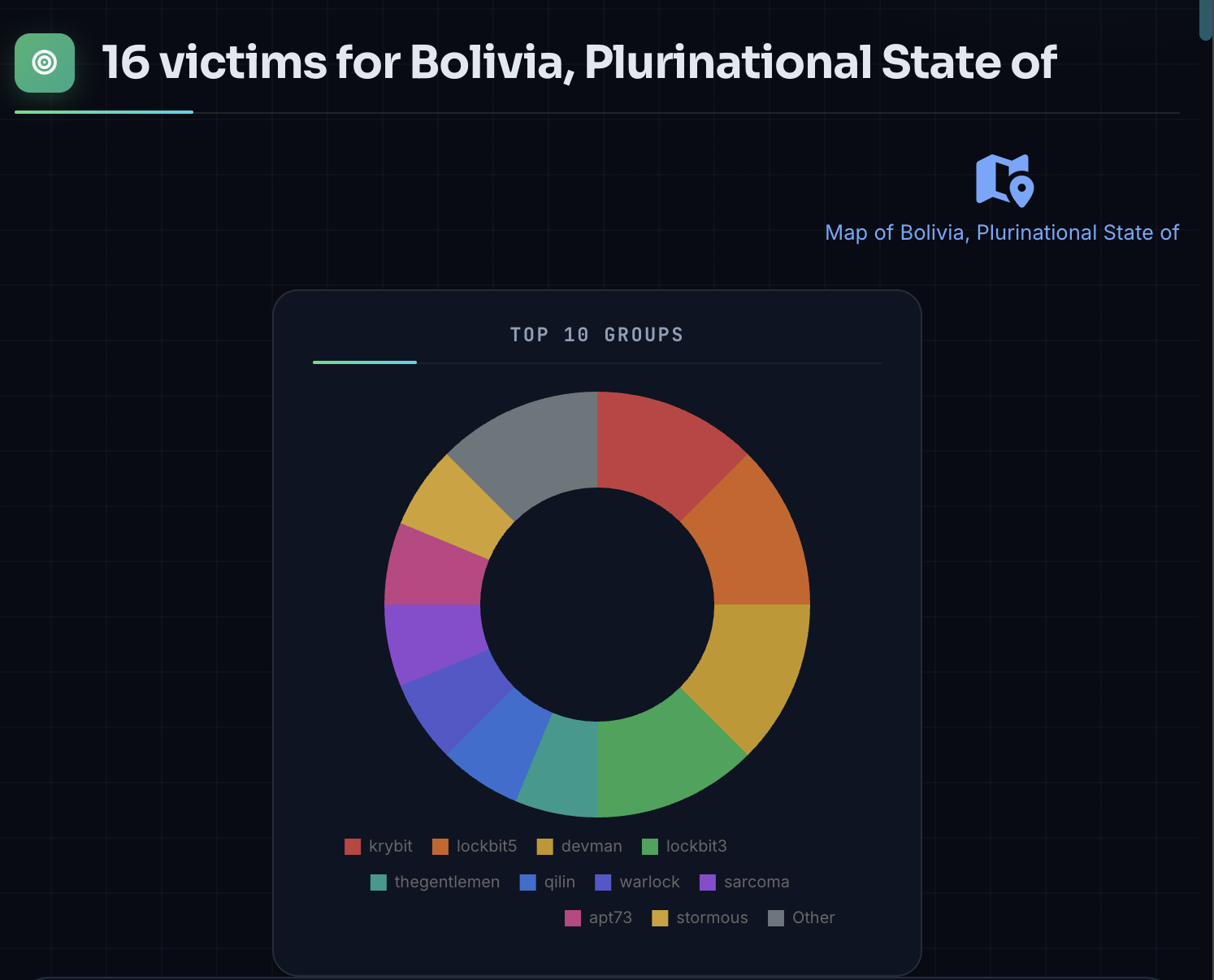
An international monitor counts 16 claims against Bolivian organisations since 2023. No state body has told the public. A claim is the attacker's word.
By Violeta Ayala — Tecnóloga Creativa
An international monitor records 16 ransomware claims against Bolivian organisations since 2023. Two of this year's claims name state bodies: the commercial registry and the health infrastructure agency. Neither has told the public. A claim is the attacker's word.
- Source:
- ransomware.live, Bolivia map
- What it records:
- The victims each ransomware group announces on its own site
- Checked on:
- 25 November 2026
- Entries:
- 16
- Organisations:
- 15. The state electricity company ENDE appears twice
This is sala.red's third story on the case. The earlier ones: Bolivia's government admits cyberattacks and Bolivia's health records are on offer for 100 US dollars.
What is ransomware?
It is the kidnapping of data for ransom. It works in five steps.
- They get in. They use a stolen password, a fake email or an unpatched flaw.
- They copy. They take the files to their own servers.
- They encrypt. They lock everything with a key only they hold.
- They charge. They demand payment in cryptocurrency for the key.
- They press. They name the victim on their site. Without payment, they publish the data.
The databases on sale in the second story look for buyers. Ransomware charges the institution itself.
Who is listed?
On 25 November Hacking Bolivia shares five cases taken from that platform. The full Bolivia map has 16 entries.
Claims by year of discovery · ransomware.live
2026 counts up to 25 November. Each claim is an announcement by the attacking group.
| Date | Organisation | Group claiming it | Sector |
|---|---|---|---|
| 31 Oct 2026 | Mercantile Investment Corporation Bolivia | Thegentlemen | Brokerage |
| 7 Jul 2026 | SEPREC | Krybit | State: commercial registry |
| 12 Jun 2026 | AISEM | Krybit | State: health |
| 11 Jun 2026 | Helios | Lockbit5 | Metering and metrology |
| 22 Dec 2025 | La Papelera | Qilin | Manufacturing |
| 7 Dec 2025 | ENDE | Lockbit5 | State: electricity |
| 19 Nov 2025 | Future | Devman | Retail |
| 6 Nov 2025 | Alphasys | Warlock | Technology |
| 15 Oct 2025 | Embassy of Bolivia in Washington | Devman | State: diplomacy |
| 16 Apr 2025 | ENDE | Lockbit3 | State: electricity |
| 22 Mar 2025 | Importadora Monterrey | Sarcoma | Steel trade |
| 11 Dec 2024 | Minera San Cristóbal | Apt73 | Mining |
| 17 Nov 2024 | UATF | Stormous | Public university |
| 15 Jul 2024 | Nuevatel, Viva | Dunghill | Telecoms |
| 7 Feb 2024 | AXS Bolivia | Lockbit3 | Telecoms |
| 23 May 2023 | Amaszonas | Medusa | Airline |
Which public bodies appear?
Five. SEPREC keeps the register of the country's companies. It is listed as claimed by the Krybit group, discovered on 7 July 2026 with an estimated attack date of 5 July.
AISEM manages hospital infrastructure and equipment. It is listed as claimed by Krybit on 12 June 2026.
The state electricity company ENDE appears in April and in December 2025, under two different groups. The Embassy of Bolivia in Washington appears in October 2025. The public university Universidad Autónoma Tomás Frías appears in November 2024.
What does it mean for you?
It depends on where your data sits. Four cases.
- You own a business. The commercial registry holds your registration, your ID number, your legal address, your partners and your balance sheets. With that, someone poses as your supplier, your bank or the registry itself and sends you a fake invoice.
- You use a public hospital. AISEM handles hospital building works and equipment. An attack there can stall a construction project or the purchase of equipment your hospital is waiting for.
- You are a customer of a phone company, an insurer or a brokerage. Those companies hold your contract, your number, your payments and your investments.
- You pay for electricity. ENDE generates and transmits the country's power. Ransomware can stop systems as well as steal data.
For a person, ransomware brings three consequences.
- The service goes down. Paperwork that took a day stalls for a week.
- Your data leaves anyway. The institution restores its systems from a backup. The attackers keep the copy they took and publish it if nobody pays.
- Nobody tells you. You find out when someone calls with your data in hand.
If you own a business, confirm by phone any change of bank account a supplier asks for. It is the most common scam after a leak of commercial records.
Does a claim prove the attack?
No. It proves that a criminal group posts the name of an organisation. It does not say whether systems were encrypted, whether data left or whether anyone paid.
The monitor RedPacket Security warns that Krybit's listings include unverified or fabricated claims. Krybit is the group that names SEPREC and AISEM.
We found no incident notice on SEPREC's announcements page. We found no statement from AISEM either.
What does this have to do with stolen passwords?
The AISEM entry adds a figure from the firm Hudson Rock: 97 employees and 121 users with credentials compromised by spyware. It is the same problem as in Hacking Bolivia's second statement, with more than one million state passwords in circulation.
A stolen password is one of the usual doors for ransomware.
Who has to tell you?
Supreme Decree 2514 obliges every public body to report an incident to the state incident response centre within 24 hours. That report is internal.
No law obliges anyone to notify the companies in the commercial registry or the patients of a hospital. Bolivia has no personal data protection law.
At sala.red, and I, Violeta Ayala, personally, call for that law as an urgent measure. With an independent authority and with the state inside its scope.
What we reviewed
We reviewed the ransomware.live map of Bolivia and the entries for SEPREC, AISEM and Mercantile Investment Corporation. sala.red does not enter the groups' sites or download files.
The Hacking Bolivia post includes the insurer Aseguradora Fortaleza, claimed by the Beast group on 29 July 2025. That case is not among the 16 entries we read.
What remains unanswered
- Were SEPREC's and AISEM's systems encrypted in June and July 2026?
- Did they report the incident to the CGII within 24 hours?
- Did data on the companies in the commercial registry leave?
- Did any public body pay a ransom?
- Does ENDE confirm the two claims of 2025?
- Does AGETIC include these cases in its report to the government?
Sources
- ransomware.live, "16 victims for Bolivia", checked on 25 November 2026.
- ransomware.live, entry for seprec.gob.bo, 7 July 2026.
- ransomware.live, entry for aisem.gob.bo, 12 June 2026.
- ransomware.live, entry for Mercantile Investment Corporation Bolivia, 31 October 2026.
- RedPacket Security, notice on aisem.gob.bo and Krybit's claims, 12 June 2026.
- Hacking Bolivia, Facebook post, 25 November 2026.
- CGII, Normativa: Supreme Decree 2514, 9 September 2015.
Share: WhatsApp X Bluesky Telegram Facebook LinkedIn Threads Email Copy link