Data Investigation
Who protects the data of the 221,000 school leavers behind Bolivia's digital diploma?
ID number, date of birth and RUDE student code. Two of those sit in the database attributed to the health system SUS and offered for 100 US dollars. The system opens in December.
By Violeta Ayala — Tecnóloga Creativa
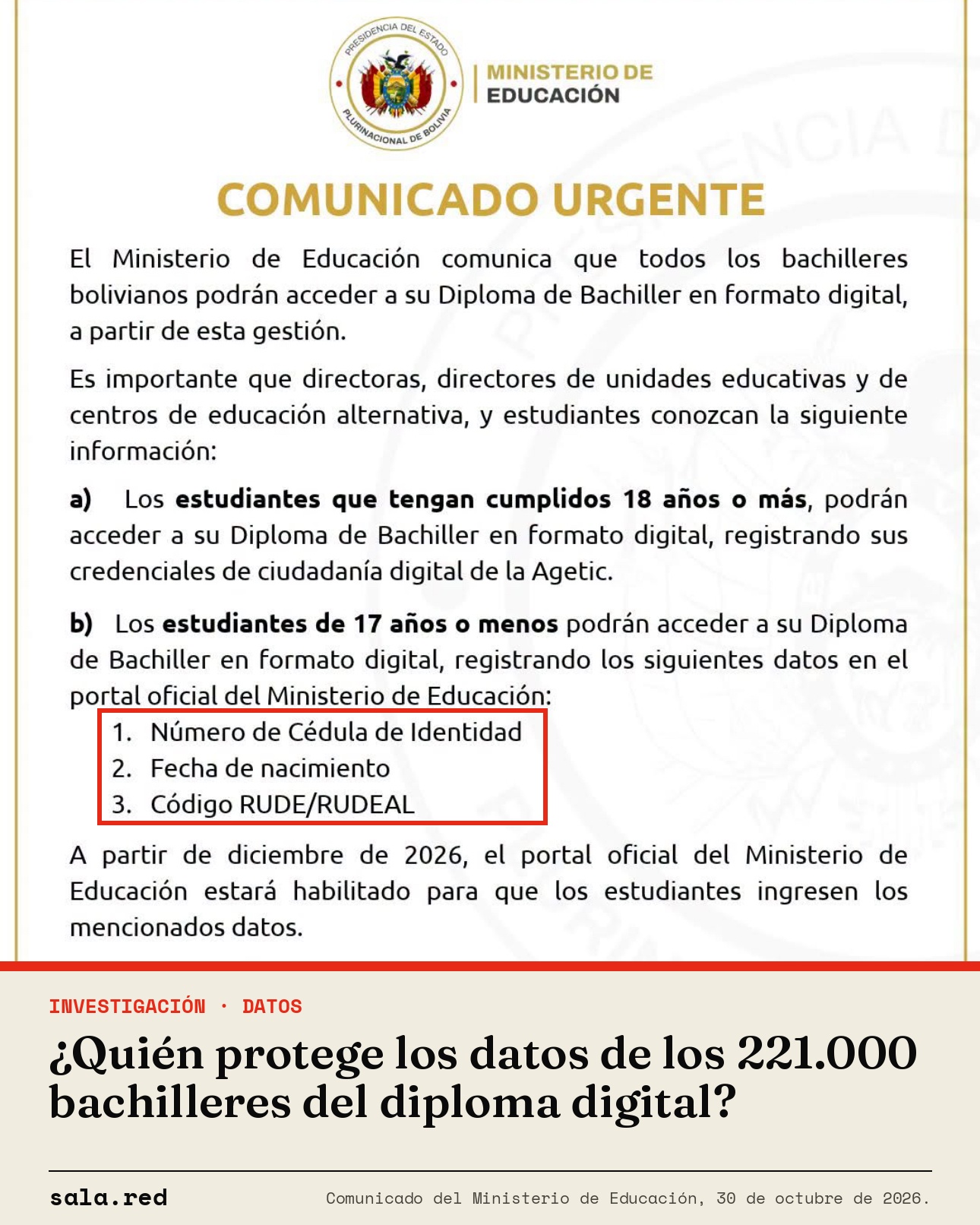
From December, more than 221,000 Bolivian school leavers receive their secondary school diploma in digital form. Those aged 17 or under open it with three pieces of data, according to a Ministry of Education statement: national ID number, date of birth and RUDE student code. Two of those sit in the database attributed to the public health system SUS and offered for 100 US dollars on underground forums.
- Rule:
- Supreme Decree 5738, of 5 October 2026
- What it orders:
- A free, digital Diploma de Bachiller from the 2026 school year
- 2026 school leavers:
- More than 221,000
- System opens:
- December 2026
- Access from age 18:
- Ciudadanía Digital credentials, the state digital identity
- Access up to age 17:
- ID number, date of birth and RUDE or RUDEAL code
- Run by:
- Ministry of Education, with the e-government agency AGETIC
This is sala.red's fourth story on the case. The earlier ones: Bolivia's government admits cyberattacks, Bolivia's health records are on offer for 100 US dollars and Bolivia's commercial registry and a health agency are listed as ransomware victims.
What changes?
On 5 October the cabinet approves Supreme Decree 5738. President Rodrigo Paz announces it the next day. Article 2 orders that from the 2026 school year the diploma is issued free and in digital form. Article 3 gives it the same legal validity as the paper diploma, with a digital signature that guarantees its authenticity.
Article 4 charges the Ministry of Education with a Digital Diploma Management System. The system must guarantee authenticity, integrity, availability and traceability.
The diploma carries a QR code. It can be downloaded and printed as many times as needed. The certified photocopy disappears.
The digital diploma in government figures
Official figures cited by Visión 360 on 6 October 2026.
Teachers' union leaders and school principals note that paper and ink now fall to families.
The Minister of Education, Erick Sanjinés, announces a second platform for diplomas issued up to 2025. He expects it in late December or the first week of January.
What does the decree say about access?
Nothing. The decree has four articles. None mentions Ciudadanía Digital, AGETIC, minors or personal data. The Ciudadanía Digital law appears only in the recitals.
The rules are left to a ministerial resolution. The decree gives 30 calendar days from its publication. The deadline falls on 4 November. We did not find that resolution on the ministry's site.
Who needs Ciudadanía Digital?
On 27 August the AGETIC bulletin presents it as a condition for every school leaver.
"The indispensable requirement is to be registered in Ciudadanía Digital."
On 30 October the Ministry of Education publishes a clarification. It calls false the claim that Ciudadanía Digital is the only way in. It describes two options by age at the close of the school year.
| Age | Where they log in | What they provide |
|---|---|---|
| 18 or over | Ciudadanía Digital | Their credentials |
| 17 or under | Ministry of Education portal | ID number, date of birth and RUDE or RUDEAL code |
The three pieces of data appear in an "Urgent statement" the ministry posts that day on its Facebook page. The text says students aged 17 or under gain access by "registering the following data on the official portal": ID card number, date of birth and RUDE or RUDEAL code. The portal opens from December.
The infographic on the ministry's site is vaguer. It speaks of "the mechanisms the Ministry of Education will enable".
A day earlier, on 29 October, the ministry explains on the same page what Ciudadanía Digital is for in this procedure: it verifies the identity of the user. The under-18 route does not use it.
The ministry sets no deadline to obtain Ciudadanía Digital. It recommends relying on its official sources.
What does registering in Ciudadanía Digital require?
AGETIC opens registration to people aged 18 or over. It admits minors only in the cases the rules provide for. The official procedure sheet describes six steps.
- Mobile phone. A personal number, validated with a code sent by SMS.
- Email. A personal account, validated with another code.
- Personal data. Document number, given names, surnames and date of birth. They are checked against SEGIP, the national ID service.
- Password. With letters, numbers and symbols.
- Three photos. Front of the ID card, back, and a selfie holding the card.
- An operator. Reviews the data and the photos, online or at an office. Online the operator records a 10-second video. At the office the operator takes a fourth photo.
The sheet for in-person registration gives a duration of two hours. An AGETIC leaflet says 15 minutes.
Another AGETIC sheet describes the login: a unique user and password, with two-factor authentication mechanisms.
An 18-year-old school leaver goes through six steps and an operator. A 17-year-old provides three pieces of data, with no password or second factor in the published rule.
Registration leaves photos of the ID card, photos of the face and a video in the hands of the state. The posts attributed to the military social insurance fund COSSMIL include almost 58,000 photos of ID cards, according to El País.
On 25 November an underground channel announces a service that would return the photo of a person's face from their ID number, date of birth or name. El País reports it and says it could not confirm that it works.
What is the RUDE code?
It is the Registro Único de Estudiantes, the single student register. It identifies every student in the Ministry of Education's system. RUDEAL does the same in alternative education.
Where are those three pieces of data today?
- ID number and date of birth. The database attributed to the Sistema Único de Salud holds 8,469,080 records with ID numbers, dates of birth, addresses and phone numbers. It has been on offer for 100 US dollars since August, according to the Bolivian daily El País.
- RUDE code. The Ministry of Education runs it. A register attributed to that ministry, with 6,943,640 students and their school history, is on offer for 150 US dollars. El País does not detail its fields. We do not know whether the RUDE code is in that database.
- Passwords. Hacking Bolivia counts 173,878 compromised accounts on the Ministry of Education's site. 205 belong to staff. Its chief executive, César Chávez, says those passwords remain active, according to El País.
The figures come from the sellers and from Hacking Bolivia. None is audited. We found no statements from the Ministry of Education or the Ministry of Health on those databases.
El País puts minors first in its list of people affected. The experts it cites warn that their identities can be used to take out loans or collect welfare payments.
What does it mean for you?
- You are 17 or under. Your diploma opens with three fixed pieces of data. None is a password you choose. None can be changed if it leaks.
- You are 18 or over. You log in with Ciudadanía Digital. Register before December. You need a valid ID card, a mobile phone and an email account.
- You are a parent. Keep photos of your child's ID card and their RUDE code off social media and chats. Confirm any notice about the diploma on the ministry's official accounts.
Under the rule in the statement, whoever holds the three pieces of data of an under-age student enters the portal in that student's name. No official text we read describes an additional verification step. The system opens in December and the rule can change.
Who answers if someone logs in as you?
On 17 November the government admits cyberattacks on state systems. Three bodies acknowledge incidents: the foreign ministry, the mining registry Senarecom and the state oil company YPFB. The diploma system opens in December.
Bolivia has no personal data protection law. No general rule sets which data the state can ask for as a key, how long it keeps them or who tells you if they leak.
At sala.red, and I, Violeta Ayala, personally, call for that law as an urgent measure. With an independent authority and with the state inside its scope.
Timeline
- 25 July 2026. Minister Sanjinés announces the free digital diploma.
- 2 August 2026. The databases attributed to SUS and to the Education register appear on underground forums.
- 27 August 2026. AGETIC presents Ciudadanía Digital as the indispensable requirement.
- 5 October 2026. The cabinet approves Supreme Decree 5738.
- 6 October 2026. President Paz announces it.
- 29 October 2026. The ministry explains that Ciudadanía Digital verifies the identity of the user.
- 30 October 2026. The ministry posts the statement with the three-data route for under-18s.
- 4 November 2026. The deadline to regulate the decree expires.
- 15 November 2026. Hacking Bolivia issues its red alert.
- 17 November 2026. The government admits the attacks.
- 19 November 2026. El País publishes the inventory of 27 databases.
- 23 November 2026. YPFB admits compromised systems.
- 25 November 2026. An underground channel announces the face-photo lookup, according to El País.
- December 2026. The digital diploma system opens.
What we reviewed
We read the full text of Supreme Decree 5738 in the Gaceta Oficial. We saw the "Urgent statement" of 30 October and the post of 29 October on the Ministry of Education's Facebook page, and the 30 October infographic on its site. We did not find the ministerial resolution that regulates the decree.
We also reviewed two AGETIC bulletins and a leaflet, the gob.bo sheets on registration and on the mechanisms of Ciudadanía Digital, and the El País investigations. The gob.bo sheets show 18 November 2026 as their last update. We read them on 26 November and saved a copy of each in the Wayback Machine.
sala.red does not enter the forums or download files.
What remains unanswered
- Is the RUDE code in the register on offer for 150 US dollars?
- Where is the ministerial resolution that regulates the decree?
- Does the portal ask under-18s for an additional verification step?
- How many of the 221,000 school leavers are 17 or under?
- Who digitally signs the diploma and where is it stored?
- Where does AGETIC store the ID photos, selfies and videos, and for how long?
- The decree requires traceability. Can the student see who downloads their diploma?
- Does the ministry change the access rule after 15 November?
- Which data open the diplomas issued up to 2025?
Sources
- AGETIC, Boletín informativo, edition 8, 27 August 2026.
- Gaceta Oficial de Bolivia, Decreto Supremo N° 5738, 5 October 2026, edition 2111NEC.
- Ministry of Education, "Aclaraciones importantes para acceder al título de bachiller en formato digital", 30 October 2026.
- Ministry of Education, "Comunicado urgente", Facebook post, 30 October 2026.
- Ministry of Education, "¿Qué es la Ciudadanía Digital y cómo se relaciona con el Diploma de Bachiller en formato digital?", Facebook post, 29 October 2026.
- ABI via eju.tv, "Educación habilita la emisión digital de diplomas de bachiller a partir de diciembre de 2026", 31 October 2026.
- AGETIC, Boletín Digital N° 038, "Ciudadanía Digital Bolivia", October 2025.
- AGETIC, "Ciudadanía Digital. Un derecho para todos los bolivianos", September 2025.
- gob.bo, procedure sheet "Registro en Ciudadanía Digital", AGETIC, checked on 26 November 2026. Archived copy.
- gob.bo, procedure sheet "Integración de Mecanismos de Ciudadanía Digital", AGETIC, checked on 26 November 2026. Archived copy.
- Red Uno, requirements to obtain the diploma in digital form, 30 October 2026.
- Visión 360, "Más de 221.000 estudiantes recibirán su título de bachiller sin costo y en formato digital", 6 October 2026.
- Red Uno via eju.tv, "¿Perdió su título de bachiller o necesita legalizarlo? Este trámite cambiará", 8 October 2026.
- Prensa Mercosur, report on the cost of printing the diploma, 6 October 2026.
- Los Tiempos, "Estudiantes que egresen en 2026 obtendrán el título de bachiller digital y gratuito", 25 July 2026.
- Los Tiempos, "Erick Sanjinés es el nuevo titular del Ministerio de Educación", 10 June 2026.
- El País, "Los datos de Bolivia, a precio de saldo", 19 November 2026.
- El País, "Las filtraciones bolivianas, una por una", 19 November 2026.
- El País, investigations team, report on YPFB and SENASAG, 26 November 2026.
- Hacking Bolivia, second statement, 18 November 2026, as cited by El País.
Share: WhatsApp X Bluesky Telegram Facebook LinkedIn Threads Email Copy link